Showing posts with label humanism. Show all posts

Monday, October 7, 2019

Psychology of Humanism

I’ve always been fascinated by the concept of “nature versus nurture,” and how we are shaped by and shape our culture. Examining movements such as the Renaissance through the lens of psychology yields some interesting ideas about how exactly changes in prevailing ideologies shape the future. 

photo by "Pere" on flickr (text added) 
According to Freud’s model of the mind, our consciousness is divided into 2 parts: the conscious mind and the subconscious mind. The conscious mind takes up only 10 percent; and our much larger subconscious is a blank slate when we are born. Throughout our lifetime, that slate is filled with patterns derived from our conscious thought and knowledge absorbed from others and the environment. Since the subconscious mind is 90% of our overall mind, whatever is in our subconscious forms our character, which then determines what we will accomplish in life.


The strong influence of external stimuli on the development of the subconscious means that changes in general attitudes, ideals, or prevailing wisdom (the “environment”) have significant impacts on the character, and therefore the actions and achievements, of individuals living in those times. The Renaissance and Reformation were absolutely crammed with such changes to the intellectual environment, and the rise of Humanism specifically may have altered attitudes about human nature and influenced the general psyche in a way that was key to later development and progress.

One of the fundamental tenets of Renaissance Humanism, as expressed by Petrarch, is that God gave humans intellectual and creative potential that was meant to be used. Humanism in that era also emphasized the responsibility of humans in developing themselves and promoting the race as a whole. Finally, as part of the “ad fontes” movement, the ancient Greek concept of Eudaimonia was probably becoming prominent, convincing people that the search for and creation of happiness and well-being was an important purpose of life. The spread of these ideologies would have significantly impacted the minds and characters of those who learned them, especially younger people whose subconscious minds were still being filled and developed.

Consider the impact this type of teaching would have on a person, in contrast with the previously dominant church doctrines. Rather than being told their individual life didn’t matter and salvation in the next life is the only thing for which they had to hope and work, someone growing up in the high Renaissance would start to internalize feelings of self-worth and agency. During the Reformation, things got even better: rather than the dogma that having wealth is a sin, Calvinists taught that material prosperity is evidence of God’s favor, motivating people to work hard and advance themselves financially.

In a discussion during the salon activity about how Renaissance and Reformation ideologies laid the foundation for the spectacular economic growth of later centuries, Joe pointed out how, in many cases, it’s not circumstances that change our mindset but rather our mindset that allows us to change our circumstances. I think the rise of Humanism during the Renaissance is a history-altering example of this. Humanism changed people, and people changed the world.


Sources:


https://en.wikipedia.org/wiki/Petrarch

https://en.wikipedia.org/wiki/Humanism#Humanistic_psychology

Image: https://www.flickr.com/photos/pere/523019984


Friday, October 4, 2019

The More Things Seem To Change


What determines a successful social movement? What affects real social change?

A political scientist will say that it’s when someone with power takes up your cause, that’s when you can really get things to change. A cynic might say money is what causes change. Someone who’s more religious might say change happens when God softens people’s hearts. All of these are probably at least a little bit true, but maybe there’s something else.

Power to the People: How Humanism Prompted Martin Luther's Success


Martin Luther once said: “I am more afraid of my own heart than of the pope and all his cardinals. I have within me the great pope, Self.”

I have always wondered what allowed Martin Luther to be as successful as he was. He made bold statements against an institution that seemed to be untouchable, and still managed to reform one of the biggest powers of the time period with only, as Luther calls it, Self.

As I was discussing with my friends Bella and Fay on Tuesday, we considered the effect individualism (an importance Renaissance ideal) had on the Reformation. One thing that was said during the conversation really stood out to me: 

The Necessity of Individualism


Despite claims that individualism leads to narcissism and is an overall menace to society, individualism can be seen to have profound positive effects throughout history particularly during the Reformation, as well as the Renaissance.

A recent article in the New York times, titled “The Age of Individualism”, explains that because of individualism, our country and our world will eventually become a disaster of self-absorbed individuals only concerned with trivial, self-centered things.

However, the Reformation and Renaissance are clear indicators of what happens when a society turns to individualism. The society flourishes. Without individualism, there would be no-one standing up to age-old theories, accepted as absolute truth and successfully prohibiting any forward progression. In his journal article about religion and modern individualism, Herbert Butterfield explains, “The individual must be able to confront the tyranny of majorities, the prejudices of prevailing culture, and the dominating spirit of the age itself.” This is why individualism is needed. Personal ideas and convictions were recognized by our predecessors as something that needed to be shared and addressed, especially if it went against what was popular and accepted at the time.

It was mentioned in one of my discussions that individualism was the reason that Martin Luther experienced success in his fight for religious reform. Martin Luther is celebrated throughout the world for the courage he had to “oppose the dominating spirit of the age itself.”  Without individualism inspired by Renaissance humanism, the Reformation could be a very different story. Without the few who believed strongly in humanism and the individuals potential to be moral and good, the higher powers against change would have destroyed the Reformation before it even really began.

I’m sure, much like individualism is presented today, some in the reformation viewed Luther as an extremist, a fanatic, someone so blinded by their own ideas and ideals that they were past reason and actually detrimental to the good of everyone around them. People feared individualism because they knew it would bring change. Their solution? Persecution.  However, despite the animosity and violence they experienced, reformers endured, bringing the world all kinds of new religious and social possibilities.

Individualism continued to change society. It encouraged Thomas Moore to write about brave new worlds that could lead to literal new worlds. It was what allowed plough boys to receive bibles of their own and Shakespeare to become a theatrical genius, despite his poverty. America itself was born from ideas created by individualistic minds during the enlightenment. That is why we continue to need individuals who celebrate individualism, who have enough conviction in their own ideas and ideals to do something about it. And through that, we can continue to change the world for the better.


Friday, September 13, 2019


What a Piece of Work is College

College is hard. That’s not to say that it’s not enjoyable at times. But it is hard. BYU is a wonderful university that most people should be very proud to get accepted into. Like it is stated in the Oration of the Dignity of Man, we are born with infinite possibilities to accomplish great things and be somebody great, depending on your moral and intellectual stamina. Similarly, we are metaphorically born into university life with infinite possibilities that all depend on, well, us. 


Coming to college, it felt a little scary leaving all of my success entirely up to myself. Classes are more difficult and there are the added stresses of making new friends, work and basically just having to be a responsible adult without your parents looking over your shoulder a lot of the time. However, during my first year, I sometimes found myself blaming the results I was seeing in my college life on the circumstances surrounding me. Humanism says otherwise. We are completely and solely responsible for our individual successes and failures and if we fail we just need to get back up and try harder or differently.  


It’s also important to remember that striving for greatness doesn’t mean that you need to always get a 4.0 grade average. Striving for greatness, for me, meant getting into BYU Women’s chorus and getting to sing in general conference, it meant taking my roommate out to dinner after she failed a test, it meant setting a goal to be fit and exercising almost every weekday, it meant studying as hard as I could so I could finish each semester knowing that I tried my very best. It was those things that made me greater. Not necessarily academic things, but life things. College gives you every opportunity to be a great person. As put in the words of Mirandola “Oh wondrous and unsurpassable felicity of man, to whom it is granted to have what he chooses, to be what he wills to be!” So let’s go out and make ourselves better through every opportunity given to us.    


Thursday, September 12, 2019

Humanism and the Repair of the World

To a medieval man or woman, society was ordered, hierarchical: if you live in the Middle Ages, someone else is always in charge. One of the most fundamental ideas born during the Renaissance is humanism: a philosophy that hinges on the then-radical concepts of self-determination and free will. Where do the laws come from? Who takes care of problems? Humanism puts that responsibility on us as individuals rather than trusting to the established hierarchy.

To me, this rings the same bells that rang when I learned about the Jewish concept of tikkun olam, often translated as 'the repair of the world'. Tikkun olam is a way of describing a sense of social responsibility. The world is broken, in need of perfecting. But God is not snapping Their fingers and fixing it, because They want us to aid in repairing it. This is our duty, obligation, and privilege.


“The phrase 'Someone ought to do something' was not, by itself, a helpful one. People who used it never added the rider 'and that someone is me'.”

― Terry Pratchett, Hogfather


The concept of tikkun olam as well as Pratchett's works have deeply informed my own practice as a hearthcrafter: I believe that I am helping to perfect the world by perfecting my own home. I hold on tightly to what is mine, and do everything in my power to protect it and the people that depend on me. Pratchett might describe my approach to the sacred duty of hospitality as weaponized selfishness.

One of the ways I keep my home feeling safe and welcoming: a ruchnik, or embroidered ritual towel-- a gift from a dear friend.


Perhaps Niccolò Machiavelli would approve of this, or perhaps he would scoff at me as naive. Of course, he is only one side in the Renaissance debates about how this newly individual responsibility is to be accomplished.

Another side, one that resonates much more deeply for me, is the various artistic movements celebrating the beauty of the world and the beauty of humans, our place in the world as something inherently valuable. Because inherent value means it's worth putting effort into. The world, say Giotto and Petrarch and Botticelli, is worth fixing. And so why would we not do everything in our power to fix it?

Thursday, December 6, 2018

Happy Birthday to a New World

About a week ago, He Jiankui announced to the world, the birth of identical twin baby girls. This, however, was not your average birthday. In many ways, it was the birth of an entirely new era. These baby girls are the first genetically modified humans ever born, and the implications to humankind are massive.

The technology Jiankui used has been around for about 40 years. Basically it is a genetic copy and paste tool. Using the system allows scientist to insert and delete portions of DNA, altering structures and functions of cells.

This technique was utilized in 1982 to make bacteria produce insulin, which dropped the price of the drug for Diabetes patients. Even before that, scientists were already seeing the possible direction of this science, towards the editing of the human genome. Conferences were called and the consensus was that if that were to be attempted, it should wait.

Soon after, in 1996, the first genetically modified produce hit the markets. The applications soon expanded beyond foods and led to the first cancer gene therapy drugs to be approved in 2017.

Now, we have on our little Earth two genetically modified little girls. Their genome has been altered to offer them immunity from HIV. The effectiveness of this is still being debated. It could put them more at risk for other diseases.

Regardless, a door has been opened, or rather a wall demolished. Whether for health, or beauty, or strength, or intelligence, the possibility for GMO humans is now very real and at our doorstep.

It is as if we have stepped off our world of random genetic phenomena and into a world of predictability and perfection. The voyages of discovery in the Renaissance revealed more of what was already around us but out of sight. These scientific voyages are truly venturing into the unknown.

What drives this science? Desire for human greatness? Mastery over Mother Nature? Ever since man realized who he was and what he was capable of, he has been striving to become more. Genetic engineering of humans is the perfect way to do this.

And when creating the essence of ones being becomes an art, we will truly be able to say "What a piece of work is man".

Wednesday, December 5, 2018

Humanism, Politics, and Nursing Homes

Staffing shortages continue to affect the nursing home industry, and most importantly the elderly who fill them. Many are wondering whether enough is being done to ensure the best possible care for our loved ones. Technology is improving and the baby-boomers are aging. The need for elderly care is about to be exponentially increased and prolonged. Are we ready to pay for it?

Staffing problems are largely due to low wages. In for-profit facilities, these wages come out of the budget of a corporation. This is an industry that has a profit margin that ranges at around 1%. Any in business knows that a 1% profit margin will turn off any investor in a heartbeat. Corporations in this industry in the United States are also obligated to pay the highest corporate tax rates in the world. In short, extra money for higher wages is difficult to fit into the budget.

Such a problem naturally leads to the discussion about the government's role in funding healthcare. This debate has been going on since the introduction of the idea of healthcare itself. In the case of nursing homes, the Liberal arguments tend to support publicly funded healthcare, whereas the Conservatives typically support privately funded healthcare. This is one of the many distinctions of political dialogue that can be traced back to the Romantic Period of the 18th and 19th centuries.

This debate has been the cause of much tension because of the high stakes in healthcare. As someone who works in a skilled nursing facility, I feel an immense sense of responsibility as people's loved ones have been placed in our care. The realization of intrinsic human value started in the Renaissance and was revived in the Reformation with Christian Humanism. Discussion about caring for the weak would not have taken place without these historical revelations.

An issue such as shortages in staff in nursing homes would only exist if it was preceded by the rhetorical influence of Humanism and political ideologies on medical research.
   

Wednesday, November 7, 2018

Hugo's Tribute to Empathy and Gothic Architecture

Disney's The Hunchback of Notre-Dame was released the year I was born (1996). Like most everyone from my generation I grew up watching old classic Disney movies, but The Hunchback of Notre-Dame was one that I watched more frequently than all of them. I even had a toy Quasimodo which was one of my prized possessions. I was a strange kid.

I haven't seen the movie for probably ten years now but the parts that intrigued me the most were the creepy demons, the gargoyles, and the dark but incredibly beautiful Notre-Dame Cathedral. I didn't know it, but the mystery of beautiful, gothic, art caught my interest before I knew what I was interested in.

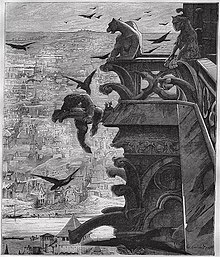
Illustration from Victor Hugo et son temps (1881)
Published in 1831, Notre-Dame de Paris (The Hunchback of Notre-Dame) by Victor Hugo carried with it humanistic themes of the Romantic period such as sympathy for the suffering of the dispossessed, which is common throughout Hugo's writing. Hugo wrote this story, however, to prove the humanistic utility of Gothic architecture.

When Hugo wrote Notre-Dame de Paris, Notre-Dame had its circular colorful stained glass window replaced with clear glass to let in more light. Gargoyles were being removed from their structures. The rapid replacement of the medieval architecture in place of contemporary themes was to Hugo a loss of appreciation for the Gothic side.


Hugo exemplifies Romanticism's reaction to the French Revolution. His father; a general in Napoleon's army, loyal to the new regime. Whereas his mother was loyal to the original monarchy. The conflicting politics eventually led to their separation, leaving Hugo left to decide on his own where he would find meaning as he moved back and forth between parents. He chose to move on and married a childhood friend with whom he had five children.

Throughout his life, Hugo saw both the light and the darkness of humanity. Absolute joy and unforgiving dispair.  Leading him to eloquently articulate both the Gothic mysteries of the unknown and the empathetic compassion for the less fortunate, properly encapsulating Romanticism in its essence.   


Photo Credit: http://paperplanereviews.blogspot.com/2013/06/the-hunchback-of-notre-dame-by-victor.html         

Tuesday, October 9, 2018

"That all men are created equal."

When John Locke wrote his Second Treatises: Of Civil Government and Thomas Hobbes wrote The Leviathan, intellects were still trying to unpack everything the sovereign individual idea had to offer. It was generally accepted by both Locke and Hobbes that all men were equal (Even though "man" was a pretty exclusive group, but it was more progress than ever before), but they were equal in different ways.

John Locke

Locke believed that men were all equally good and needed very little authority to govern them. According to Man's "State of Nature," no one has power over another and all are equally free to do as they please so long as they don't infringe on other's freedom. Locke had a relatively optimistic outlook on human nature.

Thomas Hobbes

Hobbes, on the other hand, thought that man needed a parent authority to create "good laws" that he could abide by. He determined that because people were continually in competition for honor and dignity, they tended toward envy and hatred. Hobbes also generally believed that people were equal despite their differences because no matter how weak, the "weak" person could still use strategy to have a "strong" person killed.

The Hybrid

Over the weekend I attended a lecture by a well-known psychology professor from the University of Toronto. He analyzed the line from the declaration of independence, "We hold these truths to be self-evident, that all men are created equal..." We know that all men are not "created equal" socially or economically, and the founding fathers who owned slaves obviously didn't think so. So what did they mean?

At the lecture, Dr. Peterson said that the self-evident truth is not that all people have equal opportunity when they come into the world, but that they all have equal capacity for good and evil. This could be thought of as a hybrid of the thoughts of Hobbes and Locke. He explained because all people have equal capacity for good and evil, they have an equal responsibility to the collective not to pursue evil and to seek out good. Because the state is made up of sovereign individuals in a free society, whether or not the state is inherently good depends on the individual.   

Friday, September 28, 2018

Audiences Shift

Happiness vs. Utilitarianism
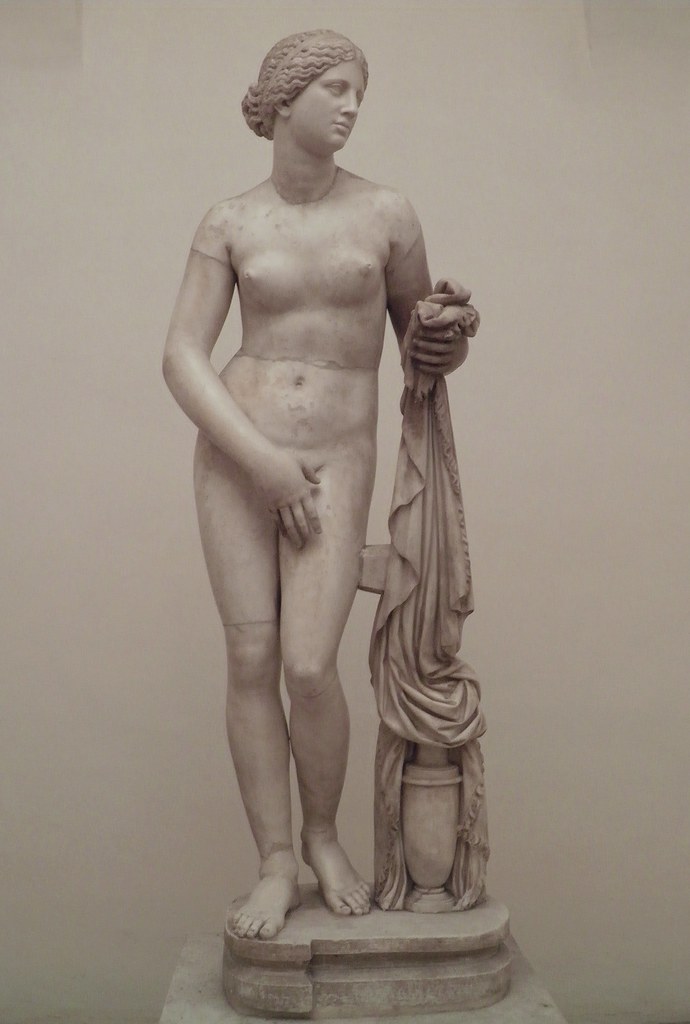
Praxiteles's Aphrodite of Knidos, a
Classical celebration of human form.
“Of all things the measure is Man, of the things that are, that they are, and of the things that are not, that they are not." Here, Protagoras is is basically saying "Man is the measure of all things." A Classical philosopher, he taught that every individual had their own version of the truth—that truth was relative to the person perceiving it. Protagoras taught people to appreciate the individual and the wide array of perspectives people have. To him, humans are not only greater than the beasts of the earth and the angels in the heavens, but higher than truth itself.

This heavily contradicts the beliefs of pre-Renaissance Christianity. The general belief during that period was that people were fallen souls and had to live by the Church’s rules to have a chance at having any worth and getting to heaven. People in anything lower than the upper class were thought of and treated like tools, made to work constantly in a feudalistic society. In any class, though, the Catholic church was law, and any education or art centered around it.

Plato, on the other hand, believed that eudamonia, happiness, was the highest goal of thinking. A fellow philosopher, Cicero also considered the individual variations within his audiences and shaped his persuasive techniques accordingly. He recognized that some people were not educated or willing enough to be persuaded by logic alone and decided it was okay to use emotion as a persuader with those audiences. As Somer discusses in her post, speakers and artists must always take the audience into consideration.

Gaining Perspective

Masaccio's The Holy Trinity
In 1424, something remarkable happened. Masaccio, a fresco painter in Italy, delivered his commissioned work, The Holy Trinity, the first known work to feature perspective. Prior to this innovation, relative size in a painting signified relative importance. However, as Lewis Mumford
says, "in the new picture of the world, size meant not human or divine importance, but distance." This shift indicated a larger cultural shift toward emphasis on the individual that came with the humanism movement.

In embracing perspective, painters no longer pressed an interpretation on their viewers. Similarly, humanism advocated for the development of individual thought and character. Just as figure's importance in painted works was no longer defined by position, so was the common man no longer defined by his position in the world, but by what he decided to make of himself.

The concept of the individual came with the concept of an individual's responsibility for their own development. In The Courtier, Castiglione discusses traits that a good courtier should seek to develop to be truly useful to his prince. Those qualities, as discussed in this blog post, ranged from an understanding of history and philosophy to athleticism and romantic proficiency. As stated before, Castiglione implies heavily throughout the work that development of these traits ought to be the purpose of 'the courtier's' life. Responsibility belonged to the individual to become whatever he desired to be. The idealists of the time believed that it was innate in man to desire to become more.

Pico della Mirandola, a philosopher of the time, mused in his Oration on the Dignity of Man,
"Let some holy ambition invade our souls, so that, dissatisfied with mediocrity, we shall eagerly desire the highest things and shall toil with all our strength to obtain them, since we may if we wish."  (More on Pico and humanism here
As the Renaissance moved past its peak in Italy, humanism and the perspective it brought with it swept into the rest of Europe. The tide of that movement collided magnificently with the surge of reform that blazed both within and without the Catholic church to create Christian humanism, an ideology that existed and thrived on both sides of the Protestant rift. This evolution of the Renaissance ideology brought with it a new dimension to perspective and the notion of 'self'.

Before, it had been enough for a man to develop himself into whatever he might wish to become. The Christian aspect of Christian humanism, however, demanded not only development, but forward progress. Erasmus, widely acclaimed as the father of Christian humanism, made this point quite poignantly in his work In Praise of Folly, an essay written from the point of view of Folly herself. Erasmus, through Folly's advocation of it, condemns the notion that being stupid and happy is a better state of being that being uncomfortable and aware of the potential for growth.

Far from the lack of perspective that defined the age before, man's development of self grew to become the focus and expectation for those who had sufficient means to pursue that course. Not only that, but the responsibility for the development of self had become compounded with the responsibility for improvement of self. These developments set us soundly on the path to achieving the deep and widely resonate sense of self that permeates out global culture today.

Photo Credit

Back, Forward, & Back Again


Petrarch looked back over his shoulder nearly thirteen centuries to glimpse sight of works that would make mankind wonder and marvel for centuries to come: Cicero’s letters.  This demonstration of ‘ad fontes’ triggered a new perspective of communication.  Somehow, diving back into the past allowed our forefathers to move more quickly forward. 

Letters to Cicero
Petrarch’s discovery didn’t stop there.  He continued to dig deeper into the past and introduced ideals of humanism—that man was capable of great things.  “What a piece of work is man!”  Shakespeare would later exclaim, which is the very sentiment that fueled and sustained a new awareness of communication.

The two letters Petrarch wrote to Cicero were only the beginning; humanism ideals couldn’t be contained to the written word alone.  Artists like Leonardo da Vinci and Michelangelo communicated their ideas and passions through arts, and for others, it was speech.  Castiglione’s The Courtier masterfully illustrates how the Renaissance-theme of sprezzatura shifted the communication-focus to speech. 

Of Humanity and Monsters


If you start introducing the history of the Black Plague in the right announcer voice, it sounds like the trailer for a great post-apocalyptic flick. The difference between history and fiction in this case, however, is in the rebuilding. One of our movies would focus on struggle, weakness, and the worst of us. It would look at human goodness with a scarcity mentality, celebrating moral grayness at the end of the world.

But, the Humanists didn’t. They found their glory in the strength and beauty of humanity. These thinkers came through a tragedy where they had very little control or ability to save lives (and were essentially at the mercy of fleas) celebrating the greatness of man. This seems counter-intuitive, but I’m still working on my cynical tendencies. I could be wrong.

Whether I’m biased by a darker glass than others or not, I’m not the only one. If entertainment like The Walking Dead is a reflection of societal thoughts and fears, then we lost the Humanist mentality somewhere along the way. We’ve come to believe that we are not only the apex predator, but monster in the closet. Montaigne found nobility in humans that others referred to as savages, while we make movies like Arrival where we have to be saved from—and despite—ourselves.

While we celebrate the printing press and the effect it had on inspiring generations, there’s a good chance that this straying from Humanist thought began with the printing press as well. The printing press showed us that we were hungry to understand the world, but it also gave us the belief that we could want to understand it. That we deserved it.

That need turned into the telegram that gave us news of the American civil war and the sinking of the Titanic. It gave us the radio that filled us with reports of a war-torn Europe. Then it gave us the film that showed us the holocaust and the atom bomb. In the grand scheme of things, it didn’t take us very long to go from criticizing the Catholic church for burning Bibles to wondering how we can control information in our day and age.

So, after seeing in graphic detail just what kind of evil humanity is capable of, do we get to say “What a piece of work is man!” with sincerity or sarcasm? Can we still look on the human form with joy? Or with only with trepidation?

I think we have to create a personal answer to that. And mine, with all of the value, experience, and cynicism that it holds, agrees with the humanists. Just with a word of caution. What a piece of work is man! And how important it is to guide that incredible power along moral lines.

Image credit to pixaby.com

To Be Human: Renaissance v.s. Reformation

Throughout history, people have had many different ideas about what it means to be human. During the Dark Ages, the view commonly held by people was that man was evil by nature and incapable of being saved or doing good all on their own, at least that's what their priests and bishops were preaching to them. Basically, their "only chance of getting back to Heaven was in and through the Church" (https://rhetciv.blogspot.com/2018/09/the-worth-of-souls-in-renaissance.html).


In contrast, when the Renaissance came around during the 14th century, it brought with it a much more positive view of mankind. "The idea was that man could become more than what he was," he had the potential to exceed and become great in anything he set his mind to (https://rhetciv.blogspot.com/2018/09/what-piece-of-work.html). This new perspective allowed the men and women of the Renaissance to be more confident and to develop their talents in the fields of art, science, rhetoric, etc.

Wednesday, September 19, 2018

Great Ambition, Great Love

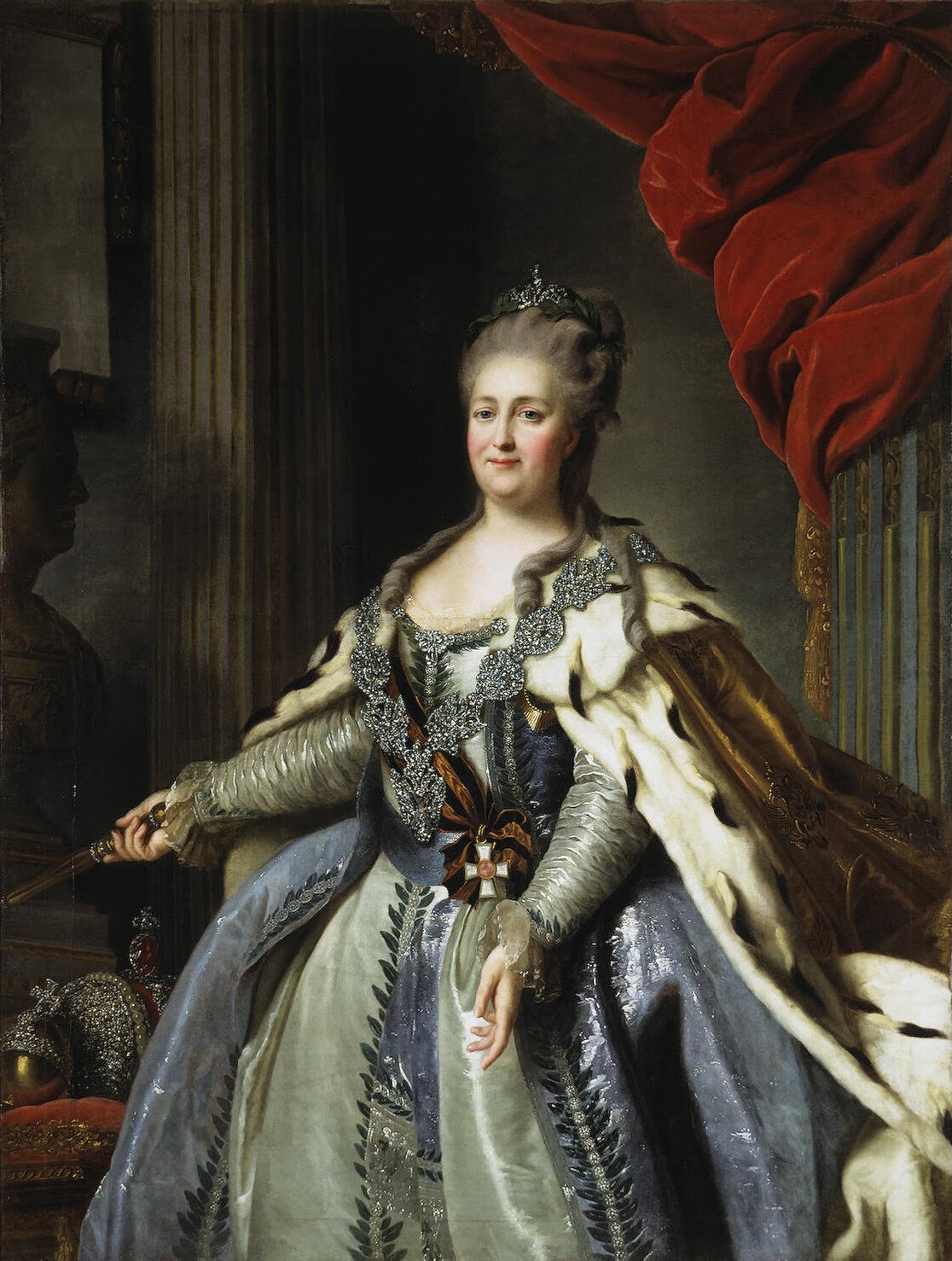
Catherine the Great relied on charm and intelligence
 to gain popularity; she exemplified sprezzatura.
Throughout history, women were generally expected to be passive; ambition was a negative trait for them to have. Even today, female leaders are often described as bossy or overbearing when acting similarly to their male counterparts. Women like Catherine the Great, however, demonstrate the good a determined woman can do. Although she made some controversial decisions, I argue that those decisions are exactly what allowed her to keep Russia afloat in turbulent times.

Catherine the Great was inarguably an ambitious woman. As a teenager she was set on becoming the next ruler of Russia, even though she was German. She begged her tutor to give her more schoolwork, and she even caught pneumonia staying up late to study Russian vocabulary. Her dedication earned her marriage to her cousin, the empress of Russia's nephew. He was a terrible ruler and husband, so Catherine forcibly took the throne from him.

Like many women today, Catherine wanted fulfillment and love. She had lovers, anywhere between 3 and 12 over her lifetime. In addition to finally giving her the love and intellectual fulfillment she sought, her relationships helped her keep Russia on good terms with other countries. It seems like a few lovers would be worth Russia's stability.
Catherine promoted education, health, and the arts, as well as equal treatment of people from all classes. She wrote the Rule of Law, a 22 chapter document for which she consulted people from every class (but serfs). She tried to free the serfs, the indentured servants of the upper classes. She gave up this feat in fear of losing the nobles' support on which she depended, but I don't think she should be blamed too much because she did more good in power than she could have out of it. 

Ambition carried Catherine the Great to uplift Russia to heights that it never would have achieved if not for her. Although she ruled in a less "respectable" way than a woman would have been expected to, she achieved her goals of power and love while ruling Russia responsibly. I argue that her greatness stemmed from her controversial deeds, rather than being hindered by them.

Image obtained from wikicommons.


Saturday, September 15, 2018

Early Humanists Set the Example For Future Revolutions

Early humanists were few and far between. Part of the reasoning for this is that humanists lacked the resources to succeed in helping others on a large scale. There are a few examples in the past of humanist efforts but they lack large-scale efforts to improve life.

This picture depicts an ancient printing press similar to those used by Aldus Manutius
One of the greatest examples of early humanist efforts is that of Aldus Manutius. This is one of the first examples of large-scale operations to improve life for the common man. He invested large sums of money into creating a business based around providing books for the common man. This is unheard of for the upper class to care for the peasant's needs.

Before Aldus, access to books, even printed books, was far out of reach for the common man. Few could afford an expensive book to be copied by hand and even books printed by a press were hard to get hands on. Aldus recognized this as a problem and created a successful company to provide books at a reasonable rate. He was fist a humanist and second a businessman. While he may have been able to increase margins by charging more per unit, he chose to put his products in reach of the lower class. Despite this fairly bad business move, he was incredibly successful.

One thing that makes the renaissance such an incredible time period is the beginning of large-scale humanist efforts such as this. Without heroes like this to lead the cause, it could have been centuries more until a collective consciousness of the basic rights of human beings was accepted. I believe that humanists like this are part of the reason there are still people fighting for rights today.

Thursday, September 13, 2018

Trying to be human


“Finding yourself” is a common enough term today. I would say most people are interested in introspective pondering and working to figure out what makes them feel content and fulfilled. This type of thinking also abounded in the Renaissance. Rather than think only what they were told to think and do what they had to do to survive, people in the Renaissance began to think about the world and themselves in different ways than ever before.

Michel de Montaigne, the first essayist.

A leader in this art was the writer Montaigne. He wrote about his daily life, musing about one topic or another, basically recording his thoughts on paper. These writings he coined “essais” after the French word “essayer,” meaning “to try.” Montaigne’s musings were attempts to understand himself and his world, and they often delved into ideas that were deeper than their titles.

People read Montaigne’s essays and were amazed to see the situations they had experienced and feelings they had felt written so brilliantly. A line from We Taste Nothing Purely reads “In sadness there is some alloy of pleasure.” I know exactly the feeling he is talking about, but I would never have even thought to put it into words. His essays also opened people’s minds to new ideas, which was an integral aspect of the Renaissance. On Cannibals, for example, explores the idea that the cannibals Montaigne met in Brazil could be more moral than the “civilized” people of Europe.

The desire to put everyday thoughts and experiences into words never died out; Montaigne has influenced writers for centuries. Personal essays of today still exhibit that humanistic exploration of self. Joyas Voladoras, written in 2004 by the late Brian Doyle, contemplates the heart. “We are utterly open with no one in the end—not mother and father, not wife or husband, not lover, not child, not friend. We open windows to each but we live alone in the house of the heart. Perhaps we must.”

It’s certainly a testament to humanist ideals that, after all this time of people exploring what it means to be human, we’re still trying to figure it out.

Image credit: Portrait of Michel de Montaigne, circa unknown by unknown author is in the public domain.

Tuesday, September 11, 2018

Humility or Repression?

Image result for magnus cathedral

      In a historical sense, the Renaissance seems to be widely interpreted as a "freeing" of the mind from the shackles of religious self-deprecation. In the Middle Ages, the holy role of king was to...motivate...his subjects to embody Christlike attributes such as humility, submissiveness, and meekness. 

      While this sounds like a noble endeavor, it usually resulted in oppression, and, more importantly, a significant repression of thoughts and creativity. When one tried to create beauty that wasn't directed completely towards God, it was self-gratifying and vain. Thus, the Renaissance was seen as beauty's hero, send to free the minds of men from the cage of forced humility. 

      The natural effects of hardened dogmatism have not changed since then, though the times have certainly been generous to artistic freedom. In some parts of the world, certain communities remain rather attached to some of the more medieval aspects of Christianity. In such communities, when a youth is ambitious or aggressive in his or her journey to make it in the world, those ambitions are put down in short order and the youth is told "don't get ahead of yourself, you're not that important."

      Never having been an overly patriotic sort of person, it makes me consider what makes Americans feel freer to follow their dreams and passions? Maybe it's because humanism doesn't develop pride and selfishness, but simply encourages people to live up to their potential. Does pursuing humility mean giving less effort to living a full and engaged life? 

      In my estimation, humility is not inverse to achievement. In fact, how can one be humble without any achievements? Is humility the war against pride, or simply the absence of anything to be proud of? Such was the dilemma of the Renaissance.
      As Friedrich Nietzsche once put it, "Of all evil I deem you capable: Therefore I want good from you. Verily, I have often laughed at the weaklings who thought themselves good because they had no claws.” (Thus Spoke Zarathustra)

https://c.visitorkney.com/assets/files/1395/istock_000058124404_large.900x600.jpg