Showing posts with label Hobbes. Show all posts

Wednesday, October 10, 2018

Can "Mean Girls" be the Solution to Avoiding War?

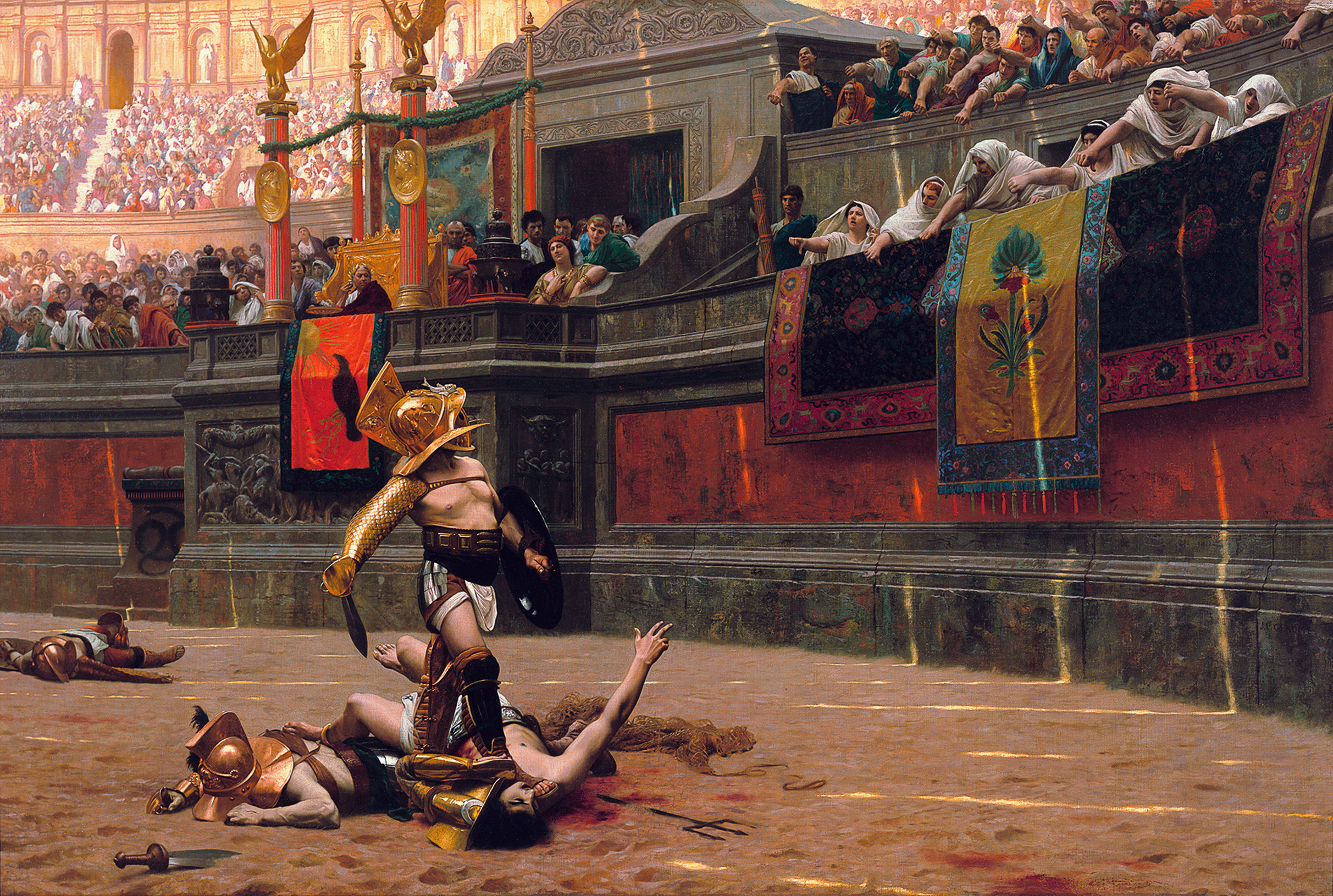
Image result for gladiator
When I was in high school, I was asked to write an analytical essay on a book by Victor Davis Hansen entitled "The Father of Us All." The author claimed that war was the resting state of society, as it were, in the same way that it takes effort to constantly smile instead of just having a default resting face. In other ways, war is the natural way for mankind to resolve any sort of disagreement.
Reading Leviathan by Thomas Hobbes reminded me of that principle. Hobbes writes, "It is certain, that during the time men live without a common power to keep them all in awe, they are in that condition which is called war." (Hobbes, 35)
 This fascinates me because it sounds like both men agree that people would always be fighting unless the organization of society is almost literally restraining them through authority. 
Image result for nfl tackleAs I was trying to decide whether I concur, I remembered once hearing someone compare the NFL to the Roman Coliseum. Are we naturally bloodthirsty, but capable of using proxies to satisfy that bloodlust? Then I read this line by Hobbes, and suddenly things made a bit more sense: "In the nature of man, we find three principal causes for [war: competition, distrust, and glory]. The first makes men invade for gain, the second, for safety, and the third for reputation." (Hobbes, 35)
If the warlike mindset is our natural state, maybe it follows that in the absence of a real conflict, society substitutes other institutions to satisfy those natural instincts. 
In modern America especially, capitalism allows people to acquire the property of others simply by outmaneuvering them in business. Society and especially technology have advanced to the point where DNA testing, cameras, and a dedicated police force take personal safety to a whole different level. Even just the advent of the streetlight radically changed the way nighttime itself functions. And in first-world countries, with the poverty line drastically different from many others, personal problems can much more be resolved through social revenge rather than physical revenge (think Mean Girls). 
Perhaps these are just the musings of my brain to try to understand the philosophy of the question, but perhaps there is a valid point here. What do you think?


Image Credits: "Pollice Verso" by Jean-Leon Gerome 1872, "2006 Pro Bowl tackle". Both licensed through the CC for non-commercial reuse. 


There is something in the water...


I wanted to focus on the actual meaning and origin of the word “Leviathan” (mostly because I think ancient, mysterious, biblical sea monsters are fascinating –and Disney mentioned it briefly in the second Atlantis movie and that is enough reason for me to spend time discussing it.) Using the imagery of a ferocious and powerful sea monster was an interesting choice for Hobbes, especially since the Leviathan has several different roles in the Bible (and in Disney films).


In the Hebrew Bible of the Book of Job, God describes the Leviathan to Job as a mighty beast who cannot be controlled, caged, or destroyed by the strength of men; only God can control this sea monster (refer to picture) and therefore Job is to have more faith in God’s power of creation and His control over the earth. Most likely, this is the form of the Leviathan that Hobbes was referring to.


However, if we jump to the book of Isaiah, God describes the Leviathan as a symbol of wickedness and specifically, wicked kings, and that if the people of God have faith in Him, this type of wickedness (A.K.A the strength of the Leviathan) cannot succeed.


And then in the second installment of Disney’s Atlantis (this is one of my favorite movie series so of course I’m going to talk about it) the Leviathan acts as a type of “hive mind” where it takes complete control of the population of a nearby village and makes them do whatever it wants, even if they commit evil.

So with these three forms of the Leviathan in mind and what they represent in a commonwealth, I definitely doubt more the social contract theory of Hobbes. Thanks to the Bible and Disney, I more strongly support the theory that man is good and therefore can govern him/herself with the need for a controlling sovereign. 

Image Credit: "Destruction of the Leviathan by Gustave DorĂ©" (Public Domain Image via WikiCommons)

Of Cattle & Commonwealth


A More Contended Life
Caleb after roping a wild bull
In his outline of causes for commonwealth, Thomas Hobbes points out that man has a desire for a “more contended life.”  They want their rights of life and liberty and their properties secured and protected.  Thus, they need a social contract to sacrifice some comfort and liberty for a greater liberty.

In my little brother’s seminary class, upon being asked if he wanted grow up as a calf in the safety, comfort, and warmth of the stall responded, “Nah, the cattle hate being corralled and cornered; I’d rather be free to roam and find my own food.”

While as humans we really do desire the “contended life” with not just its luxuries but assurance that our rights and properties will be protected, having grown up on a cattle ranch, Caleb understood that cattle prefer the range over the corral and peace over protection.

Like Bees & Ants
Some of the reasons Hobbes says creatures live harmoniously are:
  • Men seek their “own superiority” whereas with creatures, so long as one is happy, doesn’t care what the other has
  • Creatures can communicate but can’t express what’s good and evil
  • Harmony is natural among creatures but only comes by agreement and a common power for men.

The “only solution” to prevent injury and insure protection is to form not just an agreement, for man can back out on his word, but to form a common power to which everyone submits his will and judgments—a commonwealth.

Commonwealth
This commonwealth is procured by one of two ways: by natural force or by voluntary agreement.  The governing power is the “sovereign” that exists solely to protect and preserve the rights of the people.  If this power is split up, the sovereign is deserting the purpose.  Therefore, it’s his responsibility to maintain those rights and inform the people of his purpose in establishing rights.

Tuesday, October 9, 2018

"That all men are created equal."

When John Locke wrote his Second Treatises: Of Civil Government and Thomas Hobbes wrote The Leviathan, intellects were still trying to unpack everything the sovereign individual idea had to offer. It was generally accepted by both Locke and Hobbes that all men were equal (Even though "man" was a pretty exclusive group, but it was more progress than ever before), but they were equal in different ways.

John Locke

Locke believed that men were all equally good and needed very little authority to govern them. According to Man's "State of Nature," no one has power over another and all are equally free to do as they please so long as they don't infringe on other's freedom. Locke had a relatively optimistic outlook on human nature.

Thomas Hobbes

Hobbes, on the other hand, thought that man needed a parent authority to create "good laws" that he could abide by. He determined that because people were continually in competition for honor and dignity, they tended toward envy and hatred. Hobbes also generally believed that people were equal despite their differences because no matter how weak, the "weak" person could still use strategy to have a "strong" person killed.

The Hybrid

Over the weekend I attended a lecture by a well-known psychology professor from the University of Toronto. He analyzed the line from the declaration of independence, "We hold these truths to be self-evident, that all men are created equal..." We know that all men are not "created equal" socially or economically, and the founding fathers who owned slaves obviously didn't think so. So what did they mean?

At the lecture, Dr. Peterson said that the self-evident truth is not that all people have equal opportunity when they come into the world, but that they all have equal capacity for good and evil. This could be thought of as a hybrid of the thoughts of Hobbes and Locke. He explained because all people have equal capacity for good and evil, they have an equal responsibility to the collective not to pursue evil and to seek out good. Because the state is made up of sovereign individuals in a free society, whether or not the state is inherently good depends on the individual.