
When I was in high school, I was asked to write an analytical essay on a book by Victor Davis Hansen entitled "The Father of Us All." The author claimed that war was the resting state of society, as it were, in the same way that it takes effort to constantly smile instead of just having a default resting face. In other ways, war is the natural way for mankind to resolve any sort of disagreement.
Reading Leviathan by Thomas Hobbes reminded me of that principle. Hobbes writes, "It is certain, that during the time men live without a common power to keep them all in awe, they are in that condition which is called war." (Hobbes, 35)
This fascinates me because it sounds like both men agree that people would always be fighting unless the organization of society is almost literally restraining them through authority.
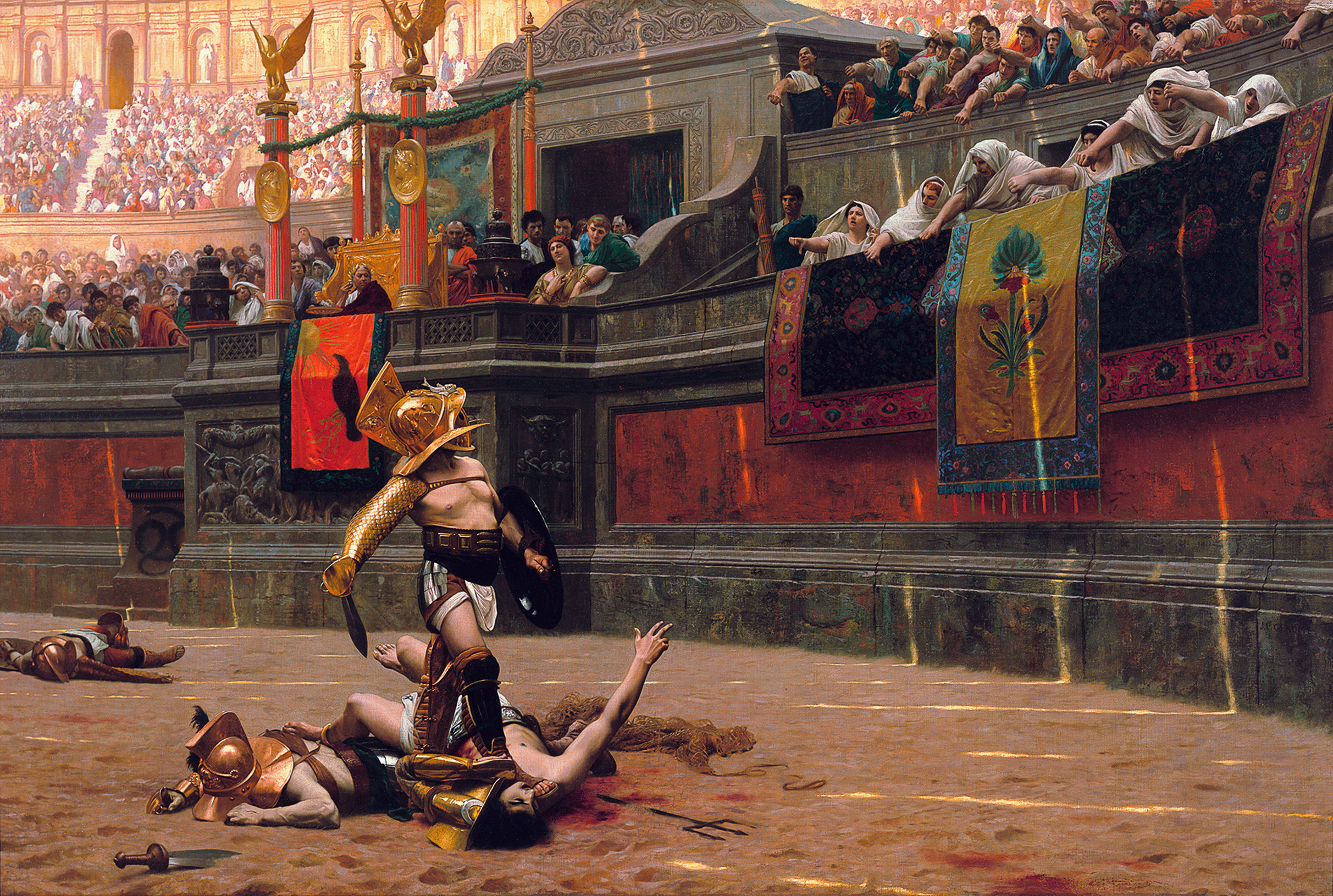
 As I was trying to decide whether I concur, I remembered once hearing someone compare the NFL to the Roman Coliseum. Are we naturally bloodthirsty, but capable of using proxies to satisfy that bloodlust? Then I read this line by Hobbes, and suddenly things made a bit more sense: "In the nature of man, we find three principal causes for [war: competition, distrust, and glory]. The first makes men invade for gain, the second, for safety, and the third for reputation." (Hobbes, 35)
If the warlike mindset is our natural state, maybe it follows that in the absence of a real conflict, society substitutes other institutions to satisfy those natural instincts.
In modern America especially, capitalism allows people to acquire the property of others simply by outmaneuvering them in business. Society and especially technology have advanced to the point where DNA testing, cameras, and a dedicated police force take personal safety to a whole different level. Even just the advent of the streetlight radically changed the way nighttime itself functions. And in first-world countries, with the poverty line drastically different from many others, personal problems can much more be resolved through social revenge rather than physical revenge (think Mean Girls).
Perhaps these are just the musings of my brain to try to understand the philosophy of the question, but perhaps there is a valid point here. What do you think?
Image Credits: "Pollice Verso" by Jean-Leon Gerome 1872, "2006 Pro Bowl tackle". Both licensed through the CC for non-commercial reuse.

