Showing posts with label By Sterling Smith. Show all posts

Monday, December 10, 2018

Healthcare. A Right or A Commodity?


By Sterling Smith

Before assuming universal healthcare will solve the healthcare crisis, it is vital to account for possible negative side effects, both logistically and morally.

As the baby boomer generation ages, the need for elderly care will increase exponentially. The demand for care in an industry that is almost 100% paid for by Medicare and Medicaid will leave our generation with a massive bill to pay. The proposed single payer solutions sound simple and enticing, however, there are deeper morals at play and the solution may not be as clear as we think it to be.

Saturday, December 1, 2018

Hot Topics of Skilled Nursing Facilities

- Low Staffing Levels

Nursing homes and long-term care centers have struggled as of late to maintain their staffing levels to qualify for federal and state funding. Because of the low wages for certified nurse assistants (CNA) and registered nurses (RN), it is difficult to slow down the high turn over rates of the industry. Record low unemployment rates have driven other workers to higher wage industries. Nursing home companies are working hard to find the balance between raising wages while maintaining a profit in an extremely low-profit industry. (See Source).

-Elderly Abuse

Low staffing has lead to lowering standards in the highering process which lead to an increase in abuse cases. One of the biggest struggles for administration in these facilities is creating detailed training programs and incentives to continually increase the quality of care. One way nursing home administrators prevent abuse is through detailed documentation of cases to enhance clear communication between the facility's staff and state surveyors. (See Source).

-Changes in Arbitration Clauses

Before November of 2016 patients who entered Skilled Nursing facilities were forced to sign an arbitration agreement upon arrival. Which means any dispute had to be settled with a mediator before going to court. This restricted the patient's ability to voice their concerns about the treatment they received in the facility. Now, arbitration is optional and can be signed after admission if an issue comes up. This gives the patient more legal freedom when communicating their concern and receiving justice. (See Source).

All of these issues are heavily influenced by federal and state funding, as facilities receive the majority of their reimbursement from Medicare and Medicaid. Based on my exposure to the industry over the years I have seen serious inefficiencies in the processes that provide funding. Skilled Nursing care has improved dramatically since its beginnings, but there is still a lot of potential solutions to provide better care that will save both the federal government and taxpayers billions of dollars.


Monday, November 26, 2018

Unification Through Pathos

My great-grandfather's Pound
When I was a baby my great-grandfather left me with a silver Pound that had the face of Winston Churchill on the back. He gave it to me because he thought that, as a baby, I looked like Churchill. It may have been a nice way of saying I should aspire for Churchill's wit because my looks wouldn't get me very far. Churchill was always just the funny looking guy on the back of that coin until I the Sinews of Peace Speech. Or, more commonly referenced as the Iron Curtain Speech. 

Considering the Kairotic nature of the situation, Churchill wanted to express the need to spread democratic western values through the unification of western countries. The speech was carefully pieced together such that it would convince those who hold close to western values join in the grand unification of the world's force for good against evil. The United Nations. Churchill uses many rhetorical devices to prove his argument. I will discuss his appeal to Pathos through his oratory delivery and his literary devices.

Oratory

Churchill delivers his address as slowly and as carefully as he wrote it. The times where he mixed up his words he would redo until it was said exactly right. His careful delivery could be heard in the way that he emphasized the first word in each of his major phrases. "OUR supreme task and duty is to GUARD the homes of the common people..." (7) This was a common strategy in dramatic speech delivery of the time. The dramatic tone carried over to develop a serious mood for the listener, so as to give incentive for the listener to pay close attention. 

Literary

"Let us preach what we practice--Let us practice what we preach" (13) This is one of many figures of speech that were employed in an effort for Churchill to appeal to the pathos. In this case, the antithesis is used to offer inspiration to the listener. He also uses amplification to create a climax.

"The dark ages may return, the Stone Age may return on the gleaming wings of science, and what might now shower immeasurable material blessings upon mankind, may even bring about its total destruction." (18)   

In conclusion, while pathos was only one of the three persuasive appeals used by Churchill, it may have proven to be the most useful. His words were meant to resonate with people of different backgrounds who shared an emotional value that was thoroughly challenged throughout the previous three decades. A value common to westerners of all nationalities. Freedom.
        

Wednesday, November 14, 2018

A Communist Trial Run:

The Kulaks were a group of people in rural Russia who were able to accumulate land and become somewhat successful farmers after the Stolypin reform after the fall of the Czar. In 1918 the label Kulak was attached to anyone who wouldn't surrender their harvest to the state. Lenin saw this as rebellion and wanted the thought of private property and industry eradicated.

The massacre started with the hanging order. "You need to hang- hang without fail, and do it so that the public sees- at least 100 notorious kulaks, the rich, and the bloodsuckers. Publish their names. Take away all of their grain. Execute the hostages..." (Lenin) The killing didn't stop at 100. According to Aleksandr Solzhenitsyn who was imprisoned in one of the Gulags (concentration camp) upwards of 5-6 million people were killed. That is how many Jews were killed in the concentration camps.

Third degree interrogation. Drawings from the Gulag. Danzig Baldaev.

Between Lenin and Stalin, according to historians, the number of those murdered capped at around 20 million. That is about the same number of deaths as the number of soldiers and civilians who died in WWI.

The dictatorships in Russia began to fascinate me as soon as I heard about them. I never learned about it in great detail in my formal education later to find out that it was most likely because of western scholars who were sympathetic to the communist movement. In studying more about Lenin and Stalin I realized that those who supported the Marxist philosophies were more concerned about pulling down the rich than lifting up the poor.

I wouldn't consider myself wise enough to think that I know what's best for humanity, but it worries when people tell me that I am "a privileged white male" as if they know what I had to overcome to get where I am. I am extremely fortunate, and I don't deserve what I have. But does anyone? Who decides who deserves what? When people decided they knew what everyone deserved or "needed" tens of millions of people were killed. You can decide for yourself, but I will stick to the imperfect method of letting people decided for themselves what they need.


Monday, November 12, 2018

Rise of Nationalism, The Fall of the Ottoman

The conflict in the Middle East has been one of continual carnage and dynamic control. Israel has been a territory of much dispute for millennia, however, the conflict as of late can be attributed to the remnants of the Ottoman empire. In a documentary called The End of the Ottoman Empire by Mathilde Damoisel of Icarus Films, the viewer is able to trace the current conflicts of today back to the reign of the Ottoman Empire.
CC

At the height of the Ottoman Empire, the imperial power of the Ottoman's expand across seven continents. The Empire consisted of Christians, Jews, and Muslims each with different sects of their own. However, the basis of their control was in a  "Turkish core" and a "Muslim shell." The beginning of the documentary opens with the Ottoman loss of the Balkans at the end of the Balkin war. This was the beginning of the end of the Empire.

With the developments of the nineteenth century in Western Europe, the Ottoman Empire was not able to keep up with the constant pressure to change from the outside, and the resisting forces from within the empire. Despite the empires desire to unify the people of the Middle East, their power was overturned by the newly created nation-states. These nation-states consisted of peoples of similar religions and ethnicities who, with the help of Western Europe became sovereign nations.

However, the struggle for sovereignty came at a great cost and for many nations in the area, the struggle is still taking place today. The second part of the documentary focuses on the broken Middle East that resulted from the fall of the Empire. The broken aspect that the Middle East has inherited can, to some extent, be attributed to the nationalism of the nation-states. The priority each nation placed on the success of their race/culture is one of the reasons for the fall of the Ottoman Empire, and the rise of Middle Eastern conflict of today. Whole populations uprooted, nationalistic tendencies became genocidal, and millions have been killed for the sake of ethnic cleansing. 


Wednesday, November 7, 2018

Hugo's Tribute to Empathy and Gothic Architecture

Disney's The Hunchback of Notre-Dame was released the year I was born (1996). Like most everyone from my generation I grew up watching old classic Disney movies, but The Hunchback of Notre-Dame was one that I watched more frequently than all of them. I even had a toy Quasimodo which was one of my prized possessions. I was a strange kid.

I haven't seen the movie for probably ten years now but the parts that intrigued me the most were the creepy demons, the gargoyles, and the dark but incredibly beautiful Notre-Dame Cathedral. I didn't know it, but the mystery of beautiful, gothic, art caught my interest before I knew what I was interested in.
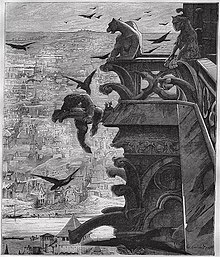
Illustration from Victor Hugo et son temps (1881)
Published in 1831, Notre-Dame de Paris (The Hunchback of Notre-Dame) by Victor Hugo carried with it humanistic themes of the Romantic period such as sympathy for the suffering of the dispossessed, which is common throughout Hugo's writing. Hugo wrote this story, however, to prove the humanistic utility of Gothic architecture.

When Hugo wrote Notre-Dame de Paris, Notre-Dame had its circular colorful stained glass window replaced with clear glass to let in more light. Gargoyles were being removed from their structures. The rapid replacement of the medieval architecture in place of contemporary themes was to Hugo a loss of appreciation for the Gothic side.


Hugo exemplifies Romanticism's reaction to the French Revolution. His father; a general in Napoleon's army, loyal to the new regime. Whereas his mother was loyal to the original monarchy. The conflicting politics eventually led to their separation, leaving Hugo left to decide on his own where he would find meaning as he moved back and forth between parents. He chose to move on and married a childhood friend with whom he had five children.

Throughout his life, Hugo saw both the light and the darkness of humanity. Absolute joy and unforgiving dispair.  Leading him to eloquently articulate both the Gothic mysteries of the unknown and the empathetic compassion for the less fortunate, properly encapsulating Romanticism in its essence.   


Photo Credit: http://paperplanereviews.blogspot.com/2013/06/the-hunchback-of-notre-dame-by-victor.html         

Saturday, November 3, 2018

Being Me vs Being Human

Something Big:  The Past
The present is too much for me to comprehend. To try and understand the truth behind history is impossible. It is impossible for us to understand the motives of prominent historical figures and major events that took place. It is completely irrational to label history as "noble," "patriarchal," "ethnocentric," or "oppressive." There are too many details that I don't know to put a label to it. While I do my best to understand the details that I know, I will never fully understand what happened in the past. Who to credit, and who to blame.

Something Broken: My Willpower
I can tell myself that I need to study for seven hours straight, but I will not even get through the first half hour without resistance from myself. It makes me wonder; who is really controlling me? Some call it the battle of the "natural man," but that name is only words associated with a part of the psyche that is incomprehensible. We call it the "natural man" to label it; but we don't understand what it is, where it came from, or why it is always with us.     

Something Artistic: Les Miserables
Les Miserables is one of my favorite stories. The transcendent yet relatable themes leave me in awe. Terrible things happen to well-meaning characters (hence its title) yet I was more satisfied with the ending of that story than any other story I have come across. I can't tell if Les Miserables gave me more faith that justice would ultimately reign or that I could trust in the mercy of the transcendent.
     
Something Mysterious: My Interests 
I love hunting, basketball, golf, menswear, and art. But why? No matter how many times my wife makes me watch Pride and Prejudice, it does not interest me. I could try and force myself to enjoy fishing, but I will never feel fulfilled doing. Some might say that I was raised and groomed into my interest. If that were the case then my other siblings and I would have similar interests, and we do not. There is something inside of me that makes me interested in those things. The scary thing is that it is something that is out of my control. I didn't choose to have those interests, those interests resonated with a part of me that is impossible for me to explain.     

Monday, October 29, 2018

"Can't We All Get Along?" Today's Political Discourse Through the Eyes of Adam Bede Characters

In 1799 rural life in Britain was relatively similar across the country. Most people were poor and struggled to provide for their families. The romanticization of a young woman dreaming of living a life of luxury with a with a wealthy squire and the strange notion of a woman preacher would have been common encounters for rural citizens across Europe.

Mary Ann Evans published Adam Bede in 1859. This was a period of time where enlightenment thinking had become part of society long enough for it to start to sink into action. This was also a time of religious tension in England. Enlightenment principles like individual social liberty and tolerance of other individuals were portrayed in characters like Mr. Irwine and Dinah. These characters were accepting and thought that all humans deserved respect:
"These fellow-mortals, every one, must be accepted as they are: you can neither straighten their noses, nore brighten their wit, nor rectify their dispositions; and it is these people--amongst whom your life is passed--that it is needful you should tolerate, pity and love: it is these more or less ugly, stupid, inconsistent people, whose movements of goodness you should be able to admire--" (Narrator, 17:160)
CC
Dinah set out to prove that caring for the dispossessed is the most important part of religion and Mr. Irwine was respectful of Dinah's title as a preacher despite being a woman.

As I skimmed through the reviews the comments mentioned themes kindness and tolerance. With the polarizing climate of politics and the dangerous rhetoric taking place in media, it seems as though the notion of kindness and tolerance has been lost.

As I have sought to find the truth concerning social issues we face in society I have found that the intentions of those supposedly fighting for the dispossessed are less concerned with helping the afflicted and more concerned about hating and smearing their opposition. Has the enlightenment value of the sovereign individual been lost? Are we being forced to join ideology groups to feel part of the compassionate cause?

I definitely don't have the answers, but a song written by Kenny Chesney in light of today's political discourse comes to mind:
"Get along on down the road
We've got a long, long way to go
Scared to live, scared to die
We ain't perfect, but we try
Get along while we can
Always give love the upper hand
Paint a wall
Learn to dance, call your Mom
Buy a boat, drink a beer
Sing a song, make a friend
Can't we all
Get along."       
While the premise may be simple and commonsensical, I think Mary Ann Evens, Dinah, and Mr. Irwine would all agree with Mr. Chesney.


Wednesday, October 17, 2018

Equal Opportunity

Adam Bede is a story of the imaginary town of Hayslope in 1799. Mary Anne Evan's (George Elliot) wrote and published the novel during the Victorian period. This was a time where patriarchy tended towards tyranny rather than benevolence. Physical labor like carpentry and farm labor was performed by the men whereas housework was performed by the women. According to the Journal of Ankara University, the novel indirectly argues that the separation of these roles was maintained through the means of the traditional family structure and the church.(1)

Despite the lack of opportunities women had to express their opinions, this novel was a perfect example of enlightenment value of enfranchisement of the individual. Despite the weak initiative of the main female character, Hetty Sorrel, there are female characters who go against the cultural norms of their times and voice their opinions in ways that wouldn't have been considered inappropriate during that time period.

Feminists like Mary Anne Evans and other great thinkers of the enlightenment have paved the way for the equality of opportunity given to women today. When I left my family to serve a two-year church mission, my mom was recently divorced, with no formal work experience, and six children to provide for. She left Canada to move to the States where there would be more opportunity for a single mother. Because of the progress that has been made in gender equality, she was able to find a job and after a series of promotions over three years she is now an executive at the company she started working for. Because the progress that has been made since Mary Anne Evans published Adam Bede woman have more freedom than ever before.


Sources:

(1) 2017, Ankara Üniversitesi Dil ve Tarih-Coğrafya Fakültesi Dergisi, Vol 57, Iss 2 (2017), volume 57, issue 2      


Tuesday, October 9, 2018

"That all men are created equal."

When John Locke wrote his Second Treatises: Of Civil Government and Thomas Hobbes wrote The Leviathan, intellects were still trying to unpack everything the sovereign individual idea had to offer. It was generally accepted by both Locke and Hobbes that all men were equal (Even though "man" was a pretty exclusive group, but it was more progress than ever before), but they were equal in different ways.

John Locke

Locke believed that men were all equally good and needed very little authority to govern them. According to Man's "State of Nature," no one has power over another and all are equally free to do as they please so long as they don't infringe on other's freedom. Locke had a relatively optimistic outlook on human nature.

Thomas Hobbes

Hobbes, on the other hand, thought that man needed a parent authority to create "good laws" that he could abide by. He determined that because people were continually in competition for honor and dignity, they tended toward envy and hatred. Hobbes also generally believed that people were equal despite their differences because no matter how weak, the "weak" person could still use strategy to have a "strong" person killed.

The Hybrid

Over the weekend I attended a lecture by a well-known psychology professor from the University of Toronto. He analyzed the line from the declaration of independence, "We hold these truths to be self-evident, that all men are created equal..." We know that all men are not "created equal" socially or economically, and the founding fathers who owned slaves obviously didn't think so. So what did they mean?

At the lecture, Dr. Peterson said that the self-evident truth is not that all people have equal opportunity when they come into the world, but that they all have equal capacity for good and evil. This could be thought of as a hybrid of the thoughts of Hobbes and Locke. He explained because all people have equal capacity for good and evil, they have an equal responsibility to the collective not to pursue evil and to seek out good. Because the state is made up of sovereign individuals in a free society, whether or not the state is inherently good depends on the individual.   

Wednesday, October 3, 2018

The Garden of Eden Post Reformation

The Adam and Eve narrative has been subjected to several different interpretations that have shaped the way we as humans view ourselves. Ironically, the narrative caused Reformation Christians to argue both for and against humanism.

In the time of The Renaissance and The Reformation, the idea of the divine being was the driver behind humanism. Authority was no longer limited to the sovereign state but extended to the sovereign individual. Men and women had more opportunity at this time in Europe than they had in a very long time. With this opportunity came the ability for mankind to create a value system for themselves and decide the most meaningful actions they could take to justify their suffering.  However, in light of easy access of the Bible, many read the Adam and Eve narrative and seemed to change their mind on the source of suffering and the state of being.

The genesis of man was key to Christian's post Reformation (1600-1700 AD) understanding of the nature of mankind. Their understanding was not in line with the Christian humanists from the beginnings of The Reformation (1400-1600 AD). Due to grossly oversimplified interpretations of the Garden of Eden narrative, the man was no longer a divine being. Mankind was interpreted as misogynistic, evil, and weak because of how people at the time interpreted Genisis. The impact that these interpretations nearly took society back to a feudal system like thinking as Hobbes famously made the argument that mankind desperately needed a strong governing force.

Despite the enlightening influences that came out of The Reformation, it came with its disadvantages. The truth that was meant to set people free, ended up putting them back in the 'evil' box they just escaped.


Image Credit: https://chrislinzey.com/2013/08/01/good-vs-evil/

Saturday, September 22, 2018

Donne's Influence in Present Day Pacific

John Donne's transformation in his writing from Catholic to Protestant was characteristic of the changes that were taking place in Europe at the time.

Many questioned the Catholic Church. After going back to the original text in an Ad Fontes fashion, interpretations of the gospel that were contradictive to the Catholic teachings of the time. The idea of the human as an individual was one of the key contradictions that made so many question Catholicism. Individuality empowered Europeans to take responsibility for their souls. Their spiritual well being was no longer dictated by the amount of tithing that was paid but through careful reflection.

Donne's Holy Sonnet 14 is a perfect example of the type of self-reflection that took place:
"Batter my heart, three-person'd God, for you As yet but knock, breathe, shine, and seek to mend; That I may rise and stand, o'erthrow me, and bend Your force to break, blow, burn, and make me new... Take me to you, imprison me, for I. Except you enthrall me, never shall be free, Nor ever chaste, except you ravish me." 
I served a church mission in the Central Pacific where everyone was affiliated with a religious group. The most common of the groups were Catholics and Protestants. In my discussions with people from both groups, I found that the people of the Central Pacific were influenced by these religions in the same way Europeans were in the Renaissance. The Catholics were fulfilled by their spiritual rituals, and the Protestants focused on their spirituality as individuals.

The fact that people on the opposite sidesof the world are still affected by the principles discussed by Donne, proves the magnitude of this enlightenment.


Tuesday, September 18, 2018

Carl Jung's Response to Gaspare and Ottaciano

A portion of The Courtier deals with the ideas of virtue and good vs evil. These differences can be summed up in Gaspare response in The Courtier to Ottaviano's claim that people cannot choose evil.
"Yet there are many who fully understand that they are doing evil, and still do it; and this is because, like thieves and murderers, they are more conscious of the pleasures of the moment than the punishment the fear in the future." Castiglione-- The Courtier
Ottaviano claimed that people unconsciously sinned and shouldn't be held accountable. Gaspare argued that humans that humans are self-conscious beings, and sin for the pleasure of the moment. While reading this dialogue I was reminded of Carl Jung's concept of The Shadow.

                                                                            cc

The idea behind The Shadow is that every individual has a dark side. Jung described this dark side as the unconscious malevolent part of our personality that has the potential to corrupt what we do, say, and think. According to Jung's description of the shadow, we won't truly know the difference between good and evil until we are aware of The Shadow and make it conscious.

My explanation of The Shadow does not do it justice so I would recommend researching it for yourself. However, I do think its logic contains elements of both Gaspare's and Ottaviano's claims. It supports Ottaviano's argument that we do evil things unconsciously. The way to overcome this would is to internalize the shadow and make it conscious. Or as Gaspare might say it, we must understand the temptations to do evil acts that bring pleasure at the moment and withstand these temptations.

The realization of the terrible things we are capable of gives us a greater capacity for virtue as we choose not to do evil. We can thank Castiglione for introducing these concepts of the nature of good, evil, and the divine individual. Revolutionary thinkers like Carl Jung looked to these renaissance pioneers to better understand who we are as human beings.