Showing posts with label Gothic. Show all posts

Tuesday, October 29, 2019

Chiaroscuro: Contrast Between the Gothic and the Fantastic

Chiaroscuro is a technique in art that uses strong contrasts between light and dark to bring more interest to a composition. This balance of light and dark has been a common theme throughout history, but one of the periods that demonstrates this well is the Romantic. During this period there was a sudden blossoming of publishing, and the rise of the novel gave way to two distinct styles: the Gothic and the Fantastical.

These two genres both stem from an abundance of imagination: one exploring our highest hopes, and the other unearthing our darkest fears. Together they clearly show the notions and ideals of the period. The American and French Revolutions were characterized by a spirit of Rebellion and Freedom, and this led to the rhetorical criticism of society and the imagination of new ideas. Many Romantic heroes and horrors came from this new originality; simultaneously producing fantastical stories of Arthurian legend while introducing the world to horrors such as Frankenstein’s monster.

Thursday, November 8, 2018

A True Story of Edgar Allen Poe's Grave

Black Cat

When I was young my family took a long trip, and at one point we made it to Baltimore, Maryland, which is the burial site for writer Edgar Allan Poe. My dad went to Poe’s grave alone, and saw something that still gives me chills whenever I hear him talk about it.

The Black Cat SynopsisIn Poe’s story the Black Cat, a man who was once the most benevolent caretaker of animals becomes a terrible enemy to them. He consistently abuses them— even his favorite black cat, whom he mutilates and kills. He does feel a little remorse, and he adopts another black cat. He eventually tries to kill this cat, too, so he grabs an ax to kill it but his wife stops him. He buries the blade in her skull instead. Then he tears down part of the cellar wall so that he may hide his wife in a hidden fireplace, and after patching it up notices the cat must have ran away. The police come to search his house and find the woman’s body only after they hear the screaming of the cat from behind the sealed wall.

My OpinionPersonally, I love reading Edgar Allan Poe. I believe he is a brilliant writer and I think he has a unique way of seeing into the darkest recesses of human nature. Nonetheless, the Black Cat is not a story I really enjoy reading. Not only do I find it highly disturbing, but I know that this tale has found its mark in me due to my father’s experience with Poe’s grave.

The Real GraveMy dad left the hotel and located the small church with the cemetery next to it. Poe’s grave wasn’t hard to find, and as he stood looking at it he heard someone come up from behind. He turned, and standing there was a hunched old man with wild white hair.

“Want to see the real grave?” he asked. “Then follow me.”

Hobbling, he took my dad behind the church, explaining that the other headstone was there for tourists. The second part of the cemetery my dad was led to was overgrown and looked like something from a horror film, but what added most to my dad’s amazement was the giant black cat sitting on top of one of the headstones. The old man pointed the grave out as belonging to Poe. The cat stared at my dad with glowing yellow eyes for a few moments before slinking away through the grass. The old man left, and my dad stood there for some time in silence. He likes to collect souvenirs wherever he goes, and he decided that the ultimate prize from our vacation would be a stone from the top of Poe’s grave. As he reached down to work one from the dirt, a sudden feeling of intense anger and hatred filled his body. He jerked his hand away and stepped back. The feeling still lingered, and he left the cemetery quickly.

My dad’s experience has stuck with me, and I can’t help but imagine that the ghost of Poe and the black cat in the story watch over his grave together.


Image Credit: Pinerest.com "Grave Protecting Scary Fast Solid Black Cat" saved from Kelli Guest

The Lady of Shalott's Final Moments

My first contact with this painting was nearly five months ago. I was studying for a final with a friend and a passerby exclaimed that she loved that screensaver! My friend’s screensaver was a picture of the painting of the “Lady of Shalott.” They had a surprisingly intense conversation about the painting and then moved on with their respective lives. This struck me as a powerful interaction about a painting that I had never experienced. It confused me how they could feel so strongly about a painting that was more than a century old.

That evening I searched the painting online. I sought to understand how they could have such strong sentiments about this painting. I love stories, I love understanding “The Why” behind people’s actions. I am generally not a fan of ambiguity and personal interpretation. I prefer the absolute truth.

"The Lady of Shalott" by John William Waterhouse 1888

During my research, I learned that this painting was created to supplement a powerful poem written by Alfred Lord Tennyson. I also learned that John William Waterhouse loved painting women right before their deaths. This appeared to be a vulnerable moment. I learned the story I wanted, and the painting suddenly struck me at a much deeper level. The Lady is dying for breaking a curse. In her last moments of life, she chooses to experience the life she has not been able to enjoy by leaving her tower and venturing out on a boat. Her face expresses a mix of deep emotions including fear and sadness, but I would also argue satisfaction and even pleasure.


In contrast with my first experience where I did not understand this piece, I have grown to love this painting. This painting typifies the Romantic period. This displays a full range of emotion expressed by the face of the Lady of Shalott. The colors in the painting are a contrast of light and dark that creates a focus on the Lady while also displaying the dark gothic or difficult emotional state that she is in. It expresses both a fear of death, desire for the unknown, and releases a tone of fatal reverence as one would feel I the presence of a dying loved one. 

Image credit: John William Waterhouse "The Lady of Shalott" 1888. By Plum Leaves licensed under CC by 2.0

Wednesday, November 7, 2018

Hugo's Tribute to Empathy and Gothic Architecture

Disney's The Hunchback of Notre-Dame was released the year I was born (1996). Like most everyone from my generation I grew up watching old classic Disney movies, but The Hunchback of Notre-Dame was one that I watched more frequently than all of them. I even had a toy Quasimodo which was one of my prized possessions. I was a strange kid.

I haven't seen the movie for probably ten years now but the parts that intrigued me the most were the creepy demons, the gargoyles, and the dark but incredibly beautiful Notre-Dame Cathedral. I didn't know it, but the mystery of beautiful, gothic, art caught my interest before I knew what I was interested in.

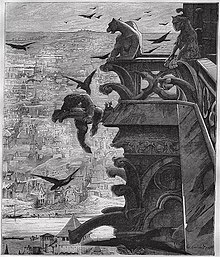
Illustration from Victor Hugo et son temps (1881)
Published in 1831, Notre-Dame de Paris (The Hunchback of Notre-Dame) by Victor Hugo carried with it humanistic themes of the Romantic period such as sympathy for the suffering of the dispossessed, which is common throughout Hugo's writing. Hugo wrote this story, however, to prove the humanistic utility of Gothic architecture.

When Hugo wrote Notre-Dame de Paris, Notre-Dame had its circular colorful stained glass window replaced with clear glass to let in more light. Gargoyles were being removed from their structures. The rapid replacement of the medieval architecture in place of contemporary themes was to Hugo a loss of appreciation for the Gothic side.


Hugo exemplifies Romanticism's reaction to the French Revolution. His father; a general in Napoleon's army, loyal to the new regime. Whereas his mother was loyal to the original monarchy. The conflicting politics eventually led to their separation, leaving Hugo left to decide on his own where he would find meaning as he moved back and forth between parents. He chose to move on and married a childhood friend with whom he had five children.

Throughout his life, Hugo saw both the light and the darkness of humanity. Absolute joy and unforgiving dispair.  Leading him to eloquently articulate both the Gothic mysteries of the unknown and the empathetic compassion for the less fortunate, properly encapsulating Romanticism in its essence.   


Photo Credit: http://paperplanereviews.blogspot.com/2013/06/the-hunchback-of-notre-dame-by-victor.html         

Thursday, October 18, 2018

Jane Eyre

I've loved literature all my life, and as a result of that, I've heard a thing or two about the Bronte sisters. Somehow, however, I've managed to get to this point without reading a single one of their books. I'm excited to amend that. I've heard a great deal about Jane Eyre, and none of the reports really matched each other. I had no idea what to make of it coming into it, and I was surprised to find such effusive love for the novel within five minutes of looking into its significance.

Promotional image for Theatre Royal Plymouth's Jane Eyre
Based on my limited understanding of the plot, it seemed to me that Jane Eyre was another Pride and Prejudice type book with a healthy dose of Gothic style and characteristics. What I did not expect to find was a quote from Virginia Woolf describing the character of Eyre as ".. an overpowering personality... There is in [her] an untamed ferocity perpetually at war with the accepted order of things which makes [her] desire to create instantly rather than to observe patiently." Apparently, one of the most significant writers in history thought that there was more to this novel than it being just another windswept Regency- Era romance.

In fact, the general consensus, even in just a cursory glance of critical opinion on the text, seems to be that Jane Eyre, the book and the character, exude a sense of  'self' that was thrillingly new for the women of the time. While cogito ergo sum and a pursuit of a new rational order had come to the men, this narrative seems to be regarded as one of the first evidences of the concept and drive for individuality coming to women.

I'm excited to be wrong about this book. If a cursory search can yield such thrilling results, what will deeper perusal uncover?  I have a sneaking suspicion that Eyre asks herself a similar question- I look forward to joining her on that journey.

Photo Credit