
I haven't seen the movie for probably ten years now but the parts that intrigued me the most were the creepy demons, the gargoyles, and the dark but incredibly beautiful Notre-Dame Cathedral. I didn't know it, but the mystery of beautiful, gothic, art caught my interest before I knew what I was interested in.
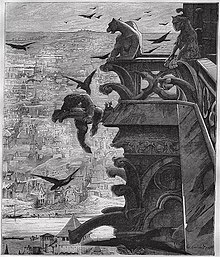 |
| Illustration from Victor Hugo et son temps (1881) |
When Hugo wrote Notre-Dame de Paris, Notre-Dame had its circular colorful stained glass window replaced with clear glass to let in more light. Gargoyles were being removed from their structures. The rapid replacement of the medieval architecture in place of contemporary themes was to Hugo a loss of appreciation for the Gothic side.
Hugo exemplifies Romanticism's reaction to the French Revolution. His father; a general in Napoleon's army, loyal to the new regime. Whereas his mother was loyal to the original monarchy. The conflicting politics eventually led to their separation, leaving Hugo left to decide on his own where he would find meaning as he moved back and forth between parents. He chose to move on and married a childhood friend with whom he had five children.
Throughout his life, Hugo saw both the light and the darkness of humanity. Absolute joy and unforgiving dispair. Leading him to eloquently articulate both the Gothic mysteries of the unknown and the empathetic compassion for the less fortunate, properly encapsulating Romanticism in its essence.
Photo Credit: http://paperplanereviews.blogspot.com/2013/06/the-hunchback-of-notre-dame-by-victor.html
