Showing posts with label bible. Show all posts

Tuesday, May 7, 2019

Sola Scriptura: How Reformers’ Emphasis on Scripture is Mirrored Today

Of all the changes that came about during the Reformation, few compare in impact than the transformation of engagement with the Bible. The transformation can be thought of in three main ways.

John Calvin and the Bible
  • First, the Bible became more accessible. Before the Reformation, the Bible was only found in Latin, which was primarily studied by priests. Consequently, most Catholics had to rely on their priest to be their middle man with God. However, after Martin Luther translated the Bible into German, scripture study became something common Christians could take part in. Individuals “could now read the Bible in their own language… with features intended to help a person read and interpret the Bible for themselves." (Museumofthebible.org)

Monday, November 26, 2018

Plight of the Ordinary Family


Winston Churchill begins his speech by addressing all and then proceeds with using “I.” He uses “I’ to compliment and show respect. He then switches to “we” as a show of solidarity. His voice is powerful, yet not overpowering. He speaks slowly, giving the audience time to take in every word. He pauses when he should, and he gives time for the audience to clap.

                                          Image credit: https://www.flickr.com/photos/45909111

There are several examples of Churchill using alliteration. When he says, “preach what we practice––let us practice what we preach,” he uses both repetition and alliteration. This rhetorical style gets the attention it desires. In that same paragraph, there is “poverty and privation” used. In the last paragraph of the speech, the alliteration is strong: “walk forward in sedate and sober strength seeking….”

Churchill uses a fair amount of metaphors, beginning with those used in his paragraph on the UNO. He says that the UNO is “already at work…that its work is fruitful…that it is a temple of peace…not merely a cockpit in a Tower of Babel.” And that “…we must be certain that our temple is built, not upon the shifting sands or quagmires, but upon a rock.” He continues with “…our path will be difficult and also long….” By quoting from the Bible, he is appealing to religious beliefs. He alludes to religion two other times when he says, “God has willed…” and “In my father’s house are many mansions.”

One of the most powerful paragraphs is a good example of appeal to pathos, with repetition and metaphors added in. In speaking of “the myriad of cottage or apartment homes where the wage-earner strives amid the accidents and difficulties of life…” he describes well their plight: “They must be shielded from two gaunt marauders, war and tyranny. We all know the frightful disturbance in which the ordinary family is plunged when the curse of war swoops down upon the breadwinner….” He shows empathy to the common man by bringing to attention “… the designs of wicked men…aggressive urge of mighty States…humble folk are confronted with difficulties with which they cannot cope.”

He ends with the powerful sentence: “For them is all distorted, all is broken, all is even ground to a pulp.” A visual description of the plight of the common man. 

Wednesday, October 3, 2018

The Garden of Eden Post Reformation

The Adam and Eve narrative has been subjected to several different interpretations that have shaped the way we as humans view ourselves. Ironically, the narrative caused Reformation Christians to argue both for and against humanism.

In the time of The Renaissance and The Reformation, the idea of the divine being was the driver behind humanism. Authority was no longer limited to the sovereign state but extended to the sovereign individual. Men and women had more opportunity at this time in Europe than they had in a very long time. With this opportunity came the ability for mankind to create a value system for themselves and decide the most meaningful actions they could take to justify their suffering.  However, in light of easy access of the Bible, many read the Adam and Eve narrative and seemed to change their mind on the source of suffering and the state of being.

The genesis of man was key to Christian's post Reformation (1600-1700 AD) understanding of the nature of mankind. Their understanding was not in line with the Christian humanists from the beginnings of The Reformation (1400-1600 AD). Due to grossly oversimplified interpretations of the Garden of Eden narrative, the man was no longer a divine being. Mankind was interpreted as misogynistic, evil, and weak because of how people at the time interpreted Genisis. The impact that these interpretations nearly took society back to a feudal system like thinking as Hobbes famously made the argument that mankind desperately needed a strong governing force.

Despite the enlightening influences that came out of The Reformation, it came with its disadvantages. The truth that was meant to set people free, ended up putting them back in the 'evil' box they just escaped.


Image Credit: https://chrislinzey.com/2013/08/01/good-vs-evil/

Friday, September 28, 2018

Same Roots, Different Times


I've got to say this, I really have a soft spot for the Reformation. Maybe it's because people standing up for what they think is right strikes a chord with me, maybe it's because I love the idea of challenging tradition or maybe it's because Dr. Christine Blasey Ford's testimony has the media world currently ablaze. I love when people realize that something is wrong, and that they have power to do something about it.


Traditional Catholic Church
The Reformation was sparked when people started to say, "Hey, I don't need this guy telling me what this scripture means anymore, I've got it right here in my hands." and the more they got into the book that was in their hands they started to say, "Wait a minute, what you're preaching isn't what I'm reading". The further they delved into the scriptures, the more dissonance was realized. Fast forward and jump across the pond to a young fourteen year old boy who is holding that exact same book. He's having the same experience. A classmate of mine shared, "I have noticed in particular how God’s hand played a role in the very details of events transpiring in this time span." And I completely agree (read her blog post here). Another classmate similarly pointed out the parallels between the protestant reformer Martin Luther and Restoration reformer Joseph Smith. He says, "Martin Luther no doubt paved the way for Joseph Smith to do, in his way, the same thing that Luther did: dare to question the churches around him." (read further here)


Back, Forward, & Back Again


Petrarch looked back over his shoulder nearly thirteen centuries to glimpse sight of works that would make mankind wonder and marvel for centuries to come: Cicero’s letters.  This demonstration of ‘ad fontes’ triggered a new perspective of communication.  Somehow, diving back into the past allowed our forefathers to move more quickly forward. 

Letters to Cicero
Petrarch’s discovery didn’t stop there.  He continued to dig deeper into the past and introduced ideals of humanism—that man was capable of great things.  “What a piece of work is man!”  Shakespeare would later exclaim, which is the very sentiment that fueled and sustained a new awareness of communication.

The two letters Petrarch wrote to Cicero were only the beginning; humanism ideals couldn’t be contained to the written word alone.  Artists like Leonardo da Vinci and Michelangelo communicated their ideas and passions through arts, and for others, it was speech.  Castiglione’s The Courtier masterfully illustrates how the Renaissance-theme of sprezzatura shifted the communication-focus to speech. 

"What a Piece of Work is Man"

"What a piece of work is man."
- Shakespeare's Hamlet (Act ii, Scene 2)

As Hamlet gives this famous soliloquy he reflects on both the inspiring and negative sides of the human condition. His deep analysis of the human condition on the level of the individual would not have been discussed without the enlightenment of the secular humanists of The Renaissance, and the Christian influence in The Reformation.

Humanism played a key role in the emergence of both The Renaissance and The Reformation. Although both embraced the ideals that humanism carried, the sources through which they approached their conclusions were different. The Renaissance thinkers took a secular approach as they read from rhetoricians and philosophers of antiquity (Cicero, Plato, Socrates, Isocrates, etc.). However, the pioneers of The Reformation developed their humanistic viewpoint with a realization of the spiritual individual, and through Biblical study.

The Renaissance

With the Black Plague behind them, early thinkers of The Renaissance had the task of re-evaluating the human condition and the meaning of life. These thinkers took it upon themselves to reopen the tomb like libraries filled with manuscripts written in "proper" Latin. Among these writings were the writings of Cicero, and his philosophical interpretations of humanism. Petrarch was one of the most important mouth pieces for Cicero in The Renaissance. People like Petrarch and Quintilian were intrigued by Cicero's articulation of the Latin language and sought to learn everything they could from those writings. This lead to the rebirth of the divine human and the rediscovery of the potential within each being.

The Transition

The early printing of Bibles, lead to experimentation in translation of the Biblical texts. The concept of going back to the sources was engrained in their approach to learning; people like Calvin Beza started printing Bibles with both the Latin text and the original Greek text side by side. The experimentation didn't stop there; despite the Catholic Church's refusal to translate the holy text to "common" language, the humanists wanted to give everyone a chance to live a rich "eloquent" life.

The Reformation

The translation of the Bible into an English printed script tends to take all the credit for The Reformation. There were many individuals who had a strong influence on the movement, but the motivation behind The Reformation stemmed from the original principles written in the Bible. Once the "plowman" was able to read for himself that man was created in the image of God, it made him question what was different between him and the wealthy cardinals. A new wave of humanism stemming from the sacred script was brought to light. These transcendent principles were even more influential than Aristotle, and even more available than any other script written up to that point.

Conclusion

These events are heavy weight-bearing pillars to the great structure we call "Western Civilization".  The Renaissance reintroduced the divine individual through secular Ad Fontes, and The Reformation through spiritual piety. Those of us who enjoy the freedoms of the sovereign individual can thank the great men and women whose works built the foundations where we plant our ensigns of freedom.
"What a piece of work is man."  


Photo Credit:

1. https://sententiaeantiquae.com/2017/05/09/tullys-tuesday-cicero-talks-about-sex/
2. https://commons.wikimedia.org/wiki/File:Christus_(Draft)_by_Thorvaldsen.jpg 


The Printing Press and the Weakening of Catholicism

Microsoft Word
Chodowiecki Basedow Tafel 21 c Z.jpg
History of Printing
I remember the time I first realized as a young child that I could type out words on a computer. I had been an avid reader, and it had never occurred to me that words that I wrote could be printed out and look just like the words that I had read in my books. I no longer would have to hand copy invitations to my friends; I could type everything out one time and each invitation would be identical.


Similarly, with the invention of the printing press came a newfound freedom. Words could now spread throughout the world without the painstaking task of hand-copying. Ideas could take root more firmly and take route faster than ever before.

Martin Luther and the Press 
Martin Luther famously posted his 95 Theses on the door of the Wittenberg Castle Church on October 31, 1517. It is speculated that Luther originally wanted only to make the issues known and that he had no intention of causing such a far-reaching disruption to the Catholic Church. However, as his ideas

Saturday, September 22, 2018

On (Un)civil Dominion: John Wycliffe as an Inspiration

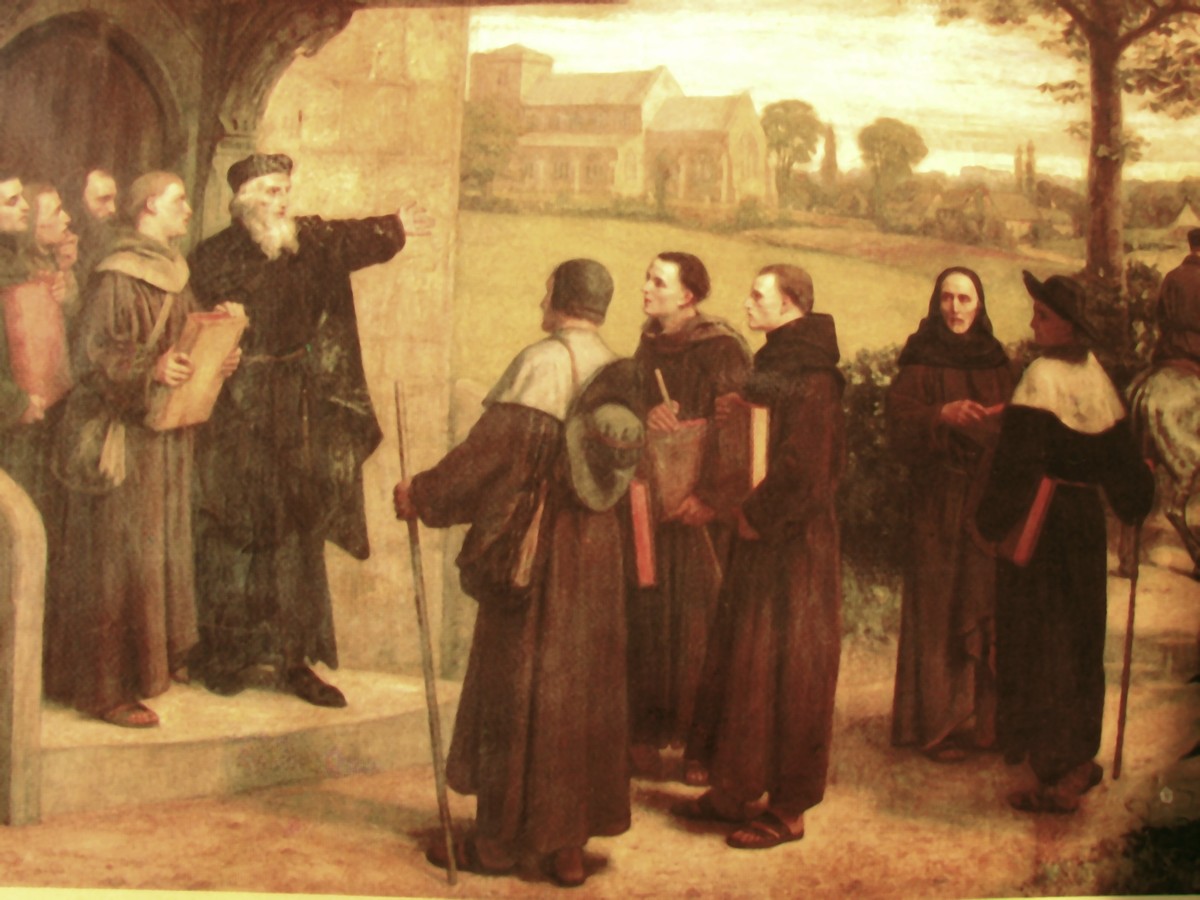
John Wycliffe and his "Lollards"

This can be considered a follow-up to my previous post, scrutinizing the theme of Ad Fontes.

Twenty-Eight Years had passed since the ending of the Black Plague that killed off most of Europe. And in those twenty-eight years John Wycliffe had begun to develop the opinions about the church that would later get him declared a heretic posthumously. The year 1377 would be the first time he would be officially condemned by the Catholic Church, in part due to his book "De civili dominio" ("On Civil Dominion"), which included a set of admonishments stating that the Clergy should hold no property and only use what they needed to survive, essentially becoming more ascetics rather than luxurists. Two years later he would be striking even harder with his work "De ecclesia" ("On the Church") wherein he states that the very concept of Purgatory never existed, and that the issues of clerical celibacy, indulgences and worshiping saints acted as resistance to truly becoming righteous people. The act that he would become most famous for after his death was his English translation of the New Testament, which would serve as the spark required to create outright revolt among the peasant populace.

Perhaps it's a bit farfetched to say, but oddly enough John Wycliffe reminds me of an elderly Joseph Smith. With his efforts in translation, his more ascetic and puritan views on Christianity and the Priesthood and his condemnation by religious and secular entities far greater than him, he seems to share many of the qualities and difficulties Brother Smith encountered in his own life. I cannot help but wonder if the Lord helped John become so popular with the lower classes as to serve as a memetic inspiration for the Prophet's own work. That is to say, that part of the reason people were drawn to the church was because of how similar Joseph's views and teachings were to the rebellious Christians of old. There's a reason, I guess, that John Wycliffe's work is brought up in the Bible Dictionary.

Image Credit - "Wyclif Giving 'The Poor Priests' His Translation of the Bible" obtained via Wikimedia Commons

Words Matter

Starting in the Renaissance and continuing through the Reformation, language played a key role in the development of literature and philosophy. They realized that their version of Latin isn't the one they thought was pure. As language changed, they realized that words change meaning and usage.

Lorenzo Valla was an important philologist of the time who spent his scholarly years study the language of the people. His most notable work is proving that the forged will of Constantine was in fact a fake. He also did research on how to write about things in classical Latin that didn't exist when the "pure" Latin was being used.

As we can see, language is so important in understanding history. As a former English Language major, I spent time in Great Britain and Ireland studying the varieties of English. I learned that language differs from place to place and from year to year (even month to month). Even if the word is familiar, it might mean something different. Most people know that in England when they say "chips" they are referring to what Americans call "fries;" when they say "trolley" they mean "cart" in our speech.

With all this variation, how can we decide what historical texts mean? In school, it might be easy to assume that the professor will tell us exactly what each text means. However, in our personal study of any historical text (such as the Bible), it is important then to go deeper. While reading history for the surface-level meaning can be difficult by itself, its always worth the effort to go deeper. Recently I've been able to do more of this with the Bible (updates to come), and I've been able to see the difference that reading in the correct context, looking for the original meaning truly makes a great difference in the meaning that I get out of it.

Is the KJV for Everyone?

Would it be better for someone to read a simplified version of the Bible and understand it, or to read the King James Version in all its glory and be lost? People have gleaned a lot of spiritual knowledge from the KJV. It is known as the version that is closest in meaning to the original scriptures, so it is probably best for scholars and those who want to closely analyze it. The typical person, though,—even the typical Christian—does not read the Bible often enough to always look at it that closely.
47 scholars worked for years to translate the King James Version of the Bible.

I have never read a version of the Bible other than the KJV. However, in reading the KJV, I’ve realized that I’m often so focused on getting through all the complicated language and sentence structure that I don’t even realize what I’m reading about. I rarely recognize the intricate beauty and rhythm of the passages, because I’m just trying to figure out what’s going on.


Unlike past versions of the Bible, the King James Version includes the English forms of names rather than the Hebrew forms in effort to keep the scriptures popular. Additionally, Jewish commentaries helped to translate the Hebrew literally, rather than into English forms of speaking, and made an effort to keep the same flow the original Hebrew had. This is probably part of what makes the writing in the KJV sound so profound—but also what makes it somewhat difficult to understand.


We start children reading simple books; why not start people new to Christianity on a simplified bible? Leland Ryken points out that the prose in modern interpretations of the bible is flat and lacks the impact that verses in the KJV have. Perhaps we could come up with a modern edition that keeps every meaning the same but simplifies the syntax so any English speaker could understand it, while maintaining the same emphases and rhythm of the KJV. There is certainly modern prose that is beautiful and impactful and easy to understand. Look at the works of Brian Doyle, for example. I wouldn’t mind reading a Bible written by him.

Image obtained from Wikimedia Commons.

Sunday, September 16, 2018

Spiritual Literacy and the Power of Translation

Most people associate the idea of gaining spiritual knowledge on one's own with Martin Luther. But prior to 1515, the year Luther posted his famous 95 Theses, there was popular demand for the word of God. A certain preacher in England named John Wycliffe believed that clergy and layman alike should be exposed directly to the Bible. His followers, known as Lollards, carried scripts of Bibles around the countryside and taught the common people. The best part? Those Bibles were in English! John Wycliffe had translated the Bible during the late 14th century. Bear in mind that this was before Gutenberg's printing press; these Bibles, as had been the case for centuries, were painstakingly written by hand.

But what was so significant about the word of God in common vernacular?

I could probably write another 15 blogposts on the history of Biblical translation, printing, and distribution; I'm passionately interested. But to answer this question, I point instead to a modern
A Nepali family reads the Book of Mormon digitally
 in their native language
example: the translation of the Book of Mormon into Nepali. Just last summer, the Book of Mormon was released in Nepali after seven years of translating. It brought immense joy to Nepali church members; Branch President Ghanashyam Sarki said, "I am so happy the Book of Mormon will finally be translated to Nepali. With the translation, I can help others to understand and appreciate the Book of Mormon. ... It will help us to know the truth." To empathize with President Sarki, I look back on my own life to when I began to read the word of God with a sufficient understanding of the language. Indeed, I found truth, and every other facet of my life has hinged upon it. The impact of "spiritual literacy" has been immeasurable.

In short, breaking down the barriers of language allows us to access knowledge-- both spiritual and temporal. The old adage "knowledge is power" only applies when we meet linguistic criteria. Wycliffe and countless others have understood this-- and put everything on the line because of it.


Image credit: Valerie Johnson, 2017.
 https://www.lds.org/church/news/celebration-commemorates-translation-of-the-book-of-mormon-into-nepali?lang=eng  

Saturday, September 15, 2018

Erasmus and the Restoration


Desiderius Erasmus. Who was he and what was his contribution during the Renaissance?  He was a Dutch humanist who is known to be one of the greatest scholars of the northern Renaissance.  He is most widely known to have laid the foundation for the common man to be able to access the Bible.  At this time, the Bible was only made available to those who could read Latin which was mainly the wealthy and learned.  However, Erasmus changed the course of history when he published the first New Testament in Greek called Novum Instrumentum omne. This was a critical moment, because it allowed both old and young, rich and poor, learned and unlearned to be able to access the teachings found inside of it. 

This was a step that members of the Church of Jesus Christ of Latter-day Saints understand was crucial in the restoration of the gospel.  After the death of Christ, many doctrines and teachings were lost, and they became inaccessible to much of the world.  In order for God’s children to be saved, they would need to understand His teachings, found in the Holy Bible.  

Joseph Smith, the prophet of the Restoration of the gospel, was a young farm boy who lived in the early 1800s.  Many believe that he is the answer to a prophecy of William Tyndale who said “I will cause a boy that driveth the plow, shall know more of the Scripture than thou dost,” referring to the pope.  Joseph Smith did have full and complete access to the Bible, and was able to call upon heaven to fully disseminate its teachings. So, some may argue, Tyndale was correct in his prophecy.  

Without the contributions of Erasmus hundreds of years previously, Joseph would not have been able to seek inspiration in the bible.  After all, he was just a young farm boy.  Members of The Church of Jesus Christ of Latter-day Saints owe much to the early pioneers, like Erasmus, who paved the way for a more accessible bible. 

Does Increased Availability Always Mean Decreased Value?

A book printed by the Gutenberg printing press
The printing press is easily one of the most influential inventions of the renaissance, if not of all time. It allowed for works to be copied quickly and distributed to people so that for the first time, regular people had access to information that was typically only shared with religious leadership or the socially elite. The printing press allowed for new ideas to be spread quickly, and it leveled the playing field by giving access to printed materials to everyone. Fast forward to today, thanks to the printing press, the internet, smart phones and a plethora of other inventions, we quite literally have huge libraries of information at our fingertips. If someone wants to know something now, they don't even have to type it out, they just ask Siri or Alexa.

The line outside the Supreme story in New York City
Over the summer I took a class on persuasion. In that class we discussed several different techniques to persuade people to buy things, see our opinions or just straight up convince them of something. We discussed the principle of scarcity in terms of purchasing. The principle of scarcity goes something like this: The less there is of something, the more people want it.  The brand Supreme, is successful because they only make a certain amount of clothing items when they release a new collection. People wait in line for hours before the store opens just to get in their to purchase an overpriced t-shirt, that no one else will have. It's madness and total brilliance.

If value is increased by how inaccessible something is, that must mean value decreases as accessibility goes up. After the printing press, information became accessible, and it has only gotten increasingly more accessible with the inventions mentioned previously in the last 30 years or so. Information is everywhere. There were men and women who died in order for us to have access to certain information. So here's my question, if we want something to be highly valued, is the best way to do it making it scarce? To take this further, do you feel that some things are less valuable because they are so easy to get to and if so how can we reverse that to see their importance and value?

image credit: Book https://www.dkfindout.com/uk/more-find-out/special-events/how-is-book-made/
image credit: Supreme NY store lineup https://www.highsnobiety.com/2015/08/20/supreme-fall-winter-2015-new-york-line-up/