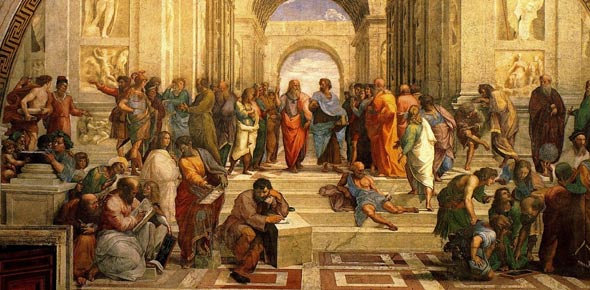
Showing posts with label renaissance vs. reformation. Show all posts

Friday, September 28, 2018

"What a Piece of Work is Man"

"What a piece of work is man."
- Shakespeare's Hamlet (Act ii, Scene 2)

As Hamlet gives this famous soliloquy he reflects on both the inspiring and negative sides of the human condition. His deep analysis of the human condition on the level of the individual would not have been discussed without the enlightenment of the secular humanists of The Renaissance, and the Christian influence in The Reformation.

Humanism played a key role in the emergence of both The Renaissance and The Reformation. Although both embraced the ideals that humanism carried, the sources through which they approached their conclusions were different. The Renaissance thinkers took a secular approach as they read from rhetoricians and philosophers of antiquity (Cicero, Plato, Socrates, Isocrates, etc.). However, the pioneers of The Reformation developed their humanistic viewpoint with a realization of the spiritual individual, and through Biblical study.

The Renaissance

With the Black Plague behind them, early thinkers of The Renaissance had the task of re-evaluating the human condition and the meaning of life. These thinkers took it upon themselves to reopen the tomb like libraries filled with manuscripts written in "proper" Latin. Among these writings were the writings of Cicero, and his philosophical interpretations of humanism. Petrarch was one of the most important mouth pieces for Cicero in The Renaissance. People like Petrarch and Quintilian were intrigued by Cicero's articulation of the Latin language and sought to learn everything they could from those writings. This lead to the rebirth of the divine human and the rediscovery of the potential within each being.

The Transition

The early printing of Bibles, lead to experimentation in translation of the Biblical texts. The concept of going back to the sources was engrained in their approach to learning; people like Calvin Beza started printing Bibles with both the Latin text and the original Greek text side by side. The experimentation didn't stop there; despite the Catholic Church's refusal to translate the holy text to "common" language, the humanists wanted to give everyone a chance to live a rich "eloquent" life.

The Reformation

The translation of the Bible into an English printed script tends to take all the credit for The Reformation. There were many individuals who had a strong influence on the movement, but the motivation behind The Reformation stemmed from the original principles written in the Bible. Once the "plowman" was able to read for himself that man was created in the image of God, it made him question what was different between him and the wealthy cardinals. A new wave of humanism stemming from the sacred script was brought to light. These transcendent principles were even more influential than Aristotle, and even more available than any other script written up to that point.

Conclusion

These events are heavy weight-bearing pillars to the great structure we call "Western Civilization".  The Renaissance reintroduced the divine individual through secular Ad Fontes, and The Reformation through spiritual piety. Those of us who enjoy the freedoms of the sovereign individual can thank the great men and women whose works built the foundations where we plant our ensigns of freedom.
"What a piece of work is man."  


Photo Credit:

1. https://sententiaeantiquae.com/2017/05/09/tullys-tuesday-cicero-talks-about-sex/
2. https://commons.wikimedia.org/wiki/File:Christus_(Draft)_by_Thorvaldsen.jpg 


From Cicero to Protestantism, The Renaissance and Reformation

Using the titles Reformation and Renaissance to describe periods of history often gives a misrepresentation of the facts, as many assume that they happened as isolated events. In reality, the Protestant Reformation occurred within the larger framework of the Renaissance and was a really a product of its time, with a few key differences that set it apart from the rest of the Renaissance.

Click!
Erasmus, one of the most
influential Humanists
The Renaissance period was a time of rediscovery and growth that created an environment in which a movement like the Reformation would be possible. One of the central ideas of the Renaissance, "ad fontes" or a return to the original material, would influence a core tenant of the Reformation, "sola scriptura" (only scripture). This was the belief that there was not a need for priests because people could turn to the source material, the Bible. For Renaissance Humanists in particular the idea of returning to the source material was vital as they rediscovered Ancient Greek and Latin authors like Cicero and Plato, who helped them realize the full potential of the Latin language and how much power language could have when rhetoric is used . Likewise, as people like Martin Luther saw a disconnect between the Catholic Church and the teachings of the bible, they too sought a return to the source.


Along with a rediscovery of the ancients, came a rediscovery of mankind. The Catholic Church's interpretation of the Bible had led people in the middle ages to conclude that this life was to be endured and that the body was corrupted. These ideas were challenged when Renaissance authors rediscovered Greco-Roman tradition, which glorified the body and the feats of man. Men like Petrarch and Erasmus were profoundly influenced by this and there was a fundamental shift as people began to focus more on this life as a sense of individualism and pride in one's work grew. Cried Shakespeare through his play "What a piece of Work is Man!" and Giovanni Mirandola writes in his Oration on the Dignity of Man
Man's Place in the universe is somewhere between the beasts and the angels, but because of the divine image planted in him, there are no limits as to what man can accomplish...

Thursday, September 27, 2018

You Can't Have One Without The Other: Renaissance and Reformation

Often times we speak of the Renaissance and Reformation periods hand in hand, sometimes as if they were the same. However, I believe that if we are to truly understand the evolution of humanity and understand how modern society came to be, it is crucial to understand the distinction between these two periods.

Related image
1) The Renaissance: a time of learning and intellectual growth
The principle idea that I believe describes the Renaissance period is that of “Sprezzatura.” The nonchalance, intellect, and wittiness of one who demonstrates Sprezzatura is a defining factor of the Renaissance because it is the embodiment of the cultural change that occurred during this period. As was stated by Cherileigh in her blog post called "Bach's Got Sprezz?"(link below), we learn that sprezzatura applies to any time period and any situation, so long as it increases the intellect or status of those involved. While the Dark Ages were a time of spiritual obscurity and unbelief in the worthiness of man, the succeeding  Renaissance was the rebirth of the idea of the divinity of man and the importance of intellectual growth. I say rebirth because this humanistic idea of the divinity of man was not brand new. One of many examples of this idea is the Ancient Roman belief in the potential of man. Thanks to Ad Fontes (going back to the sources), the Renaissance facilitated the rebirth of the belief in the good that man has within him. Sprezzatura was demonstrated in the Renaissance as people actively sought to grow intellectually. If only putting on a fake face of intelligence, people began to seek out learning to be viewed as elite and knowledgeable.

Related image
2) Martin Luther driving the Reformation 
This “sprezzaturic” culture of open mindedness and an interest in learning opened the door for the Reformation to take place. The Reformation could not have taken place without the Renaissance first having occurred because of the need for open-minded people who might be willing to go against the grain of societal culture. Up until this point, humanity believed that intellect was directly associated with being among the elite of society. But as all desired to improve themselves, it became apparent that within religion there was not equality in opportunity, and only the elite had the ability to come closer to God. Opposition against the Catholic church resulted in individuals such as Martin Luther stepping forward to break down the barrier that had been built in society. 

The open-mindedness that occurred in the Renaissance period resulted in the ability for the Reformation to take hold in the hearts and minds of truth seekers. No longer was spiritual learning only something that was available for the elite, but for all. That same open-mindedness allowed the invention of the printing press to take hold, and further break down the barriers that hindered the lower classes.

Image result for plowing fields
3) The plower was historically a
lower rank in society
An example of the change in perspective that occurred between the Renaissance and Reformation periods can be seen in a comparison of the Sermon of John Colet and the Sermon of Hugh Latimer. Although both men address the issue of spirituality and obedience, Colet writes pre-Reformation, addressing the clergy (elite) using proper language and a meticulously structured argument, demonstrating Sprezzatura and intellectual adeptness. On the other hand, Latimer writes post-Reformation and directs his words to the common man, using a metaphor of a plower. Although both spoke on the same topic, there was a difference in both men’s views as to who was worthy to hear their words. Stephen Rackleff's blog post called "Martin Luther and Anti-Materialism" (link below) makes a great point about the view of man's worthiness during the Reformation period as he explains that Luther was a humanist in that all people were worthy to learn, regardless of status or material things.

The Renaissance and the Reformation periods are similar due to the dramatic growth and social change that occurred in each of them. However, they are also very different because of the manner in which the social change occurred. But regardless of their differences, it is clear that one could not have occurred without the other.

Cherileigh's "Bach's Got Sprezz?"https://rhetciv.blogspot.com/2018/09/bachs-got-sprezz.html?showComment=1537848876951#c4070184762700641662

Stephen Rackleff's "Martin Luther and Anti- Materialism" https://rhetciv.blogspot.com/2018/09/martin-luther-and-anti-materialism.html?showComment=1537411135234#c7846465948698898239

Images:
1) http://www.italymagazine.com/featured-story/renaissance-part-5-art
2) http://www.ripr.org/post/brown-university-historian-martin-luthers-legacy-and-reformation#stream/0
3) https://library.calvin.edu/hda/node/7860