Showing posts with label reformation. Show all posts

Monday, October 7, 2019

Psychology of Humanism

I’ve always been fascinated by the concept of “nature versus nurture,” and how we are shaped by and shape our culture. Examining movements such as the Renaissance through the lens of psychology yields some interesting ideas about how exactly changes in prevailing ideologies shape the future. 

photo by "Pere" on flickr (text added) 
According to Freud’s model of the mind, our consciousness is divided into 2 parts: the conscious mind and the subconscious mind. The conscious mind takes up only 10 percent; and our much larger subconscious is a blank slate when we are born. Throughout our lifetime, that slate is filled with patterns derived from our conscious thought and knowledge absorbed from others and the environment. Since the subconscious mind is 90% of our overall mind, whatever is in our subconscious forms our character, which then determines what we will accomplish in life.


The strong influence of external stimuli on the development of the subconscious means that changes in general attitudes, ideals, or prevailing wisdom (the “environment”) have significant impacts on the character, and therefore the actions and achievements, of individuals living in those times. The Renaissance and Reformation were absolutely crammed with such changes to the intellectual environment, and the rise of Humanism specifically may have altered attitudes about human nature and influenced the general psyche in a way that was key to later development and progress.

One of the fundamental tenets of Renaissance Humanism, as expressed by Petrarch, is that God gave humans intellectual and creative potential that was meant to be used. Humanism in that era also emphasized the responsibility of humans in developing themselves and promoting the race as a whole. Finally, as part of the “ad fontes” movement, the ancient Greek concept of Eudaimonia was probably becoming prominent, convincing people that the search for and creation of happiness and well-being was an important purpose of life. The spread of these ideologies would have significantly impacted the minds and characters of those who learned them, especially younger people whose subconscious minds were still being filled and developed.

Consider the impact this type of teaching would have on a person, in contrast with the previously dominant church doctrines. Rather than being told their individual life didn’t matter and salvation in the next life is the only thing for which they had to hope and work, someone growing up in the high Renaissance would start to internalize feelings of self-worth and agency. During the Reformation, things got even better: rather than the dogma that having wealth is a sin, Calvinists taught that material prosperity is evidence of God’s favor, motivating people to work hard and advance themselves financially.

In a discussion during the salon activity about how Renaissance and Reformation ideologies laid the foundation for the spectacular economic growth of later centuries, Joe pointed out how, in many cases, it’s not circumstances that change our mindset but rather our mindset that allows us to change our circumstances. I think the rise of Humanism during the Renaissance is a history-altering example of this. Humanism changed people, and people changed the world.


Sources:


https://en.wikipedia.org/wiki/Petrarch

https://en.wikipedia.org/wiki/Humanism#Humanistic_psychology

Image: https://www.flickr.com/photos/pere/523019984


Friday, October 4, 2019

Art and Religion: where the falling angel meets the rising ape

The 14th and 15th centuries may have been the birthplace of philosophical, scientific, and religious innovation and discovery, but when we think of the Renaissance, the first thing that comes to mind for most people will always be the art. And for good reason—of all the brave new worlds opened in the Renaissance, the world of art was at the forefront; was part and parcel of a heady new worldview. The art of the Renaissance encapsulates everything that the period was.

We can see this in the way art changed from the medieval era: the expression of humanism in a renewed appreciation for the beauty of the human form; the Renaissance emphasis on verisimilitude reflecting a broader shift in a society newly enamoured of observation, of critical thinking. Where medieval art was symbol, Renaissance art was a representation of reality as it was seen. A manifestation of a pattern, found throughout the Renaissance, of intellectual openness and honesty. A desire to look at the world, to think for oneself. The same curiosity, observation, criticism, would give birth not just to painting and sculpture, but to the Protestant Reformation.

Form vs. Content: A Tale of Translation

Lutherbibel.jpg
Original copy of Luther's translated Bible - 1534

Language and communication in the sixteenth and seventeenth century were paramount in shaping the beliefs of the people and the overall social climate. For the first time, religious and secular texts were made available to the masses as a result of the printing press. Translation efforts made these texts available to even more people, changing communication and learning completely. Being a dual-language speaker myself, I was particularly interested in the role that translation played during this era, and how the people responded to that role. What kind of texts were being translated? How common was translation? What problems arose from such translation? 

Power to the People: How Humanism Prompted Martin Luther's Success


Martin Luther once said: “I am more afraid of my own heart than of the pope and all his cardinals. I have within me the great pope, Self.”

I have always wondered what allowed Martin Luther to be as successful as he was. He made bold statements against an institution that seemed to be untouchable, and still managed to reform one of the biggest powers of the time period with only, as Luther calls it, Self.

As I was discussing with my friends Bella and Fay on Tuesday, we considered the effect individualism (an importance Renaissance ideal) had on the Reformation. One thing that was said during the conversation really stood out to me: 

The Necessity of Individualism


Despite claims that individualism leads to narcissism and is an overall menace to society, individualism can be seen to have profound positive effects throughout history particularly during the Reformation, as well as the Renaissance.

A recent article in the New York times, titled “The Age of Individualism”, explains that because of individualism, our country and our world will eventually become a disaster of self-absorbed individuals only concerned with trivial, self-centered things.

However, the Reformation and Renaissance are clear indicators of what happens when a society turns to individualism. The society flourishes. Without individualism, there would be no-one standing up to age-old theories, accepted as absolute truth and successfully prohibiting any forward progression. In his journal article about religion and modern individualism, Herbert Butterfield explains, “The individual must be able to confront the tyranny of majorities, the prejudices of prevailing culture, and the dominating spirit of the age itself.” This is why individualism is needed. Personal ideas and convictions were recognized by our predecessors as something that needed to be shared and addressed, especially if it went against what was popular and accepted at the time.

It was mentioned in one of my discussions that individualism was the reason that Martin Luther experienced success in his fight for religious reform. Martin Luther is celebrated throughout the world for the courage he had to “oppose the dominating spirit of the age itself.”  Without individualism inspired by Renaissance humanism, the Reformation could be a very different story. Without the few who believed strongly in humanism and the individuals potential to be moral and good, the higher powers against change would have destroyed the Reformation before it even really began.

I’m sure, much like individualism is presented today, some in the reformation viewed Luther as an extremist, a fanatic, someone so blinded by their own ideas and ideals that they were past reason and actually detrimental to the good of everyone around them. People feared individualism because they knew it would bring change. Their solution? Persecution.  However, despite the animosity and violence they experienced, reformers endured, bringing the world all kinds of new religious and social possibilities.

Individualism continued to change society. It encouraged Thomas Moore to write about brave new worlds that could lead to literal new worlds. It was what allowed plough boys to receive bibles of their own and Shakespeare to become a theatrical genius, despite his poverty. America itself was born from ideas created by individualistic minds during the enlightenment. That is why we continue to need individuals who celebrate individualism, who have enough conviction in their own ideas and ideals to do something about it. And through that, we can continue to change the world for the better.


Friday, September 20, 2019

A Modern Reformation

Have you thought recently about the reformation? I mean the 21st century one. That’s right, there’s another religious reformation going on! This reformation shares many parallels with its predecessor. Just as many devout Christians sought to better reconnect with God in the Protestant reformation, so are many millennials striving to understand God in innovative ways today.


(Girl: freerange stock, Luther: Wikimedia commons, photo editing by Emma Crisp)

Friday, September 13, 2019

Poor Moe Q. McGlutch Loved Control Too Much

Tyrants since the beginning of time have attempted to limit people’s knowledge. From Mao Zedong’s book burnings to Caligula banning The Odyssey for its themes of freedom, restriction of knowledge in the form of restricting books and reading has always been an important tool for those who have power and want to keep it as it is.


In Renaissance-era Europe, the Catholic Church played the role of that kind of organization. It’s difficult for us to comprehend the sort of system of religion that encompassed Europe during the Renaissance. But imagine, for a minute, being unable to read the scriptures for yourself. You aren’t one of the lucky ones who have been educated. If you want to know what God says, the way He wants you to live your life, you have to rely on your bishop to tell you. And you haven’t got any way to check for yourself, you just have to trust that what he says is right. In addition, everyone around you believes exactly what you do-- including the leaders of your country.


Tuesday, May 7, 2019

Testament: A Look into Motivations that Spurred the Reformation


In Martin Luther's writing, Babylonian Captivity of the Church, Luther references the account of the last supper that is given in the Bible. One of the reasons given of the why the existing practices of the Catholic Church were incorrect–particularly selling indulgences–was explained by looking into the meaning of a "testament," more specifically, the "new testament" represented by the cup in the last supper.

Luther stated, "Christ, who is the truth, truly says that this is the new testament in his blood, [...] Thus, if we inquire what a testament is, we shall learn at the same time what the mass is, what its right use and blessing, and what its wrong use." 

The Bible can be viewed as a Will and Testament of Jesus Christ
As I read this, I was struck by the connection made to the word "testament" as it is generally used. A testament states the desires of a person before their death of the distribution of their estate. It usually consists of certain properties being promised to certain individuals; it is also common for these promises to have prerequisites: the heir(s) to the estate must fulfill certain requirements to inherit the promised property. 

The Butterfly Effect of the Printing Press

The Butterfly Effect is the theory that everything is conditional upon something else and small occurrences can result in massive occurrences. We may not always know the cause of such massive occurrences, but they're there. The term "the butterfly effect" suggests that something as massive as a tornado or a hurricane could have been started from the smallest wind coming from a butterfly's wings, therefore suggesting that nothing is an accident and everything has a stimulus.


Sacred Things: Literature in Light of the Reformation

The Reformers' Views on Literature

Photo by Syd Wachs on Unsplash
In 1523, the father of the Protestant Movement, Martin Luther, wrote a letter to a friend to congratulate him on a well-written poem. Luther remarked that the only thing he wanted for the youth of his religious movement was education in literary arts, ultimately vowing “that there should be as many poets and rhetoricians as possible, because I see clearly that by no other methods is it possible to train men for the apt understanding . . . and felicitous treatment of sacred things.” Luther believed that art should be used to understand the sacred, rejecting the Catholic church’s tendency to replace the sacred with iconoclastic art pieces. Rhetorically, art's purpose was to bring the audience to a greater understanding of God.

Examples of Faith from the Reformation

The Reformation was a time of religious upheaval all across Europe. When Martin Luther nailed his 95 thesis on the church “bulletin board” in 1517, he could never have foreseen the vast effect his action would have on the whole of Europe, and the entire world. At first the Catholic church reacted by somewhat candidly writing up their “Consilium de Emendanda Ecclesia,” outlining some things they recognized as needing reform. It turned out that it wasn’t enough, and people began breaking away from the Catholic church and practicing Lutheranism and other protestant faiths. Protestants were calling out for a more authentic, personal sort of worship, and a direct learning of the Word of God by individuals. The effects were wide spread and in many cases, like that of one of my ancestors, immensely life changing, as some were forced to choose between their home countries and their faith.

Sola Scriptura: How Reformers’ Emphasis on Scripture is Mirrored Today

Of all the changes that came about during the Reformation, few compare in impact than the transformation of engagement with the Bible. The transformation can be thought of in three main ways.

John Calvin and the Bible
  • First, the Bible became more accessible. Before the Reformation, the Bible was only found in Latin, which was primarily studied by priests. Consequently, most Catholics had to rely on their priest to be their middle man with God. However, after Martin Luther translated the Bible into German, scripture study became something common Christians could take part in. Individuals “could now read the Bible in their own language… with features intended to help a person read and interpret the Bible for themselves." (Museumofthebible.org)

Thursday, December 13, 2018

The One-Sided Contracts of the Music Industry

By: Jared Van Leeuwen

Even though the music industry has improved regarding its treatment of recording artists, it still has a long ways to go.


I have loved music for as long as I can remember. As a child, my parents would always listen to the biggest hits of Journey, Bon Jovi, Queen, The Beatles, and other classic rock bands while I was finding out about the music of Avril Lavigne and Kelly Clarkson on my own. As I got older and found out that I could sing, I realized that I wanted to make music just like them a
nd that is still what I'm pursuing to this day.


However, I came to find out that the music industry isn't exactly what I had hoped it would be as a kid. My searches led me to articles and interviews where Kelly Clarkson talked about the fights she had with her record label regarding her music and career. I read post after post and listened to multiple podcasts where people talked about how the music industry interfered with their life and basically stabbed them in the back. I have also seen plenty of articles, especially recently, about artists saying that their labels are giving them more creative control or that they have gone completely independent. Truly, there is a shift taking place in the music industry that is starting to better favor the artist. However, even though the music industry has improved regarding its treatment of recording artists, it still has a long ways to go.

Wednesday, December 5, 2018

The ancient beginnings of public relations


West facade of the Parthenon, Athens, 5th century BCE
When you hear the words public relations, what comes to your mind?  For many people, they know what it is in a general sense, but can’t quite find the words to define it.  I saw this firsthand when I told others that I was accepted into the public relations program.  At first, they were very excited for me, but then I would watch as a puzzled look came over their faces where they would then ask me, “now what exactly is public relations?”  

Wednesday, October 3, 2018

The Garden of Eden Post Reformation

The Adam and Eve narrative has been subjected to several different interpretations that have shaped the way we as humans view ourselves. Ironically, the narrative caused Reformation Christians to argue both for and against humanism.

In the time of The Renaissance and The Reformation, the idea of the divine being was the driver behind humanism. Authority was no longer limited to the sovereign state but extended to the sovereign individual. Men and women had more opportunity at this time in Europe than they had in a very long time. With this opportunity came the ability for mankind to create a value system for themselves and decide the most meaningful actions they could take to justify their suffering.  However, in light of easy access of the Bible, many read the Adam and Eve narrative and seemed to change their mind on the source of suffering and the state of being.

The genesis of man was key to Christian's post Reformation (1600-1700 AD) understanding of the nature of mankind. Their understanding was not in line with the Christian humanists from the beginnings of The Reformation (1400-1600 AD). Due to grossly oversimplified interpretations of the Garden of Eden narrative, the man was no longer a divine being. Mankind was interpreted as misogynistic, evil, and weak because of how people at the time interpreted Genisis. The impact that these interpretations nearly took society back to a feudal system like thinking as Hobbes famously made the argument that mankind desperately needed a strong governing force.

Despite the enlightening influences that came out of The Reformation, it came with its disadvantages. The truth that was meant to set people free, ended up putting them back in the 'evil' box they just escaped.


Image Credit: https://chrislinzey.com/2013/08/01/good-vs-evil/

Friday, September 28, 2018

Audiences Shift

Happiness vs. Utilitarianism
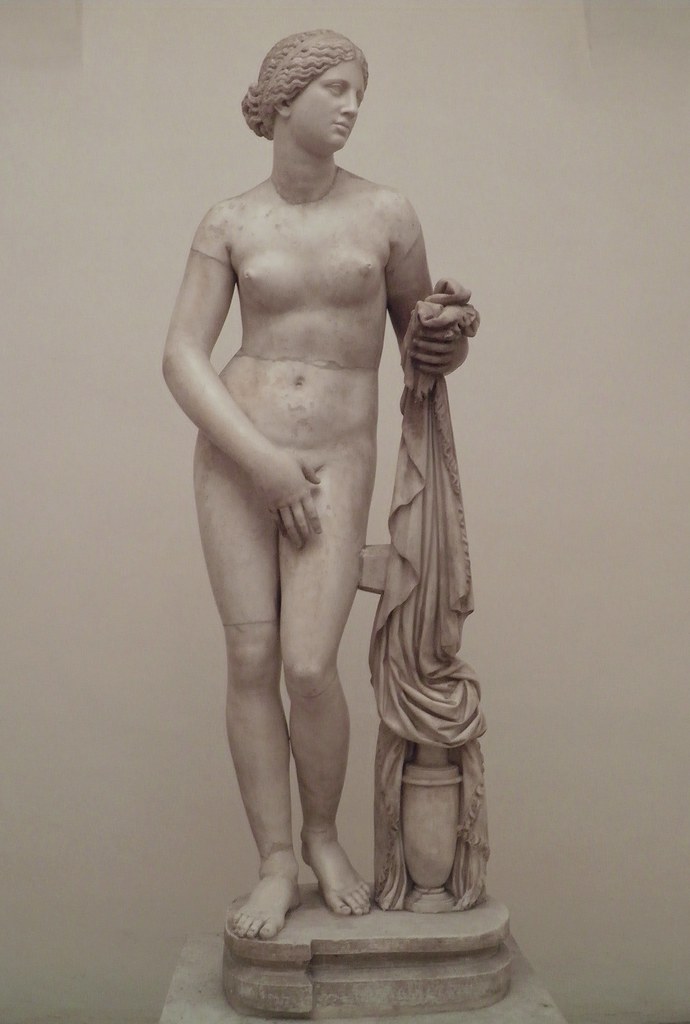
Praxiteles's Aphrodite of Knidos, a
Classical celebration of human form.
“Of all things the measure is Man, of the things that are, that they are, and of the things that are not, that they are not." Here, Protagoras is is basically saying "Man is the measure of all things." A Classical philosopher, he taught that every individual had their own version of the truth—that truth was relative to the person perceiving it. Protagoras taught people to appreciate the individual and the wide array of perspectives people have. To him, humans are not only greater than the beasts of the earth and the angels in the heavens, but higher than truth itself.

This heavily contradicts the beliefs of pre-Renaissance Christianity. The general belief during that period was that people were fallen souls and had to live by the Church’s rules to have a chance at having any worth and getting to heaven. People in anything lower than the upper class were thought of and treated like tools, made to work constantly in a feudalistic society. In any class, though, the Catholic church was law, and any education or art centered around it.

Plato, on the other hand, believed that eudamonia, happiness, was the highest goal of thinking. A fellow philosopher, Cicero also considered the individual variations within his audiences and shaped his persuasive techniques accordingly. He recognized that some people were not educated or willing enough to be persuaded by logic alone and decided it was okay to use emotion as a persuader with those audiences. As Somer discusses in her post, speakers and artists must always take the audience into consideration.

Back, Forward, & Back Again


Petrarch looked back over his shoulder nearly thirteen centuries to glimpse sight of works that would make mankind wonder and marvel for centuries to come: Cicero’s letters.  This demonstration of ‘ad fontes’ triggered a new perspective of communication.  Somehow, diving back into the past allowed our forefathers to move more quickly forward. 

Letters to Cicero
Petrarch’s discovery didn’t stop there.  He continued to dig deeper into the past and introduced ideals of humanism—that man was capable of great things.  “What a piece of work is man!”  Shakespeare would later exclaim, which is the very sentiment that fueled and sustained a new awareness of communication.

The two letters Petrarch wrote to Cicero were only the beginning; humanism ideals couldn’t be contained to the written word alone.  Artists like Leonardo da Vinci and Michelangelo communicated their ideas and passions through arts, and for others, it was speech.  Castiglione’s The Courtier masterfully illustrates how the Renaissance-theme of sprezzatura shifted the communication-focus to speech. 

"This is My Work and My Glory"

“For behold, this is my work and my glory – to bring to pass the immortality and eternal life of man.”  This scripture is found in the book of Moses where God reveals his grand purpose for His children.  While studying the Renaissance and Reformation, I have noticed in particular how God’s hand played a role in the very details of events transpiring in this time span. Throughout the 14th – 17th century and then later in the 19th century when the gospel of Jesus Christ was brought back to the earth in what we know as the restoration.  

The restoration of the gospel was happening long before the spring of 1820.  Elder Bruce R. McConkie (1915–85) of the Quorum of the Twelve Apostles taught, “Beginning in the 14th century, the Lord began to prepare those social, educational, religious, economic, and governmental conditions under which he could more easily restore the gospel for the last time among men.” 

To Be Human: Renaissance v.s. Reformation

Throughout history, people have had many different ideas about what it means to be human. During the Dark Ages, the view commonly held by people was that man was evil by nature and incapable of being saved or doing good all on their own, at least that's what their priests and bishops were preaching to them. Basically, their "only chance of getting back to Heaven was in and through the Church" (https://rhetciv.blogspot.com/2018/09/the-worth-of-souls-in-renaissance.html).


In contrast, when the Renaissance came around during the 14th century, it brought with it a much more positive view of mankind. "The idea was that man could become more than what he was," he had the potential to exceed and become great in anything he set his mind to (https://rhetciv.blogspot.com/2018/09/what-piece-of-work.html). This new perspective allowed the men and women of the Renaissance to be more confident and to develop their talents in the fields of art, science, rhetoric, etc.

"What a Piece of Work is Man"

"What a piece of work is man."
- Shakespeare's Hamlet (Act ii, Scene 2)

As Hamlet gives this famous soliloquy he reflects on both the inspiring and negative sides of the human condition. His deep analysis of the human condition on the level of the individual would not have been discussed without the enlightenment of the secular humanists of The Renaissance, and the Christian influence in The Reformation.

Humanism played a key role in the emergence of both The Renaissance and The Reformation. Although both embraced the ideals that humanism carried, the sources through which they approached their conclusions were different. The Renaissance thinkers took a secular approach as they read from rhetoricians and philosophers of antiquity (Cicero, Plato, Socrates, Isocrates, etc.). However, the pioneers of The Reformation developed their humanistic viewpoint with a realization of the spiritual individual, and through Biblical study.

The Renaissance

With the Black Plague behind them, early thinkers of The Renaissance had the task of re-evaluating the human condition and the meaning of life. These thinkers took it upon themselves to reopen the tomb like libraries filled with manuscripts written in "proper" Latin. Among these writings were the writings of Cicero, and his philosophical interpretations of humanism. Petrarch was one of the most important mouth pieces for Cicero in The Renaissance. People like Petrarch and Quintilian were intrigued by Cicero's articulation of the Latin language and sought to learn everything they could from those writings. This lead to the rebirth of the divine human and the rediscovery of the potential within each being.

The Transition

The early printing of Bibles, lead to experimentation in translation of the Biblical texts. The concept of going back to the sources was engrained in their approach to learning; people like Calvin Beza started printing Bibles with both the Latin text and the original Greek text side by side. The experimentation didn't stop there; despite the Catholic Church's refusal to translate the holy text to "common" language, the humanists wanted to give everyone a chance to live a rich "eloquent" life.

The Reformation

The translation of the Bible into an English printed script tends to take all the credit for The Reformation. There were many individuals who had a strong influence on the movement, but the motivation behind The Reformation stemmed from the original principles written in the Bible. Once the "plowman" was able to read for himself that man was created in the image of God, it made him question what was different between him and the wealthy cardinals. A new wave of humanism stemming from the sacred script was brought to light. These transcendent principles were even more influential than Aristotle, and even more available than any other script written up to that point.

Conclusion

These events are heavy weight-bearing pillars to the great structure we call "Western Civilization".  The Renaissance reintroduced the divine individual through secular Ad Fontes, and The Reformation through spiritual piety. Those of us who enjoy the freedoms of the sovereign individual can thank the great men and women whose works built the foundations where we plant our ensigns of freedom.
"What a piece of work is man."  


Photo Credit:

1. https://sententiaeantiquae.com/2017/05/09/tullys-tuesday-cicero-talks-about-sex/
2. https://commons.wikimedia.org/wiki/File:Christus_(Draft)_by_Thorvaldsen.jpg