Showing posts with label communication. Show all posts

Tuesday, December 11, 2018

ESA: Species Savior

by Haley Brown

The stakes are high when it comes to conserving the earth's biodiversity; is the Endangered Species Act up to the task?


bird wing looking wildlife beak eagle fauna bird of prey bald eagle vertebrate alaska falcon buzzard inflight bif kachemakbay andymorffew morffew naturethroughthelens baldeagle accipitriformes
The bald eagle is one of the ESA's success stories.
The Endangered Species Act (ESA) is generally considered to be a positive program. A poll from 2015 showed that 90% of Americans support it. Since Richard Nixon passed it in 1973, the act has aimed to prevent animal and plant species from going extinct due to human interference.

Ecologists agree that legislation to conserve biodiversity is necessary—each species plays a unique role in its ecosystem, so the loss of any can be detrimental. However, ecologists disagree on the ESA's efficacy. Currently over 2000 species are on the list of endangered and threatened species covered by the act. 99% of species on the list are still around, which some see as a success. However, critics are more focused on the mere 1% of those that have been recovered and removed from the list. So how should we measure the ESA's success? With the condition the earth is in now and all the destruction humans have inflicted upon our natural neighbors, the ESA's success can really only be judged justly by the species it has kept from extinction.

The Tightrope Walk of Internet Censorship

by Isaac Smith

It is vital that we avoid the temptation to combine law enforcement and media censorship under the banner "internet freedom," 

Image result for defeat of islamic state
Just yesterday marked the one-year anniversary of the "full liberation" of Iraqi territory from the Islamic State. For more than three years, the terrorist regime oppressed large parts of Syria and Iraq, carrying out public executions and often publishing videos of them on social media.
The Islamic State's use of the internet to spread extremist propaganda in various ways has raised important questions about how information on the internet is or ought to be regulated. 

Monday, December 3, 2018

Hot Spots in Public Relations

Are public relations specialists even necessary?
  • Many companies are beginning to mange their own public affairs by utilizing the skills of already existing employees rather than hiring a PR firm.  In doing this, a company can save $10k+ a month, so in some instances, it does make sense.  There has been a decline in the necessity of public relations professionals in the workplace in the last few years, because the job responsibilities of a PR specialist align closely with that of a marketer or advertiser. https://www.forbes.com/sites/neilstclair/2015/03/05/why-you-should-almost-never-pay-for-pr/#64e8e8fe1c35 
Do I really need a degree in public relations to work in the field?
  • With how closely public relations is related to marketing, advertising, communications, etc. is it really even necessary to get a degree in public relations to work in the field?  Or could a degree in one of these neighboring fields be enough to get your foot in the door?  Not to mention, the future of public relations is in social media, so who is to say that someone who is extremely business smart and savvy with social media couldn't do just as good of a job as a college graduate with a public relations degree?                https://www.thebalancecareers.com/media-industry-jobs-you-can-get-without-a-degree-4023960
Greater varieties of communication platforms
  • The increase in communication platforms can be seen as a way to get more information out to the public and reach more specific audiences, but when it comes to PR, it can be extremely difficult to determine which platform to use.  As the platforms increase in number, so does the research and time into making sure it is the correct medium for the correct audience. 

Of these controversies in public relations, the one that has me feeling the most passionate, is the first one regarding the necessity of specialists in general.  I will be graduating with a public relations degree next spring, so understanding the likelihood of me getting placed in the workplace is foremost on my mind. 

Wednesday, October 3, 2018

Hands-On Anatomy


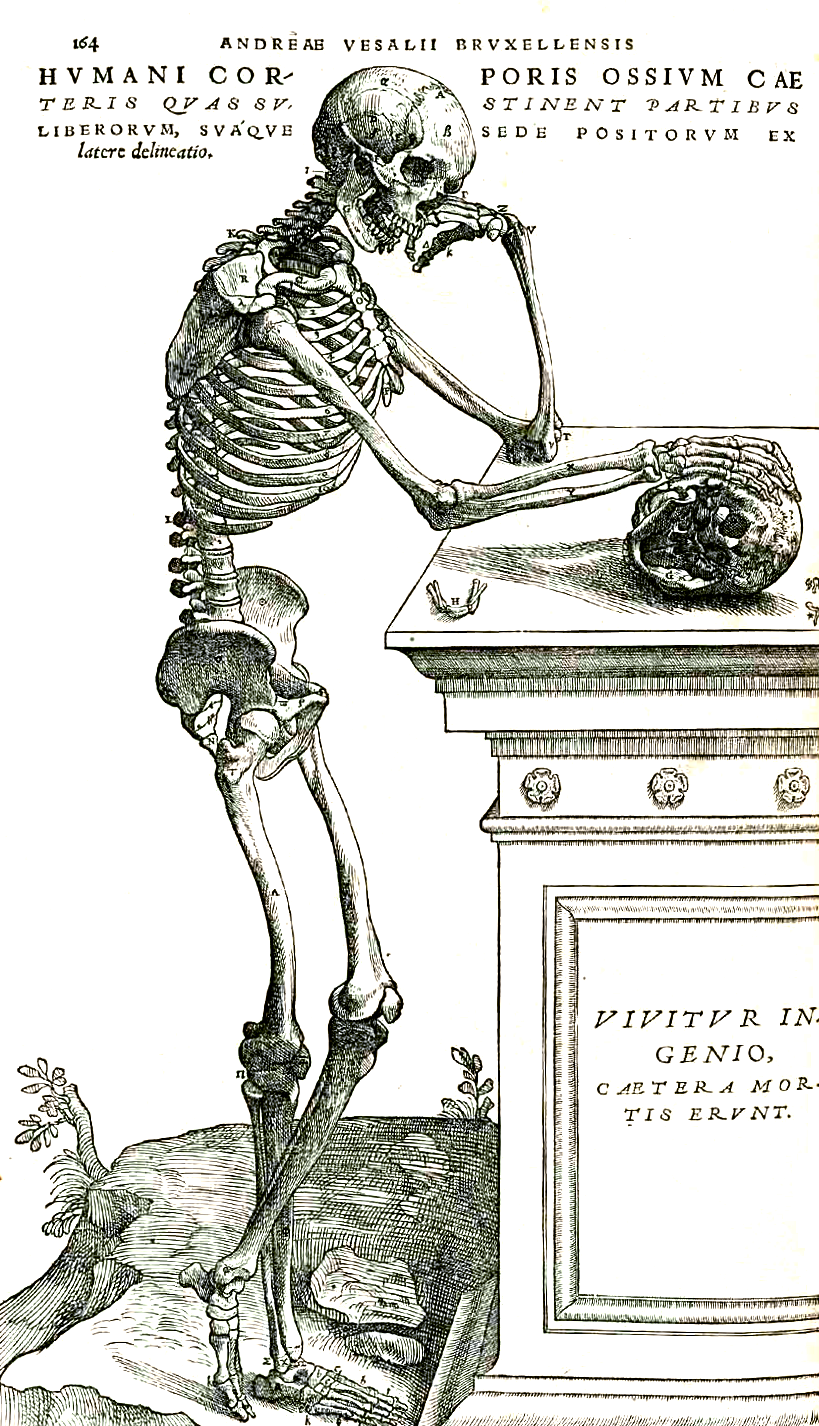
Vesalius had the models in his book
posing in picturesque environments.
We go to the doctor assuming our physicians know the difference between human and dog anatomy. However, that was not always necessarily the case. Into the 16th century, surgeons would teach their pupils about human anatomy by reading them the texts of Galen, a Greek physician in the second century. Physicians rarely if ever dissected human cadavers themselves; they learned anatomy from Galen's 1300-year-old texts, while Galen himself had never dissected a human cadaver due to religious restrictions.
Andreas Vesalius, a 16th-century physician, had a different approach. He dissected animal corpses, but he also dissected human cadavers and studied them extensively. To communicate (and show off) his knowledge, Vesalius wrote the Seven Books on the Fabric of the Human Body, commonly known as the Fabrica.

In the Fabrica, he included detailed descriptions and woodcuts of every layer of the body, from bones to nerves. Vesalius worked with commissioned artists to depict anatomy from multiple previously unseen perspectives. His goal was to clearly communicate the details of human anatomy to physicians and students. The Fabrica was so successful, cadaver dissections began to be more common. 

Friday, September 28, 2018

How Mediums and Rhetoric Shaped the Renaissance

We witness changes in communication today at the very localized level. For example, the way I speak to my friends now is very different from the way I would if I had never been exposed to cell phones and the internet. Between texting and conversing via tagging each other in Facebook memes, today’s social interface hardly resembles that of the Renaissance. While forms of communication in the Renaissance Era is fairly difficult to track there are certain factors and events that can indicate changes in trends.

Image result for printing press gutenberg
Caxton showing specimens of his printing to King Edward
Medium:

One such event was the birth of the printing press. With tools like computers, we take the magic of printing for granted. The printing press allowed print to be faster and less costly, causing a spike in the availability of the written word.

Arguably one of the most adept users of the new medium of communication was Martin Luther. His 95 Theses were not the only things he published. He wrote and published many short sermons and pamphlets. These were cheap and short enough that someone could have it read to them if they didn’t know how to read themselves. Luther was a genius who recognized quickly how printing could help him spread his ideas.

Even if the information that was published wasn’t accurate, it’s accessibility gave more people who wouldn’t normally read the option to do so. With more people reading, more people were talking about what they had read and learned.

This led to discussion and debates at Saoirse’s and the birth of the idea of “sprezzatura”, which described a certain wit, sophistication, and eloquence of speaking at these gatherings. An example of the accomplishments of one who possessed this can be found here.

Discussion in the public square acquired a different flavor when the Protestant Reformation took hold. Because open discussion was now the norm, people began to publicly critique, criticize, and even protest against aspects of the Catholic Church.

Back, Forward, & Back Again


Petrarch looked back over his shoulder nearly thirteen centuries to glimpse sight of works that would make mankind wonder and marvel for centuries to come: Cicero’s letters.  This demonstration of ‘ad fontes’ triggered a new perspective of communication.  Somehow, diving back into the past allowed our forefathers to move more quickly forward. 

Letters to Cicero
Petrarch’s discovery didn’t stop there.  He continued to dig deeper into the past and introduced ideals of humanism—that man was capable of great things.  “What a piece of work is man!”  Shakespeare would later exclaim, which is the very sentiment that fueled and sustained a new awareness of communication.

The two letters Petrarch wrote to Cicero were only the beginning; humanism ideals couldn’t be contained to the written word alone.  Artists like Leonardo da Vinci and Michelangelo communicated their ideas and passions through arts, and for others, it was speech.  Castiglione’s The Courtier masterfully illustrates how the Renaissance-theme of sprezzatura shifted the communication-focus to speech. 

The Printing Press and the Weakening of Catholicism

Microsoft Word
Chodowiecki Basedow Tafel 21 c Z.jpg
History of Printing
I remember the time I first realized as a young child that I could type out words on a computer. I had been an avid reader, and it had never occurred to me that words that I wrote could be printed out and look just like the words that I had read in my books. I no longer would have to hand copy invitations to my friends; I could type everything out one time and each invitation would be identical.


Similarly, with the invention of the printing press came a newfound freedom. Words could now spread throughout the world without the painstaking task of hand-copying. Ideas could take root more firmly and take route faster than ever before.

Martin Luther and the Press 
Martin Luther famously posted his 95 Theses on the door of the Wittenberg Castle Church on October 31, 1517. It is speculated that Luther originally wanted only to make the issues known and that he had no intention of causing such a far-reaching disruption to the Catholic Church. However, as his ideas