Showing posts with label Catholicism. Show all posts

Friday, September 28, 2018

Same Roots, Different Times


I've got to say this, I really have a soft spot for the Reformation. Maybe it's because people standing up for what they think is right strikes a chord with me, maybe it's because I love the idea of challenging tradition or maybe it's because Dr. Christine Blasey Ford's testimony has the media world currently ablaze. I love when people realize that something is wrong, and that they have power to do something about it.


Traditional Catholic Church
The Reformation was sparked when people started to say, "Hey, I don't need this guy telling me what this scripture means anymore, I've got it right here in my hands." and the more they got into the book that was in their hands they started to say, "Wait a minute, what you're preaching isn't what I'm reading". The further they delved into the scriptures, the more dissonance was realized. Fast forward and jump across the pond to a young fourteen year old boy who is holding that exact same book. He's having the same experience. A classmate of mine shared, "I have noticed in particular how God’s hand played a role in the very details of events transpiring in this time span." And I completely agree (read her blog post here). Another classmate similarly pointed out the parallels between the protestant reformer Martin Luther and Restoration reformer Joseph Smith. He says, "Martin Luther no doubt paved the way for Joseph Smith to do, in his way, the same thing that Luther did: dare to question the churches around him." (read further here)


On progress within the Common Man's written world

A Gift from that God who watches over us

On Progress Within the Renaissance Man's Written World

Before the advent of the Printing Press within the 15th century, the average man was largely reduced to the spoken word, as he was not literate, and even if for some odd reason he was there were almost no books for him to read. Only the local clergy as well as collegiates had the knowledge and resources to be able to read and study anything in any capacity. With Johannes Gutenberg's invention of such around 1439, however, several drastic shift began, the most greatest of which are the heightening of literacy in the general public and the reduction of trust placed on the Clergy as the representatives for the people in the eyes of God.

The Printing Press and the Weakening of Catholicism

Microsoft Word
Chodowiecki Basedow Tafel 21 c Z.jpg
History of Printing
I remember the time I first realized as a young child that I could type out words on a computer. I had been an avid reader, and it had never occurred to me that words that I wrote could be printed out and look just like the words that I had read in my books. I no longer would have to hand copy invitations to my friends; I could type everything out one time and each invitation would be identical.


Similarly, with the invention of the printing press came a newfound freedom. Words could now spread throughout the world without the painstaking task of hand-copying. Ideas could take root more firmly and take route faster than ever before.

Martin Luther and the Press 
Martin Luther famously posted his 95 Theses on the door of the Wittenberg Castle Church on October 31, 1517. It is speculated that Luther originally wanted only to make the issues known and that he had no intention of causing such a far-reaching disruption to the Catholic Church. However, as his ideas

Saturday, September 22, 2018

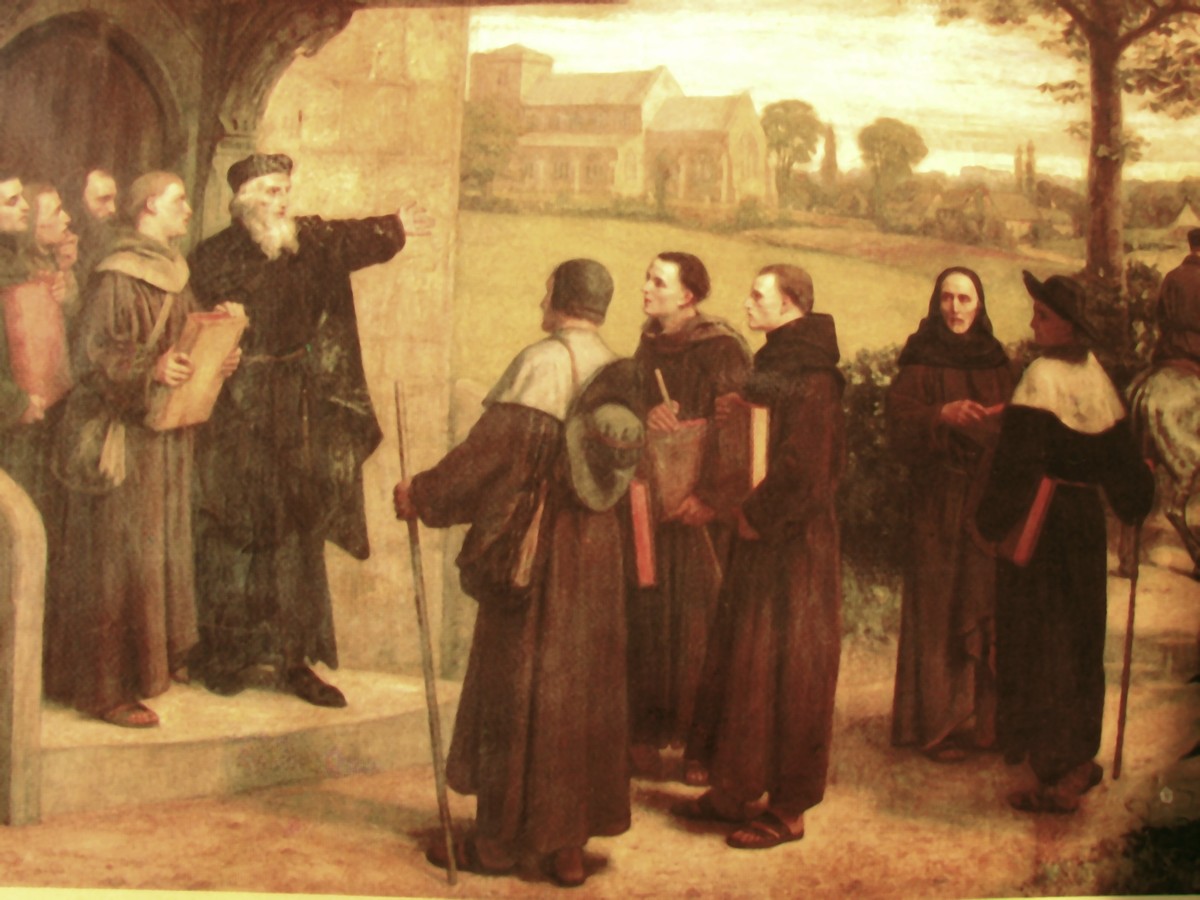
On (Un)civil Dominion: John Wycliffe as an Inspiration

John Wycliffe and his "Lollards"

This can be considered a follow-up to my previous post, scrutinizing the theme of Ad Fontes.

Twenty-Eight Years had passed since the ending of the Black Plague that killed off most of Europe. And in those twenty-eight years John Wycliffe had begun to develop the opinions about the church that would later get him declared a heretic posthumously. The year 1377 would be the first time he would be officially condemned by the Catholic Church, in part due to his book "De civili dominio" ("On Civil Dominion"), which included a set of admonishments stating that the Clergy should hold no property and only use what they needed to survive, essentially becoming more ascetics rather than luxurists. Two years later he would be striking even harder with his work "De ecclesia" ("On the Church") wherein he states that the very concept of Purgatory never existed, and that the issues of clerical celibacy, indulgences and worshiping saints acted as resistance to truly becoming righteous people. The act that he would become most famous for after his death was his English translation of the New Testament, which would serve as the spark required to create outright revolt among the peasant populace.

Perhaps it's a bit farfetched to say, but oddly enough John Wycliffe reminds me of an elderly Joseph Smith. With his efforts in translation, his more ascetic and puritan views on Christianity and the Priesthood and his condemnation by religious and secular entities far greater than him, he seems to share many of the qualities and difficulties Brother Smith encountered in his own life. I cannot help but wonder if the Lord helped John become so popular with the lower classes as to serve as a memetic inspiration for the Prophet's own work. That is to say, that part of the reason people were drawn to the church was because of how similar Joseph's views and teachings were to the rebellious Christians of old. There's a reason, I guess, that John Wycliffe's work is brought up in the Bible Dictionary.

Image Credit - "Wyclif Giving 'The Poor Priests' His Translation of the Bible" obtained via Wikimedia Commons

Wednesday, September 19, 2018

Riding Westward

Last year I took a class on the history of British literature. We ended up in a lot of interesting texts and poems during the course, but my favorite place that we landed was the metaphysical poetry of John Donne. Metaphysical poetry is interesting in that it's a sort of manifestation of the Renaissance spirit. It can be appreciated on the surface level for it's beauty and skill, but also included in the lines are references to a wide variety of sources. John Donne, for example, liked to call upon not only religious images, but also scientific and philosophical themes.

John Donne had a rough life. He was born a Roman Catholic in a time in England where that was illegal. He married the woman he loved in secret, and was thrown in jail for it. When he was released, he dealt with the deaths of several of his twelve children and eventually his dear wife, all while struggling financially.

On top of everything, he was 'encouraged' by the king to abandon his religion and become an Anglican priest, which, of course, he did. All through this, he wrote. Early on, he wrote some pretty bawdy stuff. But later, when the trouble hit, his poetry shows a deep commitment to his faith, to his God, whatever trappings the world may have put on Him.

"Hence is't, that I am carryed towards the West/
This day when my Soules forme bends toward the East." 
My favorite poem by John Donne is called Good Friday, 1613, Riding Westward. Due to the metaphysical nature of the poem, I can't say that I understand everything  Donne is trying to say to me. But I understand the feeling. He talks about how, on Good Friday, a day when all Christian hearts move eastward to the cross, he's facing the wrong direction. He goes on to wonder how anyone could bear to face eastward to see the Lord's suffering, finishing with a supplication to God for strength to be able to look on His face.

The Renaissance and Reformation was a time of "riding westward". It was a time of forging ahead into a new day all the while concerned that something important was being left behind. Donne speaks to that beautifully with a particular poignancy, having been Catholic and pressed forward by the movement of the time.

In the end though, the main reason I like John Donne so much has nothing to do with his profound eloquence or his remarkable ability to layer several meanings in a single line. Set aside the unique perspective and poetic brilliance and you see a man. A very human, very real man, trying his best in a world that hasn't done much for him.

Photo Credit

Saturday, September 15, 2018

To Live in the Shadow of a Giant... Spender: Pope Adrian VI

The Little Man Himself, Adrian

Note: This can be considered a follow-up to my previous post about Pope Leo X, found here.

Of the few virtues people consider universal, charity is high up on the list. However, another one that few people ever think of, or apply to their lives, is frugality. And indeed, from the beginning of his time in the Papacy to the very end of it, this was an issue that Pope Adrian VI had to deal with. Having to serve as the successor to the infamously burning wallet that was Pope Leo X, Adrian found himself with all of the mess and none of the benefits his predecessor enjoyed. To mix up a famous quote: "He was the pope they needed, not the pope they wanted." The reason for such was his extreme efforts to restore the Catholic Church to it's former economic position. To do so required numerous spending cuts, which the Cardinals and other Catholic officials did not like in the slightest due to the luxury they immersed themselves in during the time of Leo's reign.

To say that I see myself in Adrian's shoes is an understatement. He was truly a holy man, (as well as a miser, but still a holy one) surrounded by people who would spend lavish amounts of currency for new robes. Almost all my life I have done my best to hold on to every penny I touch, whether that be by buying new shoes on clearance, not spending a dime of my summer allowance in order to buy a game I wanted later, or even skipping meals so that my semester budget doesn't go overboard. Meanwhile I look around me and people are searching to buy the newest gadget, the clothes that are in fashion, the shoes whose adornments match their hair. Pope Adrian is the type of person I would look up to in this world, one who is frugal, quiet and truly believes in the things he preaches and does. I sincerely hope that this man is happy in the next world.

Image Credit: "Pope Adrian VI" (public domain images via Wikimedia Commons)

Fluidity Within Christianity

Martin Luther and the 95 Theses
When Martin Luther posted his 95 Theses to the door of the Wittenberg Castle Church, he probably had no idea about the influence that this would have on Christianity.

Luther became disgruntled with the Catholic Church and many of their teachings, particularly those saying that to be able to be saved one needed to purchase indulgences for themselves and their loved ones and that both faith and works were needed to enter the kingdom of God (Luther believed only faith was needed). Theories promote the idea that Luther posted his 95 Theses not in an act of total defiance, but rather to set up debates and discussions he was planning to have later on. Nonetheless, the ideas he presented caught fire and spread throughout the world. Luther's ideas paved the way for Protestantism, and many Christian denominations began to sprout from the broken roots of the Catholic Church. 
                                 Image result for martin luther 95 theses

Religion Today
I served a mission for the Church of Jesus Christ of Latter-day Saints in North Carolina, which is one of the states in an area known as the "Bible Belt." When my plane touched down in Charlotte, I was immediately surprised at the number of churches standing throughout the city. It seemed to me that there were more churches than there were office buildings and homes combined! What especially struck me was peoples' viewpoints on religion. I met several people who had moved in from another city and were in search of a new church. Although the individual may have been a Presbyterian in their old city, they were completely willing to switch to another denomination, such as: Baptist, Methodist, Latter-day Saint, Episcopalian, Moravian, etc. They would go from church to church until they found a pastor they liked. The pastor (not the religion) mattered because different teachings were presented even within those churches claiming to be from the same denomination. The fluidity of Christian denominations today stands in stark contrast to religion before Luther's time.

Image Credit: www.history.com

Wednesday, September 12, 2018

The Sun is a Mass of... Something: The Discus of Copernicus

"His diagram of arrangement of the planets"

Before Galileo Galilei ever rose to eminence, there was Copernicus. Born of merchant parents in Poland, the polylinguist (that is to say, one who has learned many languages) studied in Krakow, where he studied the arts and first developed his theory of a heliocentric universe. A heliocentric universe is one where the sun is placed at the center of the solar system, and thus at the time the universe, with the Earth and other planets rotating around it. At the time, this was almost (or perhaps not so almost) heretical to suggest, as the popular theory of the time was that the Earth was at the center of the universe, with the Sun and the other planets rotating around it. In 1532 he finished his work and manuscript, but he refused to publish the paper at the time, due to his worry of people deriding his work thanks to it's radical and difficult hypotheses. It wasn't until a year before his death in 1543 from paralysis that he gave the manuscript to his good friend the Bishop of Chelmno to be published in Nuremburg, Germany.

A couple of the hypotheses his statement that the Earth does not just rotate, but also tilt; and that any movement we believe the stars perform is instead merely due to the movement of the Earth around it's axis and the Sun. This also contradicted the beliefs of the time because the Terracentric model believed that the Stars rotate around the Earth, as everything else did. While this was quite an outside-the-box theory for the scholars at the time, it wasn't until 60 years later that the Catholic Church took any major interest, and thus action, against the theory. Perhaps he was justified in his worry then, as while he died of illness, it would be his more famous successor Galileo who would have to deal with the brunt of the Church's scorn.

Image Credits: "Copernicus - the Heliocentric Solar System" (public domain images via Wikimedia Commons

Saturday, September 8, 2018

Papal Patronage: Leo's Luxuries

Known for his cheerful disposition (and his spending of the Church's coffers), Pope Leo X is an interesting figure within the period known as the Renaissance. Simultaneously a genuine holy man, a luxurist and a politician, Leo has become a controversial figure in this modern era. The most infamous reason, of course, was his excessive spending. Two years of his papacy had led to every florin and ducato that his predecessor Julius II had ever obtained vanishing into thin air. His own personal income would make most company CEO's jealous, with a recorded income of 580,000 ducats one year, which translates into the modern US dollar as 102.5 million. When finally realizing how quickly money was going down the drain, he resorted to such measures as selling the robes and hats of cardinals, pawning off items of the church and even statues of the apostles themselves. It is hardly surprising, then, that his successor Pope Adrian VI became known as a severe penny pincher.

The Benefits?
Just because he spent enormous sums of money does not mean he did no good. In 1513 he reformed the University of Rome such that all of the faculties which had been shut down due to budget cuts were restored, all of the professors teaching there had their pay increased as well as hiring teachers from across the continent. His donations helped establish the first Greek printing-presses within Rome, and he gave stable jobs within the clergy to important artists and poets at the time, the most famous of whom being Raphael. He donated millions of modern dollars annually to hospitals, war veterans as well as many other sick and inflicted. The highest salaries paid at that time were given to Musicians to lend their voice (or their instrument) to the Church Choir, and it was under his guidance that the common folk, regardless of language, could join the Choir in song.

Regardless of whether or not he was truly a hedonist as some accused him of being, Leo was a significant factor in the development of music and other arts during his time.