Showing posts with label Church of Jesus Christ of Latter-day Saints. Show all posts

Friday, September 28, 2018

Same Roots, Different Times


I've got to say this, I really have a soft spot for the Reformation. Maybe it's because people standing up for what they think is right strikes a chord with me, maybe it's because I love the idea of challenging tradition or maybe it's because Dr. Christine Blasey Ford's testimony has the media world currently ablaze. I love when people realize that something is wrong, and that they have power to do something about it.


Traditional Catholic Church
The Reformation was sparked when people started to say, "Hey, I don't need this guy telling me what this scripture means anymore, I've got it right here in my hands." and the more they got into the book that was in their hands they started to say, "Wait a minute, what you're preaching isn't what I'm reading". The further they delved into the scriptures, the more dissonance was realized. Fast forward and jump across the pond to a young fourteen year old boy who is holding that exact same book. He's having the same experience. A classmate of mine shared, "I have noticed in particular how God’s hand played a role in the very details of events transpiring in this time span." And I completely agree (read her blog post here). Another classmate similarly pointed out the parallels between the protestant reformer Martin Luther and Restoration reformer Joseph Smith. He says, "Martin Luther no doubt paved the way for Joseph Smith to do, in his way, the same thing that Luther did: dare to question the churches around him." (read further here)


(Un)plain Jane: A Legacy of Rhetoric and Faith

Our discussions in class and our readings regarding the Reformation have mostly focused on the personal religious expressions displayed in sermons, theses, etc. by disgruntled men with religious authority. However, as a lady myself, I must ask the question; where the ladies at??


Though the role of a woman was often muted on the subject of religious uprisings and formations of new institutions during the Reformation, there were several contributions made to the world of rhetoric by the women, albeit they were often only granted publishing opportunity because of their social or political status. Nonetheless, there is some fascinating literature by these Reformation women that add to the concept of freedom to personal religious devotion and that ultimately influenced the type of relationship Latter-day Saints seek with God in the restored Church. 


Jane's Rhetoric of Adversity and Faith


Lady Jane Grey experienced an incredibly difficult life when she was forced (beaten) into marrying some duke of somewhere when her cousin Edward VI didn’t want to marry her, forced to the position of successor to her cousin King Edward VI after his death, and forced to the execution block for accepting (unwillingly) that position which her cousin Mary believed was rightfully hers and revolted for. Cue awkward family reunions…


However, the legacy of rhetoric that Lady Jane Grey is too beautiful to overlook. This written prayer of hers titled “A Certain Prayer of the Lady Jane in the Time of Her Trouble” speaks profoundly of her spiritual maturity (by the way, she was only 15 when she was executed): “I, being defiled with sin, encumbered with afflictions, unquieted with troubles, wrapped in cares, overwhelmed with miseries, vexed with temptation, and grievously tormented with the long imprisonment of this vile mass of clay, my sinful body, do come unto Thee, O merciful Saviour, craving Thy mercy and help, without the which so little hope of deliverance is left, that I may utterly despair of my liberty.”


Jane & Joseph: Under the Same Divine Pavilion


This excerpt from Lady Jane Grey reminds me of another well-known declaration of faith in the Church of Jesus Christ: “O God, where art thou? And where is the pavilion that covereth thy hiding place? How long shall thy hand be stayed, and thine eye, yea thy pure eye, behold from the eternal heavens the wrongs of thy people and of thy servants, and thine ear be penetrated with their cries? Yea, O Lord, how long shall they suffer these wrongs and unlawful oppressions, before thine heart shall be softened toward them, and thy bowels be moved with compassion toward them? let thine ear be inclined; let thine heart be softened, and thy bowels moved with compassion toward us."


This scripture from Doctrine and Covenants section 121 is a plea from Joseph Smith when he is imprisoned in liberty jail. Similar to Lady Jane Grey, in their adversity they only had faith, a concept that Christian Rounds and Peter Cables both described in their blogs: “ I may not live to see all of my questions answered either, but I can[…]proceed with what I do have: Faith.


The rhetorical legacy of Lady Jane Grey and her written relationship with God is only a small part of the profound influence that the Reformation era concept of Christian humanism had on the restoration of The Church of Jesus Christ of Latter-day Saints.

Image Credit: Lady Jane Grey (Public domain image via WikiCommons)


Saturday, September 22, 2018

On (Un)civil Dominion: John Wycliffe as an Inspiration

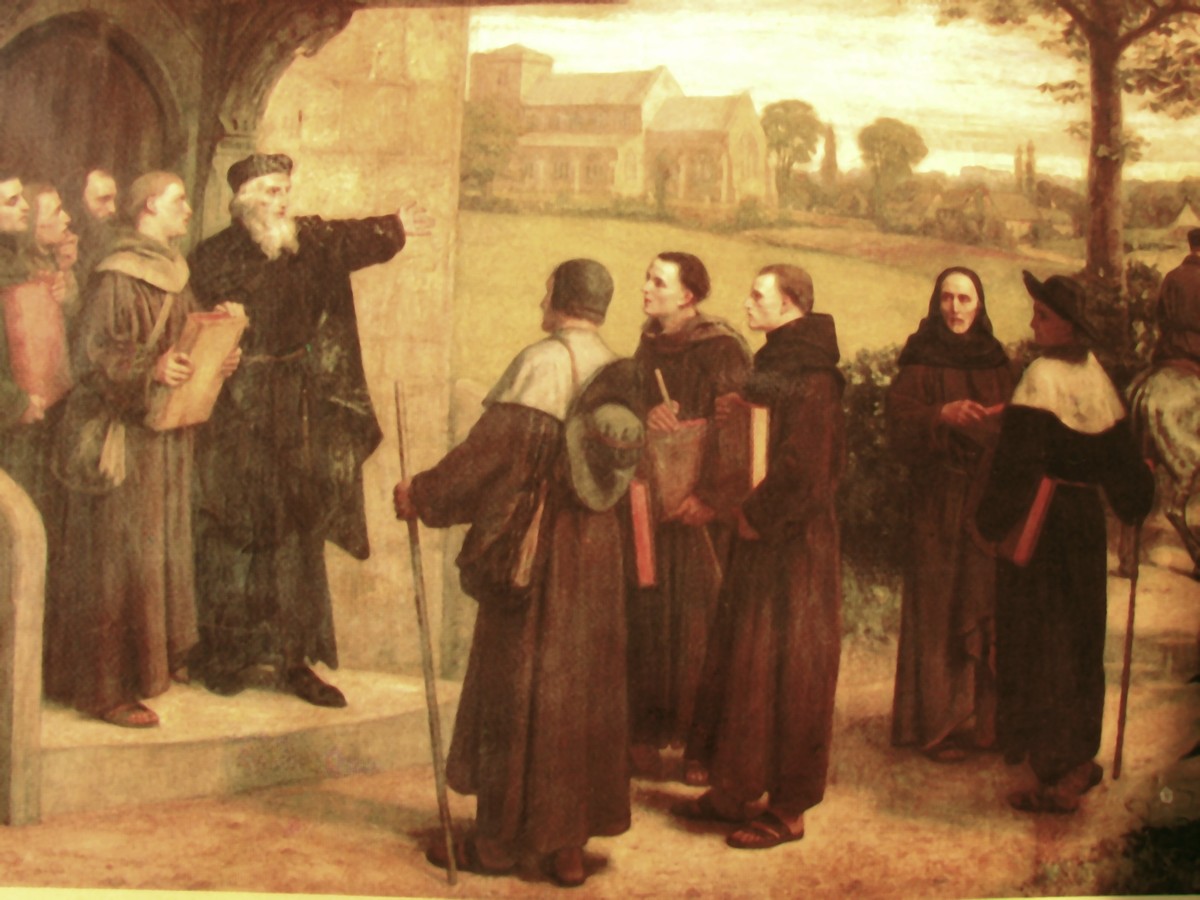
John Wycliffe and his "Lollards"

This can be considered a follow-up to my previous post, scrutinizing the theme of Ad Fontes.

Twenty-Eight Years had passed since the ending of the Black Plague that killed off most of Europe. And in those twenty-eight years John Wycliffe had begun to develop the opinions about the church that would later get him declared a heretic posthumously. The year 1377 would be the first time he would be officially condemned by the Catholic Church, in part due to his book "De civili dominio" ("On Civil Dominion"), which included a set of admonishments stating that the Clergy should hold no property and only use what they needed to survive, essentially becoming more ascetics rather than luxurists. Two years later he would be striking even harder with his work "De ecclesia" ("On the Church") wherein he states that the very concept of Purgatory never existed, and that the issues of clerical celibacy, indulgences and worshiping saints acted as resistance to truly becoming righteous people. The act that he would become most famous for after his death was his English translation of the New Testament, which would serve as the spark required to create outright revolt among the peasant populace.

Perhaps it's a bit farfetched to say, but oddly enough John Wycliffe reminds me of an elderly Joseph Smith. With his efforts in translation, his more ascetic and puritan views on Christianity and the Priesthood and his condemnation by religious and secular entities far greater than him, he seems to share many of the qualities and difficulties Brother Smith encountered in his own life. I cannot help but wonder if the Lord helped John become so popular with the lower classes as to serve as a memetic inspiration for the Prophet's own work. That is to say, that part of the reason people were drawn to the church was because of how similar Joseph's views and teachings were to the rebellious Christians of old. There's a reason, I guess, that John Wycliffe's work is brought up in the Bible Dictionary.

Image Credit - "Wyclif Giving 'The Poor Priests' His Translation of the Bible" obtained via Wikimedia Commons

Wednesday, September 19, 2018

A Return to Simplicity

I served my mission in Oklahoma City, and while serving I had many opportunities to do "church swaps."  This is where my companion and I would attend the different services of our investigators, and they would attend ours.  Doing this on my mission was the first time in my life visiting different denominations, and it was extremely eye opening to me.  

In many areas that I served in, we met for church in a trailer.  (Keep in mind, I was serving in tiny little towns in rural Oklahoma).  This was a large contrast from the other churches we would visit that were so much more beautifully designed and more eloquently decorated.  From the stained class, to the elaborate sermons, to the rich paintings, and tall ceilings, the other churches seemed to be much more put together than our little trailer that would hold 20 people max.  

Why do I bring this up?  Well, in reading Martin Luther’s, The Babylonian Captivity, I noted that one of Luther’s biggest hang-ups with the church was that it was too distracting from Christ.  He believed that the whole pageantry of outward things needed to be put away including ornaments, chants, prayers, organs, vestments, etc.  He called for a return to Christ, which was ultimately a return to simplicity.  When I read this, my mind went back to the days in my mission visiting churches that resembled this. 

As beautiful as the many churches that we visited were, they were lacking many key components of Christ’s church, that I believe are found in the Church of Jesus Christ of Latter-day Saints. When it comes to following Christ, it is all about simplicity. 

Image Credit: https://www.flickr.com/photos/24736216@N07/6949012238

Sunday, September 16, 2018

Spiritual Literacy and the Power of Translation

Most people associate the idea of gaining spiritual knowledge on one's own with Martin Luther. But prior to 1515, the year Luther posted his famous 95 Theses, there was popular demand for the word of God. A certain preacher in England named John Wycliffe believed that clergy and layman alike should be exposed directly to the Bible. His followers, known as Lollards, carried scripts of Bibles around the countryside and taught the common people. The best part? Those Bibles were in English! John Wycliffe had translated the Bible during the late 14th century. Bear in mind that this was before Gutenberg's printing press; these Bibles, as had been the case for centuries, were painstakingly written by hand.

But what was so significant about the word of God in common vernacular?

I could probably write another 15 blogposts on the history of Biblical translation, printing, and distribution; I'm passionately interested. But to answer this question, I point instead to a modern
A Nepali family reads the Book of Mormon digitally
 in their native language
example: the translation of the Book of Mormon into Nepali. Just last summer, the Book of Mormon was released in Nepali after seven years of translating. It brought immense joy to Nepali church members; Branch President Ghanashyam Sarki said, "I am so happy the Book of Mormon will finally be translated to Nepali. With the translation, I can help others to understand and appreciate the Book of Mormon. ... It will help us to know the truth." To empathize with President Sarki, I look back on my own life to when I began to read the word of God with a sufficient understanding of the language. Indeed, I found truth, and every other facet of my life has hinged upon it. The impact of "spiritual literacy" has been immeasurable.

In short, breaking down the barriers of language allows us to access knowledge-- both spiritual and temporal. The old adage "knowledge is power" only applies when we meet linguistic criteria. Wycliffe and countless others have understood this-- and put everything on the line because of it.


Image credit: Valerie Johnson, 2017.
 https://www.lds.org/church/news/celebration-commemorates-translation-of-the-book-of-mormon-into-nepali?lang=eng  

Wednesday, September 12, 2018

Around the World in…1095 Days?


Portuguese explorer, Ferdinand Magellan, actually only made it 596 days—a stab wound in the ended his life while in the Philippines—but his crew continued their exploration and made it back to Spain 1095 days after they’d left, becoming the first people to circumnavigate the world.  That record has since been exceeded--credited largely to the advances of technology--and cultures have mixed more than ever before.

Magellan and his ships
Phileas Fogg’s Voyage 
In the  movie, Around the World In 80 Days, Phileas Fogg, because of a bet, decides to travel the world in 80 days using almost any and mode of transportation available in the late 1800s: “boats, trains, balloons, elephants” (https://www.imdb.com/title/tt0327437/plotsummary#summaries).  His adventures lead him from London to Paris, to Turkey then India, and from China to San Francisco and New York.  Although fictional, the movie illustrates how technology had advanced, allowing ordinary people to launch their own voyages, tasting a larger sample of cultures in a shorter amount of time.

“When Steve Fossett Became the Magellan of the Skies”
Flash forward to February 28, 2005 when American pilot and businessman, Steve Fossett, flew around the world in 67 hours (https://www.smithsonianmag.com/history/when-steve-fossett-became-magellan-of-skies-180954323/).  That’s 392 times faster than Magellan’s ships, again demonstrating how advanced technology increased man’s ability to explore the world.

Coming Full Circle
Instead of taking on several-year voyages or multi-day flights to travel around the world, much of what the early explorers discovered comes to us instead.  In mere seconds we can access pictures of Paris’s Eifel Tower, find recipes from Rome, listen to Mexico’s Mariachi band, or watch the World Cup from nearly anywhere.

But technology isn’t the only reason we can experience a cultural feast in our day-to-day lives.  When I served as a Spanish-speaking missionary for the Church of Jesus Christ of Latter-Day Saints, my “trainer” was Hermana (Sister) Fastidio.  I thought her last name sounded Spanish and quickly learned what fastidio meant: a nuisance or annoyance.  But Hermana Fastidio was from the United States—in fact, she wasn’t Hispanic at all. Her grandfather was Filipino, and because the Spanish (the first voyage being led by Magellan) conquered the Philippines several centuries earlier, many of the surnames are resultantly Spanish. 

I doubt the early explorers envisioned that technology would breach the scope it has or that their voyages would lead this melting pot of cultures.

Image Credit: (Laurence Bergreen: Poza krawedz swiata, Rebis, Poznan 2005), (https://www.pexels.com/photo/camera-caucasian-cell-cellphone-267438/)

Zion or Utopia: What Latter Day Saints Can Learn From the Age of Conquest


During the Age of Conquest of the Renaissance, people were sailing to new lands and becoming acquainted with cultures that were vastly different from their own. Though this was a great period that brought new information and experiences to people, there were some rather negative side effects. People from other lands were often depicted as savages that needed to become "civilized," and though the men and women of the Renaissance had quality resources that could improve their way of life, they also tried to completely impose their own culture upon them in an attempt to make a Utopia.

Kairos in the Church of Jesus Christ of Latter-day Saints

In the Church of Jesus Christ of Latter-day Saints, the saints use a very different language in their congregations in comparison to how they speak ordinarily. Most speak in accordance with their culture in their regular activities and even inside the meeting houses, but when they pray, give a talk, or teach a lesson their language suddenly becomes more formal. Words like “admonished,” “epistles,” and “cease” are used rather than “got mad at,” “letters,” and “stop.”


Growing Up in the Church of Jesus Christ

The Bible, Book of Mormon and other religious books were written in ancient times and, as would be expected, they were written in ways that reflect those times. Members of the Church have grown up hearing people read these works and teach from them, and teachers habitually use the same phrases and words that are used in the scriptures when they elaborate on what was said. Because of this, it is natural for a member of the Church to automatically revert to speaking with these same terms and expressions when religious topics arise because that is how they have heard people speak about those subjects.

“Kairos” is an ancient term that encompasses the fact that people will alter what they have to say and how they say it based on the time, place and audience. Members of the Church undoubtedly implement the particular words and sentence structures they use because of these same reasons. When they do this, they are able to convey the messages they want to their fellow members, and all understand them.

Image credit: lds.org