Showing posts with label spiritual. Show all posts

Thursday, November 8, 2018

An Elegy towards the New World: Dvorak

The Ever-Evolving Composer

The first time that I had ever heard the 4th movement of Dvorak's 9th Symphony was in a video game called Asura's Wrath in 2013. In that game, the rebellious god Asura challenges his old teacher Augus to a battle to the death. As the two deities clash on the lunar surface, the finale to the New World Symphony begins to play as an accompaniment to the clash of fists. Watching this hot-blooded conflict as a high-schooler gave me stars in my eyes, and the song which played stuck around in my head for weeks, and I would find myself humming to it's tune as I walked to class. It was only later, of course, that I would even find out the symphony's name, and could listen to it on YouTube in it's entirety.

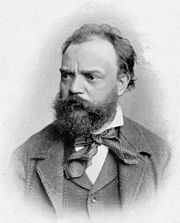
Antonin Dvorak (Ahn-toe-nin Di-vor-shack) was the typical musical prodigy common among famous composers having been proficient at the violin since the age of 6. He became famous after his death for mixing African spiritual melodies as well as Native American dances into his most famous work, the 9th or New World Symphony. Considered one of the greatest musical works of all time, a recording of it was brought by Neil Armstrong onto the Apollo 11 mission. Within 30 seconds of the 4th movement's beginning, we have the sort of leitmotif a nefarious warlord would have, as he crushes the world beneath his feet. It transitions into a lighter, but still gray repeating continuation, before descending into quiet, but hopeful stillness with the usage of the flute. Thus proceeds an optimistic march which is interspersed with several brief returns to that oppressing opening. Eventually, we reach the "Largo" of the piece which had been used by Dvorak's student William Fisher for the spiritual song "Goin' Home", which wears it's African influence on it's sleeve. We then transition to long stretches of tranquility before moving into the climax, a true return to the opening once more before the final minutes of victorious trumpets, marking the end of the piece. 

Ultimately, the 4th movement tells a story, a story of darkness which conquers all and destroys peace before finally in the end being defeated by a simple good. It's a piece of music which I hold close to my heart.

Image Credit: "Antonin Dvorak" via Wikimedia Commons

Friday, September 28, 2018

(Un)plain Jane: A Legacy of Rhetoric and Faith

Our discussions in class and our readings regarding the Reformation have mostly focused on the personal religious expressions displayed in sermons, theses, etc. by disgruntled men with religious authority. However, as a lady myself, I must ask the question; where the ladies at??


Though the role of a woman was often muted on the subject of religious uprisings and formations of new institutions during the Reformation, there were several contributions made to the world of rhetoric by the women, albeit they were often only granted publishing opportunity because of their social or political status. Nonetheless, there is some fascinating literature by these Reformation women that add to the concept of freedom to personal religious devotion and that ultimately influenced the type of relationship Latter-day Saints seek with God in the restored Church. 


Jane's Rhetoric of Adversity and Faith


Lady Jane Grey experienced an incredibly difficult life when she was forced (beaten) into marrying some duke of somewhere when her cousin Edward VI didn’t want to marry her, forced to the position of successor to her cousin King Edward VI after his death, and forced to the execution block for accepting (unwillingly) that position which her cousin Mary believed was rightfully hers and revolted for. Cue awkward family reunions…


However, the legacy of rhetoric that Lady Jane Grey is too beautiful to overlook. This written prayer of hers titled “A Certain Prayer of the Lady Jane in the Time of Her Trouble” speaks profoundly of her spiritual maturity (by the way, she was only 15 when she was executed): “I, being defiled with sin, encumbered with afflictions, unquieted with troubles, wrapped in cares, overwhelmed with miseries, vexed with temptation, and grievously tormented with the long imprisonment of this vile mass of clay, my sinful body, do come unto Thee, O merciful Saviour, craving Thy mercy and help, without the which so little hope of deliverance is left, that I may utterly despair of my liberty.”


Jane & Joseph: Under the Same Divine Pavilion


This excerpt from Lady Jane Grey reminds me of another well-known declaration of faith in the Church of Jesus Christ: “O God, where art thou? And where is the pavilion that covereth thy hiding place? How long shall thy hand be stayed, and thine eye, yea thy pure eye, behold from the eternal heavens the wrongs of thy people and of thy servants, and thine ear be penetrated with their cries? Yea, O Lord, how long shall they suffer these wrongs and unlawful oppressions, before thine heart shall be softened toward them, and thy bowels be moved with compassion toward them? let thine ear be inclined; let thine heart be softened, and thy bowels moved with compassion toward us."


This scripture from Doctrine and Covenants section 121 is a plea from Joseph Smith when he is imprisoned in liberty jail. Similar to Lady Jane Grey, in their adversity they only had faith, a concept that Christian Rounds and Peter Cables both described in their blogs: “ I may not live to see all of my questions answered either, but I can[…]proceed with what I do have: Faith.


The rhetorical legacy of Lady Jane Grey and her written relationship with God is only a small part of the profound influence that the Reformation era concept of Christian humanism had on the restoration of The Church of Jesus Christ of Latter-day Saints.

Image Credit: Lady Jane Grey (Public domain image via WikiCommons)


Wednesday, September 19, 2018

Through A Spiritual Lens

Attending Brigham Young University (or any religious school) is something so unique because it allows the students enrolled there to look at history through a spiritual lens. Just yesterday I had the opportunity to visit the Crandall Printing Museum (which has a replica of the Gutenberg Press) on Center Street in Provo. The curator walked us through the steps it took to create the printing press, and at the end he told us that Gutenberg built six presses, which seemed at the time illogical. Because of the expense it took to build six presses, buy supplies for them, and staff them, he was wasn't able to pay his debts; it would have made more sense to build fewer until he was more established. The curator (being religious) said that he felt that Gutenberg was inspired to buil
d that many because by building six presses that required six teams, there were six teams worth of people that knew the business of printing. They then went out and started their own presses and trained more people who then went out and started more printed presses, etc. This widespread of printing catapulted the printing age forward much more quickly than it might have done with only two presses.

I think that looking at history through a spiritual lens gives us the chance to see God's hand is so many things that happened, without which, we may not have had the religious freedom that we do today. I think that Martin Luther is another great example of this. What if someone had stopped him from hanging up the 95 Theses on the door of the church? Or what if someone had taken it down immediately, and he had been killed? The one act of putting up that piece of paper started a religious reform that opened the door for people everywhere to start questioning what they were being taught. Before this, that wasn't a luxury they had.

I'm sure that when this started, it would have been scary: rejecting something that you had been taught your whole life and believing in something new. But without this reform—his simple paper on the door—we wouldn't have the opportunity to believe the way we want. Being able to look at history through a spiritual lens can change an revolutionary act to an inspired revolutionary act.