Showing posts with label Christianity. Show all posts

Friday, October 4, 2019

Adoniram Judson, D.D. "The Burman Apostle"

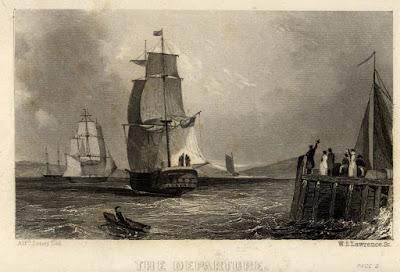
 A message of missionary work had sunk "down into [Judson's] heart, as lead goes down into the ocean... and led him to abandon home, country, and all the joys of civilized life, for chains, and dungeons and torture." Adoniram Judson was on his way to Rangoon, Burma  (Yangon, Myanmar) to preach the Gospel of Christ to a 'heathen' nation. He left as a Congregational theologian and arrived to Calcutta as a Baptist convert because he tried to use scripture to prove the baptists wrong and when he realized his belief was mistaken he had the humility to change even though rejecting his own organization meant the loss of funding and support for his 40 year long mission. He is a hero to me.

'The Departure' of Rev. Adoniram Judson, D.D. 
(found in BYU Library 'Judson Offering' 1847)
200 years later I was leaving Thailand and the Thai language behind as one of the first twenty missionaries from the Church of Jesus Christ of Latter-day Saints to serve in Myanmar and I thought few could understand my position. I felt like I was starting from scratch until I began to learn of the man who was the reason behind the Burmese Bible which I now held. 

Friday, September 28, 2018

Gaining Perspective

Masaccio's The Holy Trinity
In 1424, something remarkable happened. Masaccio, a fresco painter in Italy, delivered his commissioned work, The Holy Trinity, the first known work to feature perspective. Prior to this innovation, relative size in a painting signified relative importance. However, as Lewis Mumford
says, "in the new picture of the world, size meant not human or divine importance, but distance." This shift indicated a larger cultural shift toward emphasis on the individual that came with the humanism movement.

In embracing perspective, painters no longer pressed an interpretation on their viewers. Similarly, humanism advocated for the development of individual thought and character. Just as figure's importance in painted works was no longer defined by position, so was the common man no longer defined by his position in the world, but by what he decided to make of himself.

The concept of the individual came with the concept of an individual's responsibility for their own development. In The Courtier, Castiglione discusses traits that a good courtier should seek to develop to be truly useful to his prince. Those qualities, as discussed in this blog post, ranged from an understanding of history and philosophy to athleticism and romantic proficiency. As stated before, Castiglione implies heavily throughout the work that development of these traits ought to be the purpose of 'the courtier's' life. Responsibility belonged to the individual to become whatever he desired to be. The idealists of the time believed that it was innate in man to desire to become more.

Pico della Mirandola, a philosopher of the time, mused in his Oration on the Dignity of Man,
"Let some holy ambition invade our souls, so that, dissatisfied with mediocrity, we shall eagerly desire the highest things and shall toil with all our strength to obtain them, since we may if we wish."  (More on Pico and humanism here) 
As the Renaissance moved past its peak in Italy, humanism and the perspective it brought with it swept into the rest of Europe. The tide of that movement collided magnificently with the surge of reform that blazed both within and without the Catholic church to create Christian humanism, an ideology that existed and thrived on both sides of the Protestant rift. This evolution of the Renaissance ideology brought with it a new dimension to perspective and the notion of 'self'.

Before, it had been enough for a man to develop himself into whatever he might wish to become. The Christian aspect of Christian humanism, however, demanded not only development, but forward progress. Erasmus, widely acclaimed as the father of Christian humanism, made this point quite poignantly in his work In Praise of Folly, an essay written from the point of view of Folly herself. Erasmus, through Folly's advocation of it, condemns the notion that being stupid and happy is a better state of being that being uncomfortable and aware of the potential for growth.

Far from the lack of perspective that defined the age before, man's development of self grew to become the focus and expectation for those who had sufficient means to pursue that course. Not only that, but the responsibility for the development of self had become compounded with the responsibility for improvement of self. These developments set us soundly on the path to achieving the deep and widely resonate sense of self that permeates out global culture today.

Photo Credit

(Un)plain Jane: A Legacy of Rhetoric and Faith

Our discussions in class and our readings regarding the Reformation have mostly focused on the personal religious expressions displayed in sermons, theses, etc. by disgruntled men with religious authority. However, as a lady myself, I must ask the question; where the ladies at??


Though the role of a woman was often muted on the subject of religious uprisings and formations of new institutions during the Reformation, there were several contributions made to the world of rhetoric by the women, albeit they were often only granted publishing opportunity because of their social or political status. Nonetheless, there is some fascinating literature by these Reformation women that add to the concept of freedom to personal religious devotion and that ultimately influenced the type of relationship Latter-day Saints seek with God in the restored Church. 


Jane's Rhetoric of Adversity and Faith


Lady Jane Grey experienced an incredibly difficult life when she was forced (beaten) into marrying some duke of somewhere when her cousin Edward VI didn’t want to marry her, forced to the position of successor to her cousin King Edward VI after his death, and forced to the execution block for accepting (unwillingly) that position which her cousin Mary believed was rightfully hers and revolted for. Cue awkward family reunions…


However, the legacy of rhetoric that Lady Jane Grey is too beautiful to overlook. This written prayer of hers titled “A Certain Prayer of the Lady Jane in the Time of Her Trouble” speaks profoundly of her spiritual maturity (by the way, she was only 15 when she was executed): “I, being defiled with sin, encumbered with afflictions, unquieted with troubles, wrapped in cares, overwhelmed with miseries, vexed with temptation, and grievously tormented with the long imprisonment of this vile mass of clay, my sinful body, do come unto Thee, O merciful Saviour, craving Thy mercy and help, without the which so little hope of deliverance is left, that I may utterly despair of my liberty.”


Jane & Joseph: Under the Same Divine Pavilion


This excerpt from Lady Jane Grey reminds me of another well-known declaration of faith in the Church of Jesus Christ: “O God, where art thou? And where is the pavilion that covereth thy hiding place? How long shall thy hand be stayed, and thine eye, yea thy pure eye, behold from the eternal heavens the wrongs of thy people and of thy servants, and thine ear be penetrated with their cries? Yea, O Lord, how long shall they suffer these wrongs and unlawful oppressions, before thine heart shall be softened toward them, and thy bowels be moved with compassion toward them? let thine ear be inclined; let thine heart be softened, and thy bowels moved with compassion toward us."


This scripture from Doctrine and Covenants section 121 is a plea from Joseph Smith when he is imprisoned in liberty jail. Similar to Lady Jane Grey, in their adversity they only had faith, a concept that Christian Rounds and Peter Cables both described in their blogs: “ I may not live to see all of my questions answered either, but I can[…]proceed with what I do have: Faith.”


The rhetorical legacy of Lady Jane Grey and her written relationship with God is only a small part of the profound influence that the Reformation era concept of Christian humanism had on the restoration of The Church of Jesus Christ of Latter-day Saints.

Image Credit: Lady Jane Grey (Public domain image via WikiCommons)


Sunday, September 16, 2018

Spiritual Literacy and the Power of Translation

Most people associate the idea of gaining spiritual knowledge on one's own with Martin Luther. But prior to 1515, the year Luther posted his famous 95 Theses, there was popular demand for the word of God. A certain preacher in England named John Wycliffe believed that clergy and layman alike should be exposed directly to the Bible. His followers, known as Lollards, carried scripts of Bibles around the countryside and taught the common people. The best part? Those Bibles were in English! John Wycliffe had translated the Bible during the late 14th century. Bear in mind that this was before Gutenberg's printing press; these Bibles, as had been the case for centuries, were painstakingly written by hand.

But what was so significant about the word of God in common vernacular?

I could probably write another 15 blogposts on the history of Biblical translation, printing, and distribution; I'm passionately interested. But to answer this question, I point instead to a modern
A Nepali family reads the Book of Mormon digitally
 in their native language
example: the translation of the Book of Mormon into Nepali. Just last summer, the Book of Mormon was released in Nepali after seven years of translating. It brought immense joy to Nepali church members; Branch President Ghanashyam Sarki said, "I am so happy the Book of Mormon will finally be translated to Nepali. With the translation, I can help others to understand and appreciate the Book of Mormon. ... It will help us to know the truth." To empathize with President Sarki, I look back on my own life to when I began to read the word of God with a sufficient understanding of the language. Indeed, I found truth, and every other facet of my life has hinged upon it. The impact of "spiritual literacy" has been immeasurable.

In short, breaking down the barriers of language allows us to access knowledge-- both spiritual and temporal. The old adage "knowledge is power" only applies when we meet linguistic criteria. Wycliffe and countless others have understood this-- and put everything on the line because of it.


Image credit: Valerie Johnson, 2017.
 https://www.lds.org/church/news/celebration-commemorates-translation-of-the-book-of-mormon-into-nepali?lang=eng  

Saturday, September 15, 2018

Fluidity Within Christianity

Martin Luther and the 95 Theses
When Martin Luther posted his 95 Theses to the door of the Wittenberg Castle Church, he probably had no idea about the influence that this would have on Christianity.

Luther became disgruntled with the Catholic Church and many of their teachings, particularly those saying that to be able to be saved one needed to purchase indulgences for themselves and their loved ones and that both faith and works were needed to enter the kingdom of God (Luther believed only faith was needed). Theories promote the idea that Luther posted his 95 Theses not in an act of total defiance, but rather to set up debates and discussions he was planning to have later on. Nonetheless, the ideas he presented caught fire and spread throughout the world. Luther's ideas paved the way for Protestantism, and many Christian denominations began to sprout from the broken roots of the Catholic Church. 
                                 Image result for martin luther 95 theses

Religion Today
I served a mission for the Church of Jesus Christ of Latter-day Saints in North Carolina, which is one of the states in an area known as the "Bible Belt." When my plane touched down in Charlotte, I was immediately surprised at the number of churches standing throughout the city. It seemed to me that there were more churches than there were office buildings and homes combined! What especially struck me was peoples' viewpoints on religion. I met several people who had moved in from another city and were in search of a new church. Although the individual may have been a Presbyterian in their old city, they were completely willing to switch to another denomination, such as: Baptist, Methodist, Latter-day Saint, Episcopalian, Moravian, etc. They would go from church to church until they found a pastor they liked. The pastor (not the religion) mattered because different teachings were presented even within those churches claiming to be from the same denomination. The fluidity of Christian denominations today stands in stark contrast to religion before Luther's time.

Image Credit: www.history.com