Showing posts with label piety and devotion. Show all posts

Friday, October 4, 2019

Art and Religion: where the falling angel meets the rising ape

The 14th and 15th centuries may have been the birthplace of philosophical, scientific, and religious innovation and discovery, but when we think of the Renaissance, the first thing that comes to mind for most people will always be the art. And for good reason—of all the brave new worlds opened in the Renaissance, the world of art was at the forefront; was part and parcel of a heady new worldview. The art of the Renaissance encapsulates everything that the period was.

We can see this in the way art changed from the medieval era: the expression of humanism in a renewed appreciation for the beauty of the human form; the Renaissance emphasis on verisimilitude reflecting a broader shift in a society newly enamoured of observation, of critical thinking. Where medieval art was symbol, Renaissance art was a representation of reality as it was seen. A manifestation of a pattern, found throughout the Renaissance, of intellectual openness and honesty. A desire to look at the world, to think for oneself. The same curiosity, observation, criticism, would give birth not just to painting and sculpture, but to the Protestant Reformation.

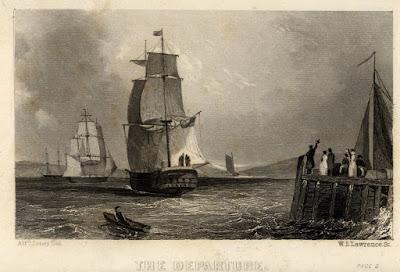
Adoniram Judson, D.D. "The Burman Apostle"

 A message of missionary work had sunk "down into [Judson's] heart, as lead goes down into the ocean... and led him to abandon home, country, and all the joys of civilized life, for chains, and dungeons and torture." Adoniram Judson was on his way to Rangoon, Burma  (Yangon, Myanmar) to preach the Gospel of Christ to a 'heathen' nation. He left as a Congregational theologian and arrived to Calcutta as a Baptist convert because he tried to use scripture to prove the baptists wrong and when he realized his belief was mistaken he had the humility to change even though rejecting his own organization meant the loss of funding and support for his 40 year long mission. He is a hero to me.

'The Departure' of Rev. Adoniram Judson, D.D. 
(found in BYU Library 'Judson Offering' 1847)
200 years later I was leaving Thailand and the Thai language behind as one of the first twenty missionaries from the Church of Jesus Christ of Latter-day Saints to serve in Myanmar and I thought few could understand my position. I felt like I was starting from scratch until I began to learn of the man who was the reason behind the Burmese Bible which I now held. 

Friday, September 20, 2019

Mystery VS Morality

Mystery VS Morality


In the Medieval Era, mystery plays were a popular source of entertainment and religious education for the general public. They were known for their extravagance and dramatic portrayals of Bible stories and the expeditions of the apostles. During the time of the Reformation, a shift in religion was apparent as culture was vehemently moving away from the Catholic religion and began exploring in the Protestant realm. This shift in religion can be seen in the dramatic representations of the time, known as morality plays. Instead of focusing on the stories of the Bible like the medieval times, morality plays encapsulated the doctrine of the Bible during the Reformation. 

The Chester Mystery Plays
The shift in theatre was mostly a result of the different emphasis that the Protestants placed on literature. John Donne’s devotional poetry was an example to all Protestants of how to look at christianity through a new lens of self-reflection. Martin Luther strongly believed poetry and rhetoric encouraged a deep respect for sacred things among the believers. This belief, coupled with Philipp Melanchthon’s humanistic encouragement to put off the old church and create a completely new religion, led Protestants to abandon worldly mystery plays and create morality plays. These plays focused on morals, values and the journey of a soul toward salvation, reflecting the values in their theology. The most popular morality play, Everyman, focuses on coming judgement, the fleeting morals of the world and the lasting morals of righteousness. It demonstrates the Protestant ideals of piety, devotion and a personal relationship with God.

scene from Everyman


The Reformation had a much deeper effect on Western culture than simply challenging the canonical doctrines and practices of the Catholic church. Reformation attitudes were evident in many aspects of life, and is especially so in the expressive entertainment and arts of the age. While the Middle Ages and Renaissance’s mystery plays featured elaborate production and execution, the morality plays were more abstract and didactic in nature, reflective of the Reformation focus on doctrine and individual connection with God. 


Fay Walker, Aubrey McDonald, Jacob Lang, Madison Smith

Tuesday, May 7, 2019

Testament: A Look into Motivations that Spurred the Reformation


In Martin Luther's writing, Babylonian Captivity of the Church, Luther references the account of the last supper that is given in the Bible. One of the reasons given of the why the existing practices of the Catholic Church were incorrect–particularly selling indulgences–was explained by looking into the meaning of a "testament," more specifically, the "new testament" represented by the cup in the last supper.

Luther stated, "Christ, who is the truth, truly says that this is the new testament in his blood, [...] Thus, if we inquire what a testament is, we shall learn at the same time what the mass is, what its right use and blessing, and what its wrong use." 

The Bible can be viewed as a Will and Testament of Jesus Christ
As I read this, I was struck by the connection made to the word "testament" as it is generally used. A testament states the desires of a person before their death of the distribution of their estate. It usually consists of certain properties being promised to certain individuals; it is also common for these promises to have prerequisites: the heir(s) to the estate must fulfill certain requirements to inherit the promised property.