Showing posts with label Castiglione. Show all posts

Friday, September 28, 2018

Gaining Perspective

Masaccio's The Holy Trinity
In 1424, something remarkable happened. Masaccio, a fresco painter in Italy, delivered his commissioned work, The Holy Trinity, the first known work to feature perspective. Prior to this innovation, relative size in a painting signified relative importance. However, as Lewis Mumford
says, "in the new picture of the world, size meant not human or divine importance, but distance." This shift indicated a larger cultural shift toward emphasis on the individual that came with the humanism movement.

In embracing perspective, painters no longer pressed an interpretation on their viewers. Similarly, humanism advocated for the development of individual thought and character. Just as figure's importance in painted works was no longer defined by position, so was the common man no longer defined by his position in the world, but by what he decided to make of himself.

The concept of the individual came with the concept of an individual's responsibility for their own development. In The Courtier, Castiglione discusses traits that a good courtier should seek to develop to be truly useful to his prince. Those qualities, as discussed in this blog post, ranged from an understanding of history and philosophy to athleticism and romantic proficiency. As stated before, Castiglione implies heavily throughout the work that development of these traits ought to be the purpose of 'the courtier's' life. Responsibility belonged to the individual to become whatever he desired to be. The idealists of the time believed that it was innate in man to desire to become more.

Pico della Mirandola, a philosopher of the time, mused in his Oration on the Dignity of Man,
"Let some holy ambition invade our souls, so that, dissatisfied with mediocrity, we shall eagerly desire the highest things and shall toil with all our strength to obtain them, since we may if we wish."  (More on Pico and humanism here
As the Renaissance moved past its peak in Italy, humanism and the perspective it brought with it swept into the rest of Europe. The tide of that movement collided magnificently with the surge of reform that blazed both within and without the Catholic church to create Christian humanism, an ideology that existed and thrived on both sides of the Protestant rift. This evolution of the Renaissance ideology brought with it a new dimension to perspective and the notion of 'self'.

Before, it had been enough for a man to develop himself into whatever he might wish to become. The Christian aspect of Christian humanism, however, demanded not only development, but forward progress. Erasmus, widely acclaimed as the father of Christian humanism, made this point quite poignantly in his work In Praise of Folly, an essay written from the point of view of Folly herself. Erasmus, through Folly's advocation of it, condemns the notion that being stupid and happy is a better state of being that being uncomfortable and aware of the potential for growth.

Far from the lack of perspective that defined the age before, man's development of self grew to become the focus and expectation for those who had sufficient means to pursue that course. Not only that, but the responsibility for the development of self had become compounded with the responsibility for improvement of self. These developments set us soundly on the path to achieving the deep and widely resonate sense of self that permeates out global culture today.

Photo Credit

Tuesday, September 18, 2018

Sprezzatura as Demonstrated by Castiglione


The effect that even the most rudimentary of orators can have on a passionate crowd is notorious. Indeed, as Shakespeare wrote "Was ever feather so lightly blown to and fro as [a] multitude?" (William Shakespeare, "Henry VI"). Mobs provide fertile ground for pathos, the Greek term for emotional rhetoric. Such rapidly raised emotions, however, often fade just as quickly as they were inflamed.

Books, on the other hand, are patient. They can convince you of an idea without ever directly referring to it or even perhaps without allowing you to realize you are being swayed. The authority of bold black words, stained permanently into an impermanent medium, always causes me to take the author at least a little more seriously--with more respect, you could say-- than if I were speaking with him or her face to face. 

Reading Baldassarre Castiglione's The Book of the Courtier has reminded me of just how subtle written rhetoric can be. In The Courtier, Castiglione uses conversations between various noblemen and ladies to illustrate the ideal attributes of a courtier. Castiglione's characters seem to navigate convoluted debates over courtly virtues to arrive at eventual conclusions, but the dialogue reminds me of Plato's Republic, in which every argument somehow seems to lead exactly to where the protagonist and primary conversationalist, Socrates, wants it to. 

Is it surprising that this singular work made such a lasting impact on the culture of civilized behaviour? Perhaps, I'm not sure, but the rhetorical genius of Castiglione is not in his appraisal of the perfect courtier; perfection is easy to peddle. Instead, we are convinced by the subtle flawlessness of the court in which the dialogues take place, the seamless and flowing arguments made by its members, and the air of sprezzatura which permeates every word of the text.

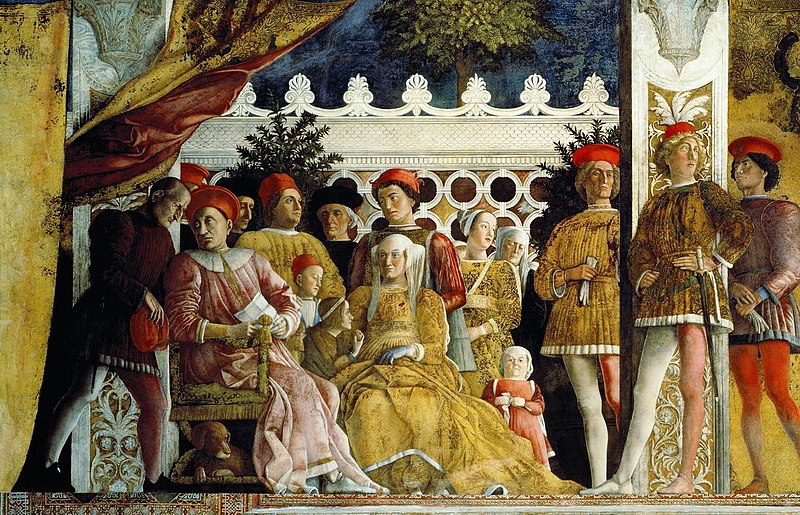
File:Andrea Mantegna - The Court of Mantua - detail.JPG

Image credits: "The Court of Mantua" by Andrea Mantegna (public domain image via Wikimedia Commons).

It's Only a Kiss...


In "The Courtier," Pietro Bembo states: "...Love is simply a certain longing to possess beauty; and since this longing can only be for things are known already, knowledge must always of necessity precede desire..." In relation to the printing press and other inventions circa the Renaissance era, the mass production of rhetoric (knowledge) changed the desire (mindset) of every society; however, this was only possible if the governing force of that society allowed the production of that rhetorical knowledge.


For example, Peter the Great of Russia created a precedent of strict control over the country and forbade customs that deviated from the vision of Russia he had of Russia (Drogin). Meanwhile, the American colonies were based on a free-for-all society, where if a religious or financial institution attempted strict control, there was plenty of other space to create one’s own institution. Therefore, while Russian leaders filtered more undesirable rhetoric out of their society, American ideals were based on freedom of speech and expression, creating drastically different pools of perspective and opinion.


Joey Franklin’s essay “The Lifespan of a Kiss” further exemplifies how rhetoric creates differing desires in different societies. In the 20th century, France offered to display the now world famous sculpture from French sculptor Augeste Rodin aptly named “The Kiss” in Tokyo but Japan refused the offer, not because of the nakedness but the gesture of kissing. Japan told the French that they would put the sculpture on display if a cloth was placed solely over the faces of the kissing couple. France refused: “morally, the French just couldn’t allow it” (Franklin).


The reason for this denial from Japan, as Franklin writes, is that the Japanese don’t kiss in the open, their romance novels and soap operas never portray kissing, meanwhile France is stereo-typically known for their vehement displays and literature of romance and expressions of the body.; essentially, varying rhetoric creates differing, collective desires for an entire country. 

 Image Credits: "The Kiss by Auguste Rodin" (public domain images via Wikimedia Commons)