Showing posts with label knowledge. Show all posts

Tuesday, September 18, 2018

It's Only a Kiss...


In "The Courtier," Pietro Bembo states: "...Love is simply a certain longing to possess beauty; and since this longing can only be for things are known already, knowledge must always of necessity precede desire..." In relation to the printing press and other inventions circa the Renaissance era, the mass production of rhetoric (knowledge) changed the desire (mindset) of every society; however, this was only possible if the governing force of that society allowed the production of that rhetorical knowledge.


For example, Peter the Great of Russia created a precedent of strict control over the country and forbade customs that deviated from the vision of Russia he had of Russia (Drogin). Meanwhile, the American colonies were based on a free-for-all society, where if a religious or financial institution attempted strict control, there was plenty of other space to create one’s own institution. Therefore, while Russian leaders filtered more undesirable rhetoric out of their society, American ideals were based on freedom of speech and expression, creating drastically different pools of perspective and opinion.


Joey Franklin’s essay “The Lifespan of a Kiss” further exemplifies how rhetoric creates differing desires in different societies. In the 20th century, France offered to display the now world famous sculpture from French sculptor Augeste Rodin aptly named “The Kiss” in Tokyo but Japan refused the offer, not because of the nakedness but the gesture of kissing. Japan told the French that they would put the sculpture on display if a cloth was placed solely over the faces of the kissing couple. France refused: “morally, the French just couldn’t allow it” (Franklin).


The reason for this denial from Japan, as Franklin writes, is that the Japanese don’t kiss in the open, their romance novels and soap operas never portray kissing, meanwhile France is stereo-typically known for their vehement displays and literature of romance and expressions of the body.; essentially, varying rhetoric creates differing, collective desires for an entire country. 

 Image Credits: "The Kiss by Auguste Rodin" (public domain images via Wikimedia Commons) 

Saturday, September 15, 2018

Quality vs Equality in Education


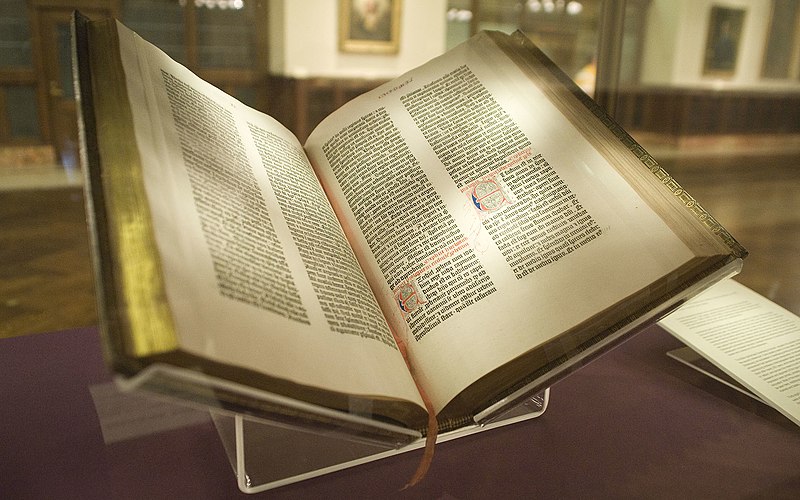
Is it better for the wide public to have access to knowledge, even if it might inhibit the learning of the wealthy? We now see the printing press as an invention that was pivotal to humanity's progression. It allowed people from all classes and trades to obtain information for themselves for which they previously would have had to rely on an academic or a church leader. However, many of those who already had access to that knowledge thought the printing press was a terrible idea. One argument, noted in The Renaissance in Perspective, was that it "would impair learning by lowering it to the level of the multitude." Others scoffed at how unattractive printed books were compared to the traditional copied ones.
File:Gutenberg Bible, Lenox Copy, New York Public Library, 2009. Pic 01.jpg
The upper class of the renaissance were hesitant to accept the printing press for fear that common people would impair their learning.
The printing press succeeded in expanding knowledge to the masses, but whether or not it tainted learning is not so certain. Regardless, I don't believe those who wanted to keep knowledge exclusive to the high classes were in the right. Societies and individuals thrive when knowledge is shared; that is worth the possibility that learning overall might be slower or less perfectly articulated. 

I think we see a similar problem in schooling now. The American government provides schooling for free so everyone in the country can be educated. It allows for a wide spread of knowledge, which as we saw with the printing press, benefits society. However, not everyone goes to public schools; those who can afford it go to private schools. This hurts public schools because they receive funding based on how many students they have. 

I see a problem of exclusivity here, similar to that with the printing press. Public schools educate children from all backgrounds, so students may receive more generalized education than if they went to a school exclusive to the wealthy. When this decreases the funding and therefore the quality of public schools, though, it becomes a problem of exclusivity. Of course this problem is more complicated than I can get into here, but we should look at the big picture: society benefits more overall when knowledge is shared among the classes than when elites have exclusive access.

Image credit: "The Gutenberg Bible" by Kevin Eng is licensed under CC BY-SA 2.0

Who’s to Blame?


Are we to blame for the sins and vices we commit? Ottaviano says, “It would be too wicked and foolish to punish men for defects that proceed from Nature through no fault of our own.” On the other hand, signor Gaspare replies, “Yet there are many who fully understand that they are doing evil, and still do it.” He continues by saying that “they are more conscious of the pleasures of the moment than of the punishment they fear in the future.”

Image credit: https://search.creativecommons.org/
 The discussion of this reading brings to mind my confusion of the scripture in Luke. Having not grown up with any religion, hearing this scripture as an adult confused me. As Jesus hung on the cross, he declared, “Father, forgive them; for they know not what they do.” It seemed to me that they knew exactly what they had done!

Ottaviano’s words seem to agree with the scripture in Luke by saying that “if they enjoyed true knowledge, there is no doubt that they would not fall into error. For reason is always overcome by desire because of ignorance, and true knowledge can never be defeated by the emotions, which originate in the body rather than the soul.”

As each of us thinks back on our own lives, would we have made a different decision if we had known better? I know I would have.