Showing posts with label Russia. Show all posts

Wednesday, November 14, 2018

A Communist Trial Run:

The Kulaks were a group of people in rural Russia who were able to accumulate land and become somewhat successful farmers after the Stolypin reform after the fall of the Czar. In 1918 the label Kulak was attached to anyone who wouldn't surrender their harvest to the state. Lenin saw this as rebellion and wanted the thought of private property and industry eradicated.

The massacre started with the hanging order. "You need to hang- hang without fail, and do it so that the public sees- at least 100 notorious kulaks, the rich, and the bloodsuckers. Publish their names. Take away all of their grain. Execute the hostages..." (Lenin) The killing didn't stop at 100. According to Aleksandr Solzhenitsyn who was imprisoned in one of the Gulags (concentration camp) upwards of 5-6 million people were killed. That is how many Jews were killed in the concentration camps.

Third degree interrogation. Drawings from the Gulag. Danzig Baldaev.

Between Lenin and Stalin, according to historians, the number of those murdered capped at around 20 million. That is about the same number of deaths as the number of soldiers and civilians who died in WWI.

The dictatorships in Russia began to fascinate me as soon as I heard about them. I never learned about it in great detail in my formal education later to find out that it was most likely because of western scholars who were sympathetic to the communist movement. In studying more about Lenin and Stalin I realized that those who supported the Marxist philosophies were more concerned about pulling down the rich than lifting up the poor.

I wouldn't consider myself wise enough to think that I know what's best for humanity, but it worries when people tell me that I am "a privileged white male" as if they know what I had to overcome to get where I am. I am extremely fortunate, and I don't deserve what I have. But does anyone? Who decides who deserves what? When people decided they knew what everyone deserved or "needed" tens of millions of people were killed. You can decide for yourself, but I will stick to the imperfect method of letting people decided for themselves what they need.


Wednesday, September 19, 2018

Great Ambition, Great Love

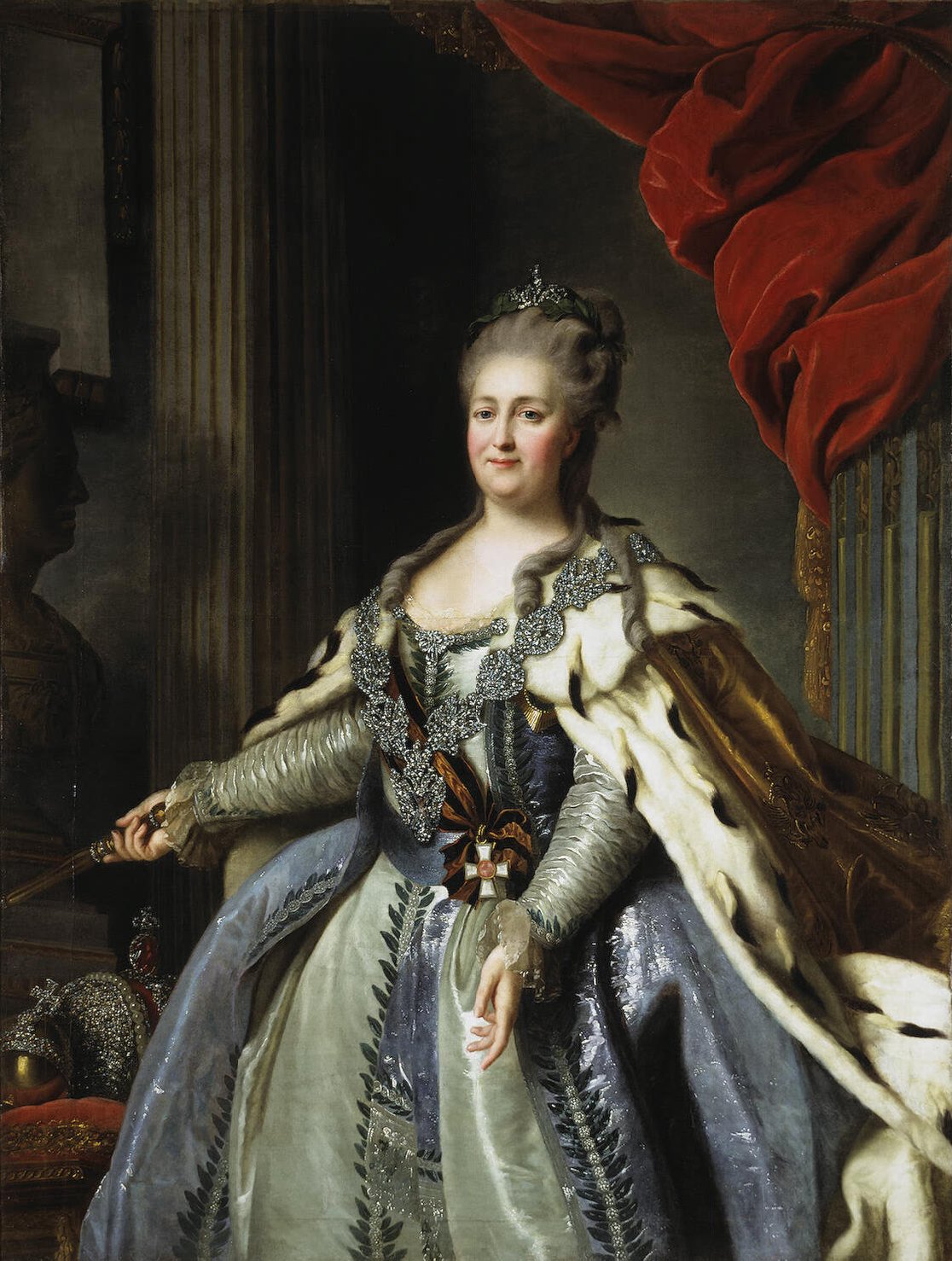
Catherine the Great relied on charm and intelligence
 to gain popularity; she exemplified sprezzatura.
Throughout history, women were generally expected to be passive; ambition was a negative trait for them to have. Even today, female leaders are often described as bossy or overbearing when acting similarly to their male counterparts. Women like Catherine the Great, however, demonstrate the good a determined woman can do. Although she made some controversial decisions, I argue that those decisions are exactly what allowed her to keep Russia afloat in turbulent times.

Catherine the Great was inarguably an ambitious woman. As a teenager she was set on becoming the next ruler of Russia, even though she was German. She begged her tutor to give her more schoolwork, and she even caught pneumonia staying up late to study Russian vocabulary. Her dedication earned her marriage to her cousin, the empress of Russia's nephew. He was a terrible ruler and husband, so Catherine forcibly took the throne from him.

Like many women today, Catherine wanted fulfillment and love. She had lovers, anywhere between 3 and 12 over her lifetime. In addition to finally giving her the love and intellectual fulfillment she sought, her relationships helped her keep Russia on good terms with other countries. It seems like a few lovers would be worth Russia's stability.
Catherine promoted education, health, and the arts, as well as equal treatment of people from all classes. She wrote the Rule of Law, a 22 chapter document for which she consulted people from every class (but serfs). She tried to free the serfs, the indentured servants of the upper classes. She gave up this feat in fear of losing the nobles' support on which she depended, but I don't think she should be blamed too much because she did more good in power than she could have out of it. 

Ambition carried Catherine the Great to uplift Russia to heights that it never would have achieved if not for her. Although she ruled in a less "respectable" way than a woman would have been expected to, she achieved her goals of power and love while ruling Russia responsibly. I argue that her greatness stemmed from her controversial deeds, rather than being hindered by them.

Image obtained from wikicommons.


Tuesday, September 18, 2018

It's Only a Kiss...


In "The Courtier," Pietro Bembo states: "...Love is simply a certain longing to possess beauty; and since this longing can only be for things are known already, knowledge must always of necessity precede desire..." In relation to the printing press and other inventions circa the Renaissance era, the mass production of rhetoric (knowledge) changed the desire (mindset) of every society; however, this was only possible if the governing force of that society allowed the production of that rhetorical knowledge.


For example, Peter the Great of Russia created a precedent of strict control over the country and forbade customs that deviated from the vision of Russia he had of Russia (Drogin). Meanwhile, the American colonies were based on a free-for-all society, where if a religious or financial institution attempted strict control, there was plenty of other space to create one’s own institution. Therefore, while Russian leaders filtered more undesirable rhetoric out of their society, American ideals were based on freedom of speech and expression, creating drastically different pools of perspective and opinion.


Joey Franklin’s essay “The Lifespan of a Kiss” further exemplifies how rhetoric creates differing desires in different societies. In the 20th century, France offered to display the now world famous sculpture from French sculptor Augeste Rodin aptly named “The Kiss” in Tokyo but Japan refused the offer, not because of the nakedness but the gesture of kissing. Japan told the French that they would put the sculpture on display if a cloth was placed solely over the faces of the kissing couple. France refused: “morally, the French just couldn’t allow it” (Franklin).


The reason for this denial from Japan, as Franklin writes, is that the Japanese don’t kiss in the open, their romance novels and soap operas never portray kissing, meanwhile France is stereo-typically known for their vehement displays and literature of romance and expressions of the body.; essentially, varying rhetoric creates differing, collective desires for an entire country. 

 Image Credits: "The Kiss by Auguste Rodin" (public domain images via Wikimedia Commons) 

Sunday, September 16, 2018

Russia: A Cross Section of Europe

Peter the Great- Tsar of Russia
I have always had an inexplicable fascination with Russia. As early as seventh grade, I found myself drawn to the policies and history of Russia. I guess I always found it confusing as a nation. Something about it seemed so irrevocably stuck in the past, yet simultaneously striving to snag a slice of Western Europe's power pie. It seemed to exist in two states of being concurrently. Until today, I could never quite account for that duality.

During the Renaissance, when there was a surge toward the new and innovative, Russia didn't budge. They clung to their traditions. Rather than returning to their roots to find the future, they stubbornly stayed medieval. Right up until the end of the 17th century, this remained unchanged. Then, Peter the Great took the throne.

Widely regarded as the most beloved leader in Russia's history, Peter the Great was a bridge between Western and Eastern Europe. Unlike previous Tsars, Peter was not only educated at
home with tutors, but went abroad and gained an interest in science and technology. When he returned to Russia, he made a full push to bring his country into the 17th century. He sponsored a generation of scholars to study in Western Europe so that he could cultivate that new learning. He even went so far as to ban certain traditions in Russia, forbidding his courtiers from wearing beards.

As is indicated by their continued love for him, the Russian people appreciated what Peter the Great was trying to do. They loved the western-style city he established- St. Petersburg. However, much of Russia continued to hold on to their traditions. Moving so abruptly from their near-medieval way of life to the end of the Renaissance era was too much for many people, and they stubbornly tried to remain the same.

Thus Russia became, and to a certain extent, continues to be, a link between the old and new in Europe. A perplexing place, where both ways of life coexist. All thanks to the Tsar who dreamed of more for his people, Peter the Great. 

https://www.biography.com/people/peter-the-great-9542228