Showing posts with label ambition. Show all posts

Wednesday, September 19, 2018

Great Ambition, Great Love

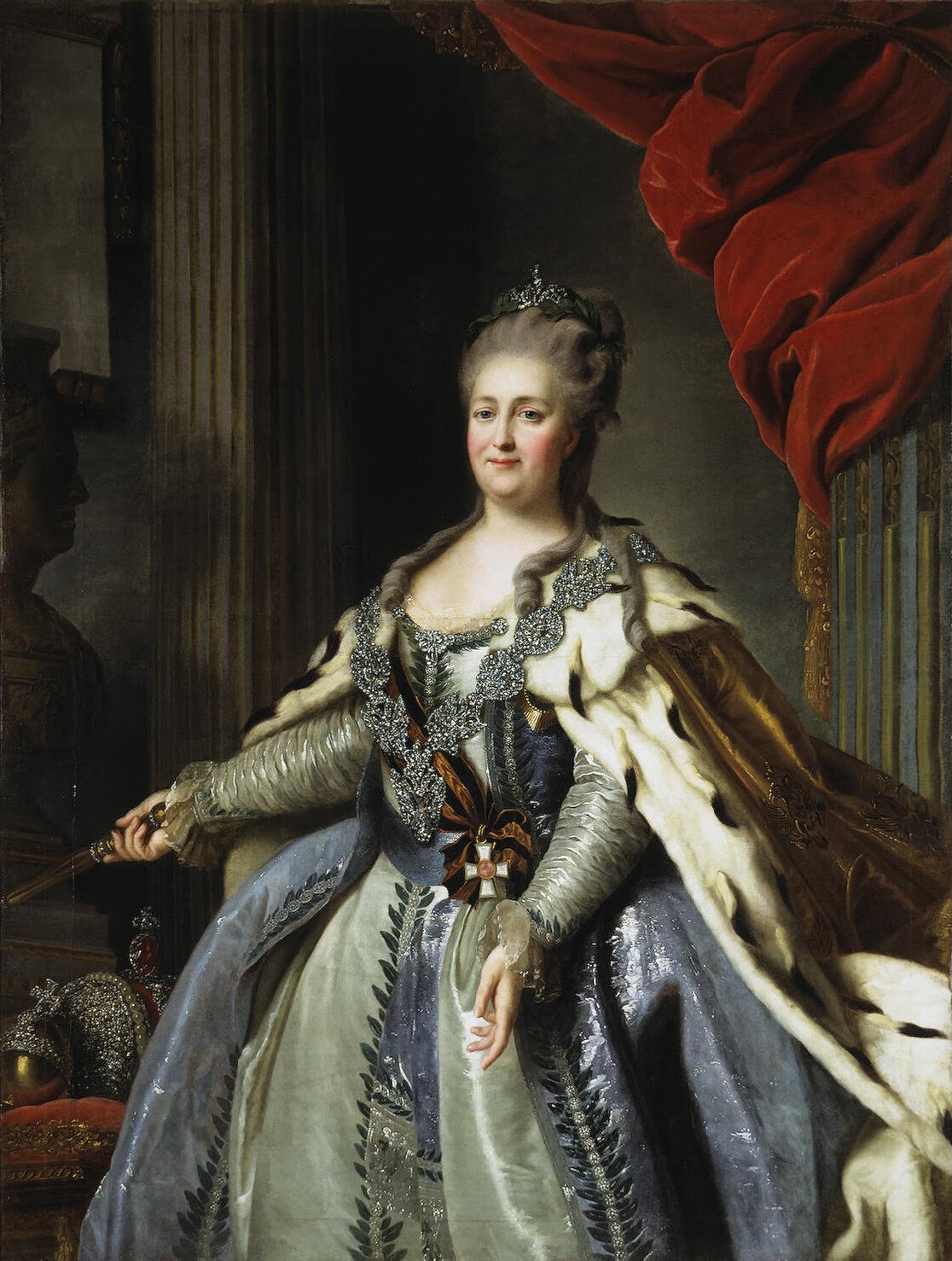
Catherine the Great relied on charm and intelligence
 to gain popularity; she exemplified sprezzatura.
Throughout history, women were generally expected to be passive; ambition was a negative trait for them to have. Even today, female leaders are often described as bossy or overbearing when acting similarly to their male counterparts. Women like Catherine the Great, however, demonstrate the good a determined woman can do. Although she made some controversial decisions, I argue that those decisions are exactly what allowed her to keep Russia afloat in turbulent times.

Catherine the Great was inarguably an ambitious woman. As a teenager she was set on becoming the next ruler of Russia, even though she was German. She begged her tutor to give her more schoolwork, and she even caught pneumonia staying up late to study Russian vocabulary. Her dedication earned her marriage to her cousin, the empress of Russia's nephew. He was a terrible ruler and husband, so Catherine forcibly took the throne from him.

Like many women today, Catherine wanted fulfillment and love. She had lovers, anywhere between 3 and 12 over her lifetime. In addition to finally giving her the love and intellectual fulfillment she sought, her relationships helped her keep Russia on good terms with other countries. It seems like a few lovers would be worth Russia's stability.
Catherine promoted education, health, and the arts, as well as equal treatment of people from all classes. She wrote the Rule of Law, a 22 chapter document for which she consulted people from every class (but serfs). She tried to free the serfs, the indentured servants of the upper classes. She gave up this feat in fear of losing the nobles' support on which she depended, but I don't think she should be blamed too much because she did more good in power than she could have out of it. 

Ambition carried Catherine the Great to uplift Russia to heights that it never would have achieved if not for her. Although she ruled in a less "respectable" way than a woman would have been expected to, she achieved her goals of power and love while ruling Russia responsibly. I argue that her greatness stemmed from her controversial deeds, rather than being hindered by them.

Image obtained from wikicommons.


Wednesday, September 12, 2018

Are We Forgetting?


One of the concepts outlined in many of the readings focused on the conflicting view of print and the mass distribution of literature and other forms of art. In “The Press-Rival and Ally,” it is written that the Italians were especially “hostile to printed books, regarding the press as a barbarous German contraption which, at best, would impair learning to by lowering it to the level of the multitude.”
While I completely condone the education for any person and being a normal working-class-originated literary student, the printing press is one of the most singularly important inventions ever gifted to humanity.
However, deriving from this concept only slightly, I wonder if there is some validity that mass production or mass sharing of images, art, or literature numbs the receiver to its impact. I recently visited BYU’s Museum of Art which is currently displaying Pulitzer Prize winning photography. Much of this collection consisted of photographs many of us may have have seen recently, such as the attack on the World Trade Centers in 2001, and there were other photographs of similar or more intense nature, such as aftermaths of war, protests, mass shootings, and suicide bombings.
As I continued to walk through the gallery, I noticed how little I was affected by the content of the photographers, especially the ones I had seen. In our social media driven society, are we continually scrolling through our news feed and Instagram posts, mindlessly scrolling past history-changing events like 9/11 or sharing a picture of the event with text written over it reminding us to “never forget”? Have we already forgotten? Does a picture truly contain 1,000 words the more times we post it? Through our quick, almost mindless, mass publication of visual rhetoric, have we also “changed the appearance and state of the world?”

Tuesday, September 11, 2018

Humility or Repression?

Image result for magnus cathedral

      In a historical sense, the Renaissance seems to be widely interpreted as a "freeing" of the mind from the shackles of religious self-deprecation. In the Middle Ages, the holy role of king was to...motivate...his subjects to embody Christlike attributes such as humility, submissiveness, and meekness. 

      While this sounds like a noble endeavor, it usually resulted in oppression, and, more importantly, a significant repression of thoughts and creativity. When one tried to create beauty that wasn't directed completely towards God, it was self-gratifying and vain. Thus, the Renaissance was seen as beauty's hero, send to free the minds of men from the cage of forced humility. 

      The natural effects of hardened dogmatism have not changed since then, though the times have certainly been generous to artistic freedom. In some parts of the world, certain communities remain rather attached to some of the more medieval aspects of Christianity. In such communities, when a youth is ambitious or aggressive in his or her journey to make it in the world, those ambitions are put down in short order and the youth is told "don't get ahead of yourself, you're not that important."

      Never having been an overly patriotic sort of person, it makes me consider what makes Americans feel freer to follow their dreams and passions? Maybe it's because humanism doesn't develop pride and selfishness, but simply encourages people to live up to their potential. Does pursuing humility mean giving less effort to living a full and engaged life? 

      In my estimation, humility is not inverse to achievement. In fact, how can one be humble without any achievements? Is humility the war against pride, or simply the absence of anything to be proud of? Such was the dilemma of the Renaissance.
      As Friedrich Nietzsche once put it, "Of all evil I deem you capable: Therefore I want good from you. Verily, I have often laughed at the weaklings who thought themselves good because they had no claws.” (Thus Spoke Zarathustra)

https://c.visitorkney.com/assets/files/1395/istock_000058124404_large.900x600.jpg