Showing posts with label women. Show all posts

Saturday, September 14, 2019

Sprezzatura in Women
The idea of the “ideal” man made me wonder what the evolution of the “ideal” woman was. Being a woman myself, I have tried to be something that society wanted me to be for much of my life.  Women in the renaissance had their “ideal” roles just as the men did. The roles of women were not as prominent as men, in fact they were supposed to be seen and not heard. Women in the renaissance were supposed to always dress a certain way that was dictated by their class. This way of life for women has evolved in history.
Image result for renaissance woman
The Renaissance Woman

Monday, October 29, 2018

Victorian Satire, Timeless Wit

Trollope's The Warden timelessly, satirically mocks Victorian society with a particular lens for the socio-political power struggles of the day. He writes about the warden (a clerical position) of a charitable hospital in small-town, 19th century England. The peaceable, gentle warden Mr.Harding is hit by the waves of the era's reforming spirit when a well-meaning surgeon, John Bold, questions the disparity between Mr. Harding's income and that of the hospital's, files a lawsuit against him, and employs the press as a means of destruction. While Trollope clearly sides with the warden, he does so in a manner that also criticizes the authority and political prowess of the church. As a battle unfolds between the church and the young reforming spirits-- a battle which the warden absolutely hates to be in-- we can see the faultiness, naivety, greed, and pride of both sides.

In particular, though, Trollope's main criticism is on the insensitive and destructive actions of "do-gooders" of his day, as personified by John Bold. In Trollope's eyes, they can blindly wield the sword of "justice" without seeing all of the injury and misery they cause. Quoting John Bold, "'If we are to act on that principle, the weak are never to be protected, injustice is never to be opposed, and no one is to struggle for the poor!' And Bold began to comfort himself in the warmth of his own virtue." While Trollope was not wholly supportive of the old order, he was more against the excessive and overzealous spirit of reform.

On the other hand, the Warden employs Victorian themes such as leading heroines whose beauty goes beyond physical features. Trollope unfolds the deep personalities of his female characters. In particular, he emphasizes the independence, pride, and wit of the Warden's 24-year-old daughter Eleanor. While this was not uncommon in Victorian novels, Trollope uses Eleanor as a means of ridiculing the social niceties of the day.

What's amazing about Trollope's writings is their ability to artfully suck us up into the present-- our politics and power struggles, in particular. While not so dramatic and romantic as some of his contemporaries, Trollope's style and subject matter is timeless. As a critic in The New Yorker stated in his article "Why Anthony Trollope is Trending", "Politics and gossip are still the essential life of the world, as every moment on Reddit reveals, and any writer who can turn them into art will survive." While American society in 2018 may not regularly face power abuses by clergy or have newspapers as their primary media source, we can still relate to the social and political struggles that Trollope mocks in Victorian society. Particularly, we can use more judgement before hopping onto the reforming bandwagon and use good sense in considering what would actually improve social justice. From the standpoint of a 2018 young adult, The Warden's biting honesty and humorous personalities hit close to home. I can't wait to explore Trollope's other works as I seek to understand the constant polar politics in my own social web. 

Illustration of Trollope by Mr.Bingo


Reference quote and image credit: https://www.newyorker.com/magazine/2015/05/04/trollope-trending 

Ivanhoe

The uniqueness of Sir William Scott's Ivanhoe comes from the fact that Scott wrote this Medieval tale of romance and adventure during the nineteenth century. The retrospective point of view that the audience gets in Ivanhoe is one that allows the tale to be told with fresh ideas. In the book, there are many themes that, at the time it is set in, would have been hard-hitting, widespread issues or divisions among the society, but during the time of Scott were only part of history. We see an example of this with the treatment of the Jews throughout the novel. In the Medieval Era, Jews were persecuted and detested, and while Sir William Scott portrays that distaste, it is clear that those feelings were not present at the time the book was written. Scott is able to incorporate these Medieval elements while giving an Enlightenment view on them.

This kind of retrospection allows the audience to explore past issues see not only how they affected the people of the time, but also how they allowed society to grow and shape itself around them. Another example of this in the novel is the status of women in society. In typical Medieval action stories, knights fought for king and country, and then for the women they loved, but in Ivanhoe, the knights put the women first, and the women are prominent in many ways. They do a great deal to aid the knights that fight for them. Critics of the novel have even said that this is a negative point to the novel as it detracts from the historical accuracy of the story. However, it seems that Scott is less concerned with the historical accuracy of the novel and more so with making it entertaining and shedding modern views on past problems. In the novel itself Scott nods to how these issues will affect the future as one of the characters remarks, "Will future ages believe that such stupid bigotry ever existed!" If Scott felt this way about the past time period about which he was writing, it's safe to say that most generations can also look back on any era with similar sentiments.

I think that Scott's newer take on old ideals is exactly what societies often do and should do. In all societies that I know of, people study history. They study the wars, the cultures, the music, the ideas, the stories, every bit of it. In any class we are in where we study history, we are learning about how those issues shaped our modern culture, and we also get to think about how our current issues are preparing the way for future generations to wonder how "such stupid bigotry [or whatever the issue may be] ever existed.

image credit: public domain images via Wikimedia Commons


Dracula, and the conflict of Women

Sadly, this is the Vlad no one remembers

Dracula is the tale of a monster, everyone knows this. While this fact is not in question, it is the nature of the monster that gets people confused. When one sees Vlad the Impaler, one thinks of a monster who lusts for blood. The Dracula in Bram Stoker's novel of the same name, however, is a creature that lusts for flesh and various luxuries. He has in his possession a castle, possibly of demonic origin, which collapses and dissapears into the Earth at the end of the novel. He has gold and wealth abundant, but his greatest treasures are the women he has in his possession, perhaps literally. With three of the beautiful and exotic females to grace his sight under his thrall, he nonetheless seeks after more. The female gender, to him, is nothing but a collectable, of which the only response is to desire more and more.

Within the times of Victorian London, the women of our species were in a crossroads of sorts. Previous years' wisdom dictated that ladies should marry men as quickly as possible while remaining absolutely devoted to their guidance, even against better judgement. After all, with a man there is a supposed safety, to quote the novel: "I suppose that we women are such cowards that we think a man will save us from our fears, and we marry him." On the other hand there was the rising wave of this newly invented concept called "Feminism" which declared that women should receive the same rights of property and suffrage as men had. By the novel's initial publishing in 1897, this first goal was already in the process of being accomplished, and the second would soon follow. In this confusing time, a novel such as Dracula would only heighten the confusion it's female readers (of which there were quite a few) would face, as they were confronted with the reality of whether they wanted to be reduced to possessions of their husbands much like Dracula's "brides", or to free themselves of such an influence as Mina Harker tries (and perhaps to some view points, fails) to accomplish.

Of course, this internal debate still goes on in the lives of today's women. To become subservient to a husband would hopefully guarantee security both physical and financial, while to try and remain free would guarantee one's ability to speak out and make decisions. From reading Dracula, we can see the extreme of one path, and the other is perhaps something one see by just walking outside. These differing impulses must be brought into a form of balance if any joy for the woman can be accomplished, as otherwise their lives would fall into disarray. This is not to say that men do not suffer similar issues, in fact I would assert that men have it just as hard. I myself have had to deal with the differing issues of Masculinity and ease of life. Rather, what I am trying to state overall with this piece is to say that the inner conflicts each of us have differ wildly, from gender to gender and person to person, and that balance must be obtained and maintained in some form or fashion for a healthy life.

Image Credit: "Vlad Tepes" obtained via Wikimedia Commons

Social Restrictions of Women


Social change takes time, and the role of women in society is one that continues to change even today. George Eliot’s novel Middlemarch is set in England, in the 1830s. At that time, women were very much controlled by the various men in their lives: fathers, brothers, husbands, and other male relatives. There were not many jobs available to them, so they ended up doing domestic service, being a laborer or seamstress, or serving the wealthy, just to name a few.

The basis of Eliot’s novel is the everyday lives of those living in and around the small town of Middlemarch. The central character, though, is Dorothea Brooke. Although she succumbed to the usual role that women had to play in those days, Dorothea very much had a mind of her own. She was known for speaking that mind, which almost always frustrated her younger sister, Celia. In one moment of frustration, Celia scolds Dorothea by saying, “…you went on as you always do, never looking just where you are, and treading in the wrong place. You always see what nobody else sees; it is impossible to satisfy you; yet you never see what is quite plain. That’s your way.”

When Dorothea decides to marry a man who is twenty-seven years older than her, it is not only Celia who disagrees with her decision: most of the town is appalled. But Dorothea, wanting to be her own woman with her own choices, responds by saying, “I should not wish to have a husband very near my own age.” Here, she shows her unique independence for a woman from her era. But as she continues in the same dialogue, we can see that she cannot escape the social restrictions put upon her because she is a woman. She remarks, “I should have a husband who was above me in judgment and in all knowledge.” She goes on to explain that “I cannot imagine myself living without some opinions, but I should wish to have good reasons for them, and a wise man could help me to see which opinions had the best foundation, and would help me to live according to them.”

I have lived out the experience of being a woman who believed that her roles in life were already chosen for her and were very limited by social restrictions. Growing up in the 70s, in the heart of the women’s liberation movement, I distinctly remember feeling that the best job I could ever attain would be that of a legal secretary.

I am astounded that, a mere forty years later, it would not even occur to my daughters or granddaughters that they could not become anything they desire. Change does happen, but it takes time.

Image credit: https://flic.kr/p/bumgGk

Persuaded.


In Jane Austen’s novel, Persuasion¸ the importance of social class in the early 1800s is demonstrated by the measures characters take to preserve their status.  Sir Walter is forced to "let" his primary residence in Kellynch Hall to avoid further economic harm, and he intends to do so discreetly to avoid negative repercussions.  However, he later openly regards the Admiral and his wife as his "tenants" as it seems fit to his advantage.  Austen ends the book novel with Anne and Wentworth wed and in good social standing, reflecting her own consideration of the importance of social class.

Admiral and Mrs. Croft give insight to how roles of men and women have changed individually and collectively, as in marriage.  Admiral Croft was just that--an admiral. He wasn't a wealthy landowner or member of the aristocracy, nevertheless he represents an evolving group of those who would be considered “gentlemen.”  Mrs. Croft likewise defied the norm and accompanied her husband on his voyages rather than stay at home.  In the 21st-century we see an increasing number of women embracing and pursuing what might be considered male roles, whether through education or careers or social interactions.

Anne & Lady Russell
Persuasion is heavily evident in the novel, specifically with Anne.  These persuasions frequently result in negative consequences until a strong-willed character, Louisa, is seriously injured because she would not be persuaded.  In the end, Anne herself, speaking of the decision to not marry Wentworth initially, acknowledges, “I must believe that I was right, much as I suffered from it, that I was perfectly right in being guided by [Lady Russell],” because she felt it her duty to obey who she considered a maternal figure.  Many readers think Anne was right to have waited and allow herself to be persuaded by Lady Russell given that she was so young and would have to elope without her father’s consent.  On the other hand, some are frustrated with her submission to Lady Russell’s advice and wish she wasn’t so easily persuaded.

Image Source: persuasion1995-1 (via Kalafudra)

Wednesday, October 10, 2018

Ladies & Locke


As I looked over the talks given this weekend at General Conference, the broadcast given by the leaders of Church of Jesus Christ of Latter-Day Saints for their members, I was perturbed. Out of twenty-six talks given that weekend, one was from a woman. I think we need to hear from women more often in the church; diverse perspectives will only strengthen it. We have come far from the days when women were expected to live to cook, clean, raise children, and look nice, but we still have a way to go before they are valued equally to men.
File:Damaris Cudworth.jpg
Locke believed women were fully rational, and had
particularly high praises for Damaris Cudworth Masham.
John Locke was actually an early supporter of semi-feminist ideas. He even used religion and scriptures to support his claims in his Two Treatises on Government. In his efforts to establish that monarchies did not have a divine right to rule, he ended up claiming that this extended to the "right" of dominion God supposedly gave to Adam over Eve. 

Locke claims that God punished Eve for disobeying him, but that he did not give the authority of a monarch to Adam as the Enlightenment monarchs often claimed. This meant that women did not owe their husbands obedience, and that their children owed equal subordination to both parents, not just the father. Locke believed that men only had power over women in their physical superiority—which was actually pretty progressive for his time.

Wednesday, September 19, 2018

Great Ambition, Great Love

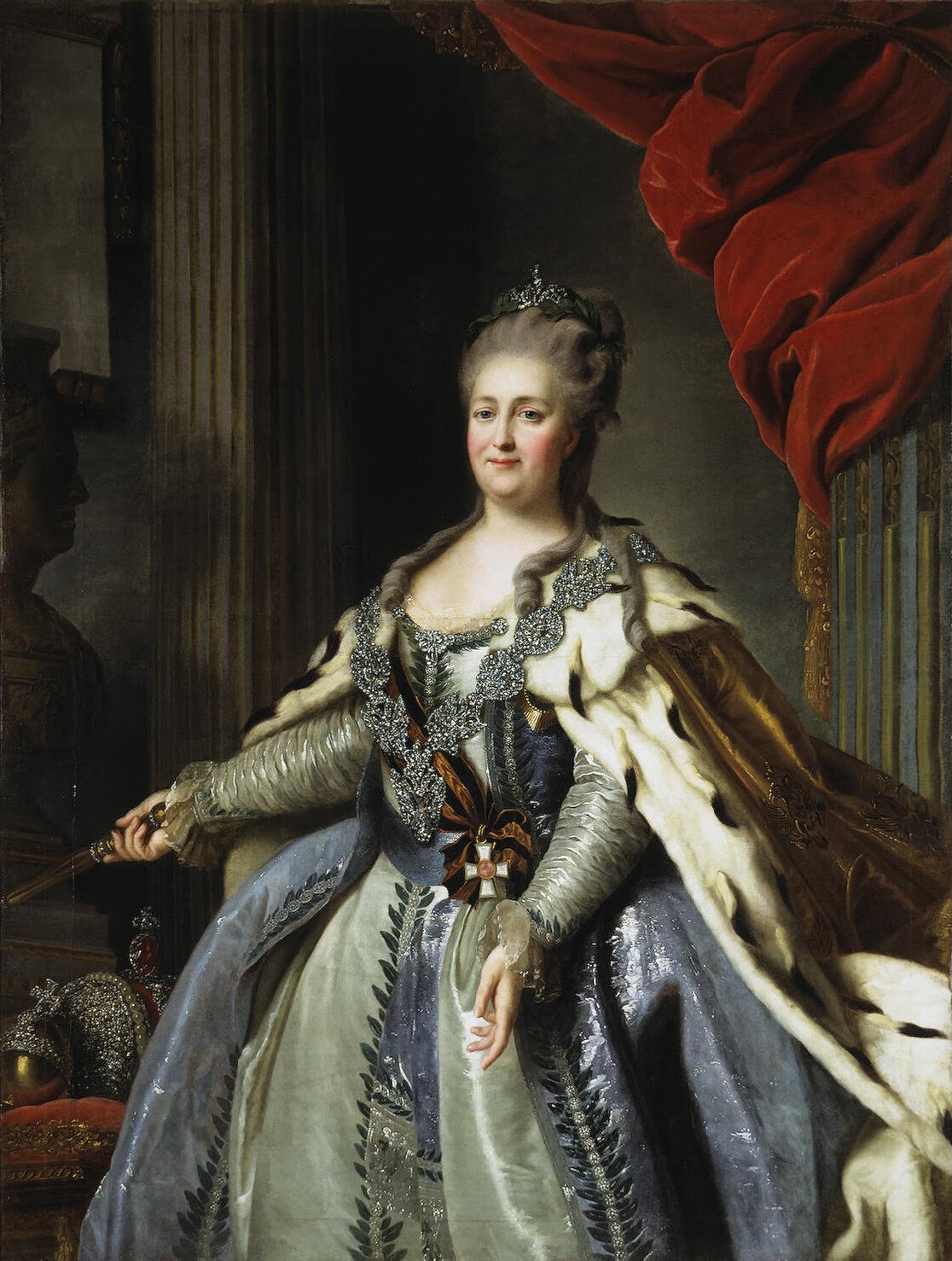
Catherine the Great relied on charm and intelligence
 to gain popularity; she exemplified sprezzatura.
Throughout history, women were generally expected to be passive; ambition was a negative trait for them to have. Even today, female leaders are often described as bossy or overbearing when acting similarly to their male counterparts. Women like Catherine the Great, however, demonstrate the good a determined woman can do. Although she made some controversial decisions, I argue that those decisions are exactly what allowed her to keep Russia afloat in turbulent times.

Catherine the Great was inarguably an ambitious woman. As a teenager she was set on becoming the next ruler of Russia, even though she was German. She begged her tutor to give her more schoolwork, and she even caught pneumonia staying up late to study Russian vocabulary. Her dedication earned her marriage to her cousin, the empress of Russia's nephew. He was a terrible ruler and husband, so Catherine forcibly took the throne from him.

Like many women today, Catherine wanted fulfillment and love. She had lovers, anywhere between 3 and 12 over her lifetime. In addition to finally giving her the love and intellectual fulfillment she sought, her relationships helped her keep Russia on good terms with other countries. It seems like a few lovers would be worth Russia's stability.
Catherine promoted education, health, and the arts, as well as equal treatment of people from all classes. She wrote the Rule of Law, a 22 chapter document for which she consulted people from every class (but serfs). She tried to free the serfs, the indentured servants of the upper classes. She gave up this feat in fear of losing the nobles' support on which she depended, but I don't think she should be blamed too much because she did more good in power than she could have out of it. 

Ambition carried Catherine the Great to uplift Russia to heights that it never would have achieved if not for her. Although she ruled in a less "respectable" way than a woman would have been expected to, she achieved her goals of power and love while ruling Russia responsibly. I argue that her greatness stemmed from her controversial deeds, rather than being hindered by them.

Image obtained from wikicommons.