Showing posts with label language. Show all posts

Tuesday, December 11, 2018

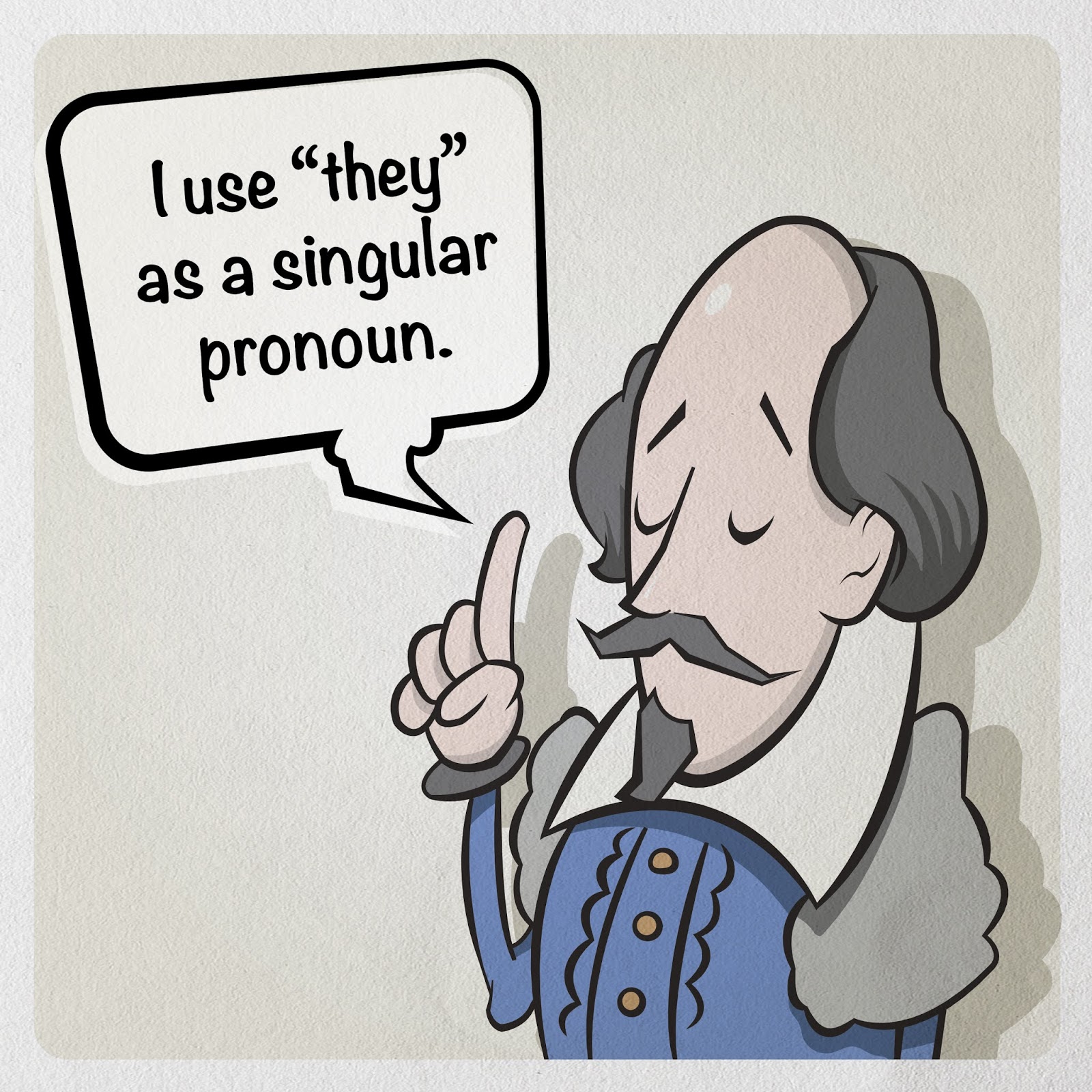
Accepting "they" as Both Plural and Singular


By Amy S. Johnson

Like life forms, languages are always changing.” (McWhorter, 1998, p. 123)

The lack of a gender-neutral third person singular pronoun is a problem that has existed since Middle English. It should be noted, though, that even great writers from the past chose to use they as a singular pronoun.
[It was] a normal pattern in English that was established four centuries before the 18th century grammarians invented the solecism. The plural pronoun [they] is one solution devised by native speakers of English to a grammatical problem inherent in that language––and it is by no means the worst solution (Merriam-Webster’s Dictionary of English Usage, 1994, p. 902).

The following examples date as far back as the 14th century.
“The righteous man … that taketh not their life in vain––Pearl, ca. 1380 (spelling modernized)
There’s not a man I meet…As if I were their well-acquainted friend––Shakespeare, The Comedy of Errors, 1593” (Merriam-Webster’s Dictionary of English Usage, 1994, p. 902).

Monday, December 10, 2018

One Language Under God

By Berlyn Flake
If we were to decide upon a universal language so that all peoples and cultures could communicate, should that chosen language be English?

Image result for wikimedia national flags
The World's Flags
There are approximately 6,500 different languages spoken today, and it is estimated that just 200 years ago there were up to 10,000 different languages. Knowing that there are so many different languages and dialects spoken, is it a wonder that miscommunication often happens?

Were we to designate a single language as the official language for the world, we could decrease misunderstandings between countries and help promote a sense of unity. The only problem is deciding which language to use.


Monday, December 3, 2018

Hot Spots in Linguistics and Editing


                                         https://pixabay.com/en/girl-english-dictionary-study-2771936/

   The feminist movement of the ‘70s caused an awareness of the need for a singular neutral pronoun in the English language. Many other languages have a neutral pronoun for both singular and plural. Pronouns are considered a “closed class” and therefore are not something easily changed. Many attempts were made at creating a new pronoun but none were accepted by the English-speaking world. The easiest solution would be to use “they” as our singular neutral pronoun, but not everyone agrees. The linguist John McWhorter says, “English speakers have been using ‘they’ in the singular for eons.” Regardless of this fact, there is still argument as to whether or not it is acceptable because “they” is a plural pronoun being used for a singular antecedent in a sentence like, “Tell each student to hand in their homework.”

   The “Oxford comma” is still a point of debate in the editing world. The Chicago Manual of Style insists on its use, but other style guides, such as the Associated Press, do not use it. Those who insist on it can prove that if it is not used in a series of items, then there can be confusion as to what the author is trying to convey. 

   Language “death” is a concern in the linguistic world. Many linguists are passionate about saving the languages throughout the world that are dying off at alarming rates. Others feel that there is nothing that can be done about it, and that it appears to be a hopeless task. The world renown linguist David Crystal looks at both sides of this issue in his book Language Death.
Crystal, D. (2000, 2014). Language Death. Cambridge, United Kingdom: Cambridge        University Press. 

The issue that I am most passionate about is the need for a singular neutral pronoun. I have been studying linguistics and linguistic change for over five years. The most important thing I’ve learned is than language changes. If we have been using “they” as a singular neutral pronoun for hundreds of years, then why are we still arguing about whether or not we can use it as such? Just because it is technically plural is not reason enough to decide that it can’t also be used as a singular pronoun: we’re already using it that way anyway!  

Monday, November 26, 2018

Talk Like You Sing

On March 5, 1946, Winston Churchill gave his famous address entitled Sinews of Peace. One thing that struck me about this speech is Churchill’s voice and the way that he uses vocal intonations to further his points in conjunction with how he uses the English language.

Vocals
I found that Churchill’s voice was very authoritative without being overwhelming. At least to me, he came across as being very grandfatherly, as someone having dominance in the household but doing what he is doing out of love.

He seeks to cast away any apprehension that the audience might have with regards to his intention. He says, “Let me however make it clear that I have no official mission or status of any kind, and that I speak only for myself. There is nothing here but what you see.” This is said in a very clear way, and the vocal intonations give the impression of someone who is being honest and completely open. Were he trying to deceive his audience, the words may have come out more hardened and absolute with no room to argue. However, in this instance, there is no artificial sweetener in his voice. It is easier to believe that Churchill is speaking his mind and that he has no intention of deceiving his audience.
Our voices change when we speak, just as when we sing.


Musical Rhythm
Churchill uses not only his voice to deliver his points, but he also uses his mastery of the English language. For example, he says, “Let us preach what we practice -- let us practice what we preach… I have not yet spoken of poverty and privation which are in many cases the prevailing anxiety.”

I have listened to speeches before where I felt that the speaker did not know what they were talking about. But, oftentimes when I have reviewed their words, I have found that what they were trying to say was admirable, but that their lack of knowledge concerning the use of language hindered the effectiveness of their delivery. I have rarely met anyone who doesn’t appreciate music, which usually has regular rhythm and rhymes. Speech is not much different. When people are able to use language in a way that is more palatable to the ear, people are more willing to give heed to what is said.

Were people more cautious in the ways that they speak, they would find it easier to persuade people. Speaking the same way we sing (without actually singing, of course) might not be a bad idea.


Image Credit: Wikipedia public domain "Frequency vs Position on the Treble Clef"