
By Amy S. Johnson
“Like life forms, languages are
always changing.” (McWhorter, 1998, p. 123)
The lack of a gender-neutral third person singular pronoun is a
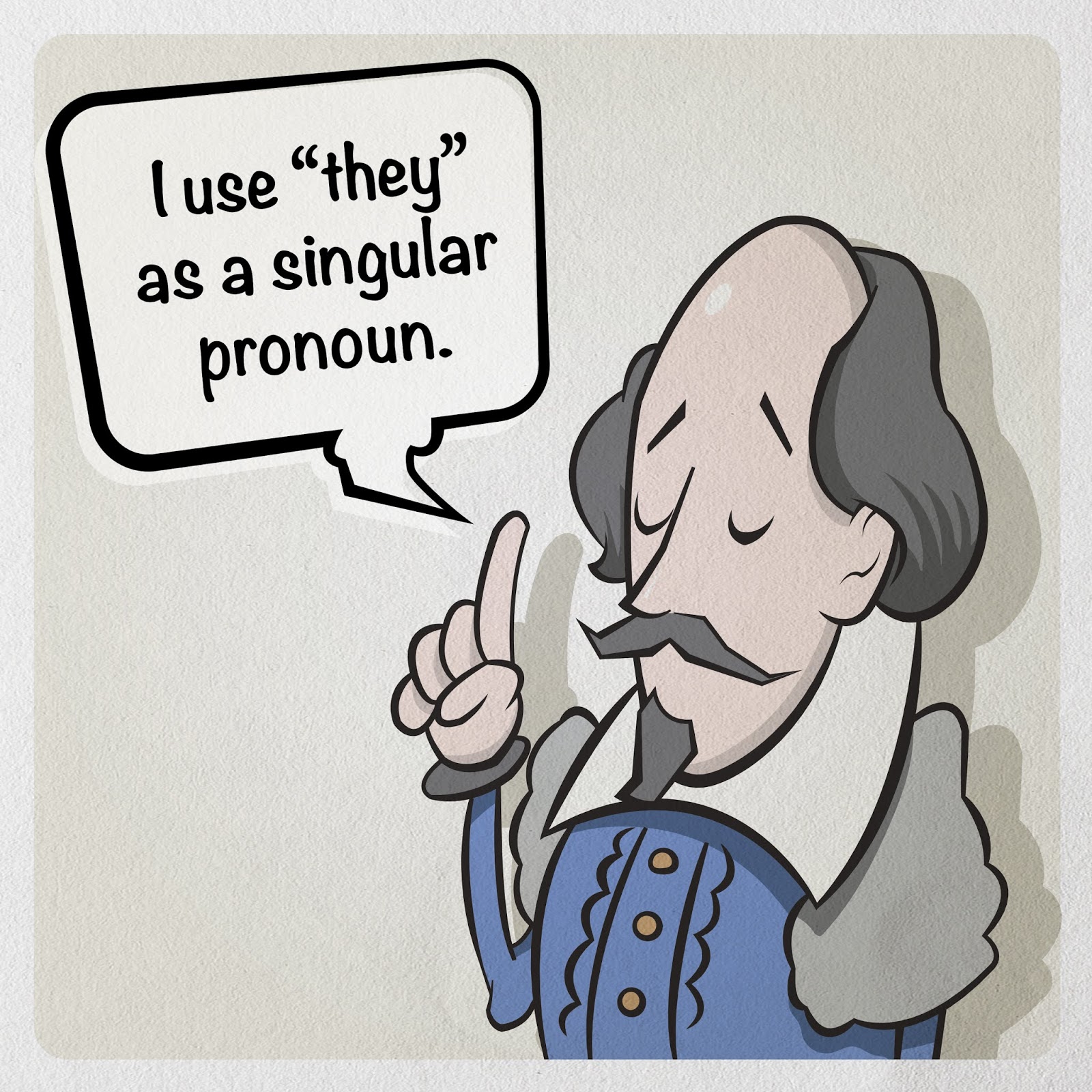
problem that has existed since Middle English. It should be noted, though, that even great writers from the past chose to use they as a singular
pronoun.
[It was] a normal pattern in English
that was established four centuries before the 18th century grammarians
invented the solecism. The plural pronoun [they] is one solution devised by
native speakers of English to a grammatical problem inherent in that
language––and it is by no means the worst solution (Merriam-Webster’s
Dictionary of English Usage, 1994, p. 902).
The following examples date as far back as the 14th century.
“The righteous man … that taketh not their life in vain––Pearl,
ca. 1380 (spelling modernized)
There’s not a man I meet…As if I were their well-acquainted
friend––Shakespeare, The Comedy of Errors, 1593” (Merriam-Webster’s
Dictionary of English Usage, 1994, p. 902).
