https://pixabay.com/en/board-school-blackboard-chalk-font-64269/
The lack of a gender-neutral third person singular pronoun is a
problem that has existed since Middle English: “And whoso fyndeth hym out of
swich blame, They wol come up…Chaucer, ‘The Pardoner’s Prologue’ ca. 1395 (in
Jespersen)” (Merriam Webster’s Dictionary of English Usage, 1994, p. 901).
The use of the traditional pronoun he,
his, him, goes back to the 18th century grammarians who boxed themselves into
the position by first deciding that the indefinite pronouns must always be
singular. They then had to decide between the masculine and feminine singular
pronouns for use in reference to the indefinites, and they chose the masculine
(they were, of course, all men) (Merriam Webster’s Dictionary of English Usage,
1994, p. 902).
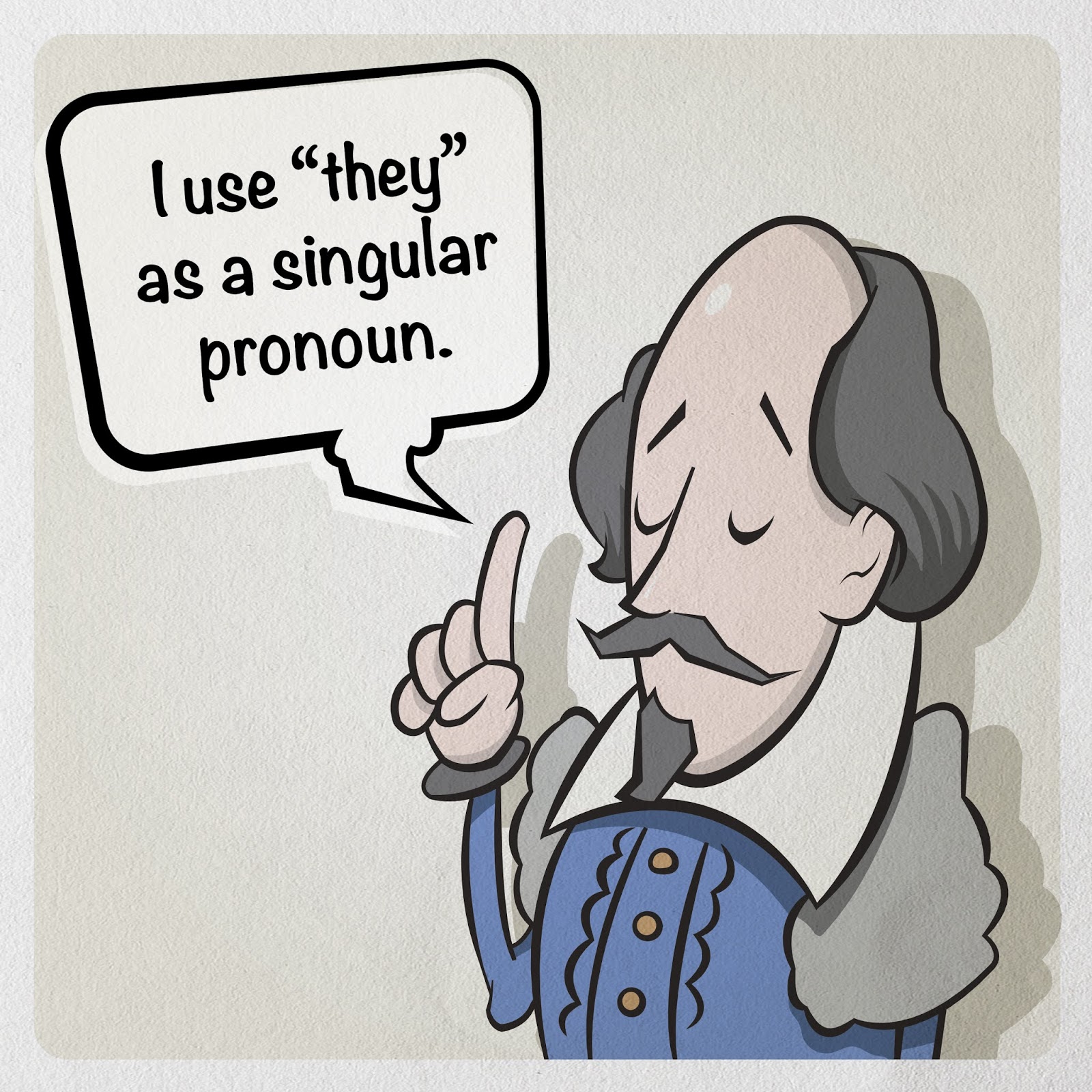
Great writers from the past used they as a singular pronoun.
[It was] a normal pattern in English
that was established four centuries before the 18th- century
grammarians invented the solecism. The plural pronoun is one solution devised
by native speakers of English to a grammatical problem inherent in that
language––and it is by no means the worst solution (Merriam Webster’s
Dictionary of English Usage, 1994, p. 902).
The following examples date as far back as the 14th century.
“The righteous man … that taketh not their life in vain––Pearl,
ca. 1380 (spelling modernized)
There’s not a man I meet…As if I were their well-acquainted
friend––Shakespeare, The Comedy of Errors, 1593” (Merriam
Webster’s Dictionary of English Usage, 1994, p. 902).
This linguistic problem could be considered one of “ad fontes”
where linguists are going back to the sources to prove that the lack of a
gender-neutral singular pronoun is not an issue brought to light only because
of the feminist movement of the ‘70s.
The problems surrounding the invention of the printing press are
analogous to our present-day problem with using they, their, and them
as singular pronouns. The English-speaking world doesn’t seem to have a problem
with using they when it speaks, but as soon as it goes to print, it goes
“prescriptivist” and starts spouting off what the grammarians insisted on in
the 18th century.
According to linguist John McWhorter(1998), “The only thing
keeping us from taking advantage of it [singular they] has been the
power of the prescriptivist hoax, starting with Lowth and Murray’s inevitable
whacks at it back in the 1700s” (p. 124).