Showing posts with label music. Show all posts

Monday, May 27, 2019

5 Theses on Potential of Music Therapy

Of all the debated issues in psychology, I would like dive a little deeper into the idea of nature vs. nurture. My personal experience and academic study has led me to the conclusion that human psychological development is strongly influenced by both nature (i.e. genetic and personality factors) and nurture (i.e. experience and exposure to ideas). There are certainly natural tendencies that every person is born with. The things a person does and learns has a tremendous impact on their development, however. 

This is what has fueled my interest in music therapy. It has already shown great promise for people recovering from trauma–particularly neurological trauma. By my own observation, I would argue that the use of music is of great benefit to a person at any time, not only following trauma.


Monday, November 26, 2018

Talk Like You Sing

On March 5, 1946, Winston Churchill gave his famous address entitled Sinews of Peace. One thing that struck me about this speech is Churchill’s voice and the way that he uses vocal intonations to further his points in conjunction with how he uses the English language.

Vocals
I found that Churchill’s voice was very authoritative without being overwhelming. At least to me, he came across as being very grandfatherly, as someone having dominance in the household but doing what he is doing out of love.

He seeks to cast away any apprehension that the audience might have with regards to his intention. He says, “Let me however make it clear that I have no official mission or status of any kind, and that I speak only for myself. There is nothing here but what you see.” This is said in a very clear way, and the vocal intonations give the impression of someone who is being honest and completely open. Were he trying to deceive his audience, the words may have come out more hardened and absolute with no room to argue. However, in this instance, there is no artificial sweetener in his voice. It is easier to believe that Churchill is speaking his mind and that he has no intention of deceiving his audience.
Our voices change when we speak, just as when we sing.


Musical Rhythm
Churchill uses not only his voice to deliver his points, but he also uses his mastery of the English language. For example, he says, “Let us preach what we practice -- let us practice what we preach… I have not yet spoken of poverty and privation which are in many cases the prevailing anxiety.”

I have listened to speeches before where I felt that the speaker did not know what they were talking about. But, oftentimes when I have reviewed their words, I have found that what they were trying to say was admirable, but that their lack of knowledge concerning the use of language hindered the effectiveness of their delivery. I have rarely met anyone who doesn’t appreciate music, which usually has regular rhythm and rhymes. Speech is not much different. When people are able to use language in a way that is more palatable to the ear, people are more willing to give heed to what is said.

Were people more cautious in the ways that they speak, they would find it easier to persuade people. Speaking the same way we sing (without actually singing, of course) might not be a bad idea.


Image Credit: Wikipedia public domain "Frequency vs Position on the Treble Clef"

Wednesday, November 14, 2018

The Saxophone, a Magnificent Monster

Look at this beast!

Initially invented in 1846 by Adolphe Sax, it wasn't until the 1920's that the Saxophone really came into prominence. It was seen as an important staple of the Jazz music genre alongside other brass instruments, which really came to dominate the musical tastes of the Roaring 20's. While initially the genre it was a part of was simply a derivative of ragtime, with the inclusion of the Saxophone alongside the popular instrument of the time the piano, the swinging dance music fused with the smooth sombre tones of the blues to form a combination that would both inspire people to dance and party as well as establish a good atmosphere in the room. It got it's big start down in New Orleans (or "N'Orlens" to any with a southern drawl), but soon migrated up into the smokey clubs of the Northeast. The saxophone was even included in a number of orchestra's in the 1920's such as the Duke Ellington Orchestra, having it's place cemented in classical music history.

I will gladly admit my love of this musical instrument, in every style of music. It's croons help in forming the conjured emotions present in the blues and classical pieces, as well as to help decelerate the tempo of a piece, such as in Derek and the Dominoes guitar piece "Layla". Meanwhile, the rapid fire jabs of a true master of the instrument can help establish the atmosphere of a freeform style like Jazz, or in more controlled bursts to set the pace for a action-packed song in a movie or video game. Even hearing my Godmother's son play his soprano sax is a delight to the ear, as the vibrations echo throughout the house and into my bones. Truly, there is nothing more wonderful, more soothing, more empathetic than the shrill cry of the sax player's beast.

Image Credit: "Alto Saxophone" obtained via Wikimedia Commons

Friday, November 9, 2018

Romanticizing the Day of Wrath

Having been a music lover my whole life, I went to my first day of Music 101 my freshman year of college not expecting to learn anything new that semester. Sure enough, much of it was review and the hardest part of the class was remembering which days the tests were open. 

By the end of the semester, though, I found I had gotten much more than an A out of the course. It had opened my eyes, or ears I should say, to music from composers and times that I had not before appreciated. 

In one unit, we listened to samples of Gregorian chants that were sung in Medieval churches. I was fascinated by the harmonies and stirring melodies, and I wasn't the only one.

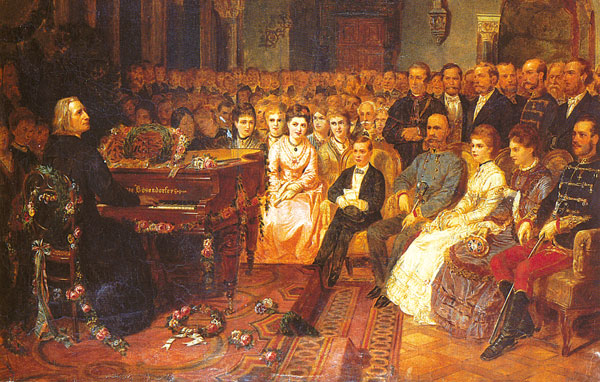
Image result for franz liszt
Franz Liszt playing for an audience
Franz Liszt completed Totentanz: Paraphrase on Dies Irae in 1849. It is a piece for solo piano and orchestra that takes the themes from one of the most haunting melodies from the Gregorian Era and develops it into an amazingly textured creation.

Liszt was a rock star of his time, and romanticizing the slightly grotesque and macabre was the thing to do. In his piece, the simple theme is repeated over and over, swirling across different instruments, octaves, and modes.

This piece has since been on my playlist and I listen to it often. No matter my current emotion, it always seems to satisfy. There are strong booming chords that release any anger in my system. There are fluttering, light moments that feel bouncy and pleasant. There are smooth melodies for contemplative peace and glorious finales for when I am feeling like a conqueror.

Every single listen takes me on that emotional ride and by the time it is finished I feel full and accomplished, and Dies Irae, "The Day of Wrath" is ingrained in my mind.


Image Credit: Wikipedia Commons

Thursday, November 8, 2018

Wedding Fanatic

This last spring and summer, I received enough wedding invitations to cover my entire refrigerator. This is not an exaggeration one bit. For two months, every single weekend was booked with wedding receptions.  And get this.  There were even weekends where I attended multiple receptions, just to make sure that I could congratulate my newly married friends.  I’m sure many of you can relate to this, especially those of you who are in my same stage of life.  What were your thoughts going to the mailbox day after day and seeing another one “bite the dust?”  Now, you might think I am crazy for how I felt about it, but I’m not going to hold back. Each time I opened another invitation, my heart did a little jump.

Musical Time-Travel

I remember at 5 years old sitting at my family's desktop PC in our loft, entranced by the bright green screen as Peter skipped across it to his theme. My Peter and the Wolf computer game wasn't particularly complex or stimulating; it was basically an animated movie set to Prokofiev's music and a narration, but you clicked to move from scene to scene. It was one of my favorites though. Before I started playing music myself, the game—and Prokofiev's composition through it—introduced me to music that could carry you to a different world and completely alter your emotions.

My juvenile computer game served Prokofiev's original goals for his piece well. He was commissioned to write it by the director of the Central Children's Theatre of Moscow in effort to teach children about music and a variety of instruments. The composer himself learned to play the piano out of inspiration from his mother, who played herself, and he wrote his first composition at age 5. He would continue on to write ballets, operas, piano compositions, and more over his lifetime. He began writing music for children after he had some of his own, which is when he wrote his iconic Peter and the Wolf.


Prokofiev's piece is great not only because it is stirring and educational, but also because it tells a story. That's part of why it affected me so much as a kid. I was entranced by the way the instruments, keys, and melodies illustrated the characters and events. The idea has become more common to us now because music is such a core element in movies, but it's amazing how much power of emotion and narrative a piece of music can have.

A few months ago, I listened to Peter and the Wolf again, for the first time in years. I had remembered the game and wondered if I would still enjoy the music—I was not disappointed. If anything, the themes were more stirring than I remembered, and the story even more enchanting. It transported me back to those times I spent in our loft, following Peter and his animal friends on their adventure.

An Elegy towards the New World: Dvorak

The Ever-Evolving Composer

The first time that I had ever heard the 4th movement of Dvorak's 9th Symphony was in a video game called Asura's Wrath in 2013. In that game, the rebellious god Asura challenges his old teacher Augus to a battle to the death. As the two deities clash on the lunar surface, the finale to the New World Symphony begins to play as an accompaniment to the clash of fists. Watching this hot-blooded conflict as a high-schooler gave me stars in my eyes, and the song which played stuck around in my head for weeks, and I would find myself humming to it's tune as I walked to class. It was only later, of course, that I would even find out the symphony's name, and could listen to it on YouTube in it's entirety.

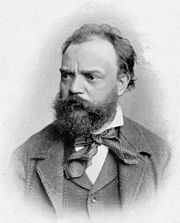
Antonin Dvorak (Ahn-toe-nin Di-vor-shack) was the typical musical prodigy common among famous composers having been proficient at the violin since the age of 6. He became famous after his death for mixing African spiritual melodies as well as Native American dances into his most famous work, the 9th or New World Symphony. Considered one of the greatest musical works of all time, a recording of it was brought by Neil Armstrong onto the Apollo 11 mission. Within 30 seconds of the 4th movement's beginning, we have the sort of leitmotif a nefarious warlord would have, as he crushes the world beneath his feet. It transitions into a lighter, but still gray repeating continuation, before descending into quiet, but hopeful stillness with the usage of the flute. Thus proceeds an optimistic march which is interspersed with several brief returns to that oppressing opening. Eventually, we reach the "Largo" of the piece which had been used by Dvorak's student William Fisher for the spiritual song "Goin' Home", which wears it's African influence on it's sleeve. We then transition to long stretches of tranquility before moving into the climax, a true return to the opening once more before the final minutes of victorious trumpets, marking the end of the piece. 

Ultimately, the 4th movement tells a story, a story of darkness which conquers all and destroys peace before finally in the end being defeated by a simple good. It's a piece of music which I hold close to my heart.

Image Credit: "Antonin Dvorak" via Wikimedia Commons

Hark! The Herald Angels Sing


Ever since I was a young kid, I can remember singing Hark! The Herald Angels Sing every December around Christmastime. Along with the other classic Christmas hymns like Joy to the World, Silent Night, and, my personal favorite, The First Noel, this song is one that I love to sing repeatedly every holiday season to help me feel close to Jesus Christ as I'm celebrating His birth. I can recall many times where I was either singing it in church with the rest of the congregation, hearing other people perform it as a special musical number in church, or even getting to sing it with my school choir for a winter concert during my senior year.


The music for Hark! The Herald Angels Sing was created by Felix Mendelssohn, a well-known composer from the Romantic Era, with the lyrics being penned by Charles Wesley. Living from 1809-1847, he has composed many piano pieces and even made an overture for A Midsummer Night's Dream. I've definitely performed a couple of his other pieces in choir as well as this one. But even though his other works continue to be performed today by choirs, orchestras, and pianists alike, Hark! The Herald Angels Sing is probably one of his more popular compositions that is still known in the mainstream world and that I can still remember by heart.


With December just around the corner, it's pretty likely that you'll soon hear some different versions of Hark! The Herald Angels Sing. Many of us know this song very well and have fond memories with family and loved ones tied to it. As you listen to it this approaching holiday season, I hope you can find as much joy in it as I do allow it to touch your heart with it's beautiful melody and lyrics.

The Mountain King and I

For me, music is has become part of who I am. It can both reflect my mood and shape it. I have played the piano since I was five years old and although I have much less time to practice now, I have come to find it relaxing. Over the past couple years my love for romantic/classical music has grown immensely. One of my favorite pieces is In the Hall of the Mountain King by Edvard Grieg. 

I'm not sure what initially drew me to this song, the melody itself is relatively simply as it is mostly a growing crescendo of the original refrain, resulting in an epic climax that brings the piece to an end. Perhaps what draws me to it is in the name itself, the imagery of what is happening in this hall of the fantastical Mountain King. I have always been drawn towards worlds that are fantastical in nature and this piece is a musical story, providing in its own way another world to delve into.


And all of that was before I learned about the whole story, about Peer Gynt and Edvard Grieg. Peer Gynt is notable by itself as a romantic play with the beginnings of modernism. It follows the peasant anti-hero Peer from his downfall to his redemption. It is nationalistic in that it is a call back to Norwegian heritage and story, while also providing social commentary in a satirical way. But it is Edvard's music, which was created when the author, Henrik Ibsen wanted to dramatize his poetry, that really remains with us today. The dramatic contrasts in pieces like the In the Hall of the Mountain King with its nearly imperceptible beginnings to its swelling end is powerful and helps tell a part of the larger drama that plays out across the 90 minutes of music made for Peer Gynt.

For me this piece represents exploration, into new genres of music as well as into new parts of our lives. Although I had been practicing and performing music by comparable composers of the time, this was one of the first romantic pieces that i really enjoyed listening to. It also reflects how life can feel, at first we may be very quiet, trying to explore and understand more without making to much of an impact. Then something changes, for better or worse things have changed and it will not be the same. This can be both good or bad, the music and life leaves that up to us to decide. 

Wednesday, November 7, 2018

Section C


It was one of those surreal moments when the world seems to stand still and nothing exists but you and the music you're playing.  I always feel that way when I play the C section of Edvard Grieg's Wedding Day at Troldhaugen.  The volume gradually builds over several measures and finally releases into a majestic melody that's both thrilling and liberating.  And then it ends. 

But you know there's more the composer wants to say.  He takes a breath and begins again, and the dynamic contrast is unmistakable.  The melody is tender and clear, captivating but soft.  This is section C.  (Start clip around 0:55 or the beginning then see if you can identify section C.)


My mom is a pianist and taught me for several years before I studied with other teachers.  Wedding Day at Troldhaugen is one of a plethora of pieces I grew up listening to her play and decided to learn.  It’s beautiful listening to it, but it’s the music transforms when you’re the one playing it (I actually get really frustrated trying to find recordings that accurately reflect that emotion.)  While I love nearly all classical music, Romantic and 21st-century pieces specifically seem to have that extra element of the sublime that so accurately expresses what words fail to yet how is the part that remains mysterious in its indefinability.

Grieg was also raised in a musical family in Norway and was taught piano lessons by his mother for several years before going to a conservatory to learn more.  His pieces reflect the emotion and imagination of the Romantic era, telling exciting and moving stories.  The above-mentioned piece was written in commemoration of his 25th wedding anniversary; this expression of his personal feelings is consistent with the emphasis on the individual during that time period.

A few of his other pieces revolve around stories and events as well.  For example, his piece, In the Hall of the Mountain King, was written for a play about a troll king and elicits a mysterious feeling that's exhilarating and almost scary because the audience doesn't know where it's going to lead.  This song is also played in the movie The Pied Piper.  He wrote a funeral march for his fellow composer and it was later played at Grieg’s own funeral.  Grieg was able to meet with several composers throughout his life, including Franz Liszt and Tchaikovsky, both of whom inspired Grieg through their music.

Saturday, November 3, 2018

I Don't Know

Something Big: The earth is absolutely massive
I've always loved flying. I love the airport, I love free pretzels and I love sipping a ginger ale cranapple mix out of a tiny red straw. The craziest part of flying to me is the descent. It's insane to look out the window and see how tiny and monopoly like all the buildings and properties look, sky scrapers look like you could push them over with your hand and the land plots in circles and squares make you feel like you're a child playing with a toy city. The magnitude of how enormous and how small the world is all at the same time is completely baffling to me.

Something Broken: Children's Unit at the Utah State Hospital
I'm taking an abnormal psychology class this semester because it totally fascinates me. We are required to volunteer 22 hours for the semester and I somehow ended up in a unit that I don't think I'm technically supposed to be on, but it's been cool, terrifying and heartbreaking at the same time. I volunteer on the children's unit. For a child to be institutionalized in a psych hospital, it has to be pretty intense for them to get there. They need to be completely uncontrollable, have almost committed murder or be a serious threat to others. To justify these kids being taken away from their families it has to be so out of hand that the benefit of treatment outweighs the damage of being away from parents. But there is so much dissonance. These boys will be in the hospital for months, with little to no parental love or closeness, they learn behaviors from each other, they hurt and have to sleep in their cell room with a sheet and a blanket. There is no one to hold them if they cry. It can't be right.

Something Artistic: Music
There is no other way I'd rather spend my money than on a good concert. I'm not moneybags over here, but I'm more than happy to shell out, travel or go to ridiculous measures to see one of my favorite artists. I think I'm my absolute happiest when I'm listening to incredible music that makes me feel things. I can't get enough of it. Now I'm obsessed with creating it on my own music that hopefully does that same thing for other people. (click here if you're curious) . I'm still not where I want to be, but the fact that music can do that for people enthralls me. I want to do that for others, and I'm not quite there yet, but I will be someday.

Something Mysterious: Death
The classic primary lesson of the glove and the hand makes sense. It does. But when someone I know dies, it still is baffling to me. The fact that they can be here, and then gone is so disheveling to me. The fact that someday my parents will die is haunting. The rest of the world will continue on, but when that day comes and the people that have been the most consistent in my life are gone I know it'll totally rock my world.

What Brings Us Together?

Something Big: The mountains are calling
Every time I walk out my front door I look up at the mountains. Whether they're covered in a white blanket, glowing under sunset rays, or basking in the midday sunlight, I can't get enough. It becomes almost a staring contest because I think that the longer I look the more I'll be able to comprehend their grandeur and beauty. The fact that something so indescribably beautiful can exist baffles me. I will stare at the mountains for twenty minutes straight, and I still can't wrap my head around it. They don't look real to me, they look like romanticized scenes from a painting. I just can't understand how the earth can be so beautiful or what humans have done to deserve something so magnificent.

Something Broken: What brings us together?
I know that marriage is all the hype in life, but I just don't really understand what the point is. If anything else had only a 50% success rate, nobody would do it. If love leads people to get married, then where does that go? If two people truly love each other in a marriage, then how do they get to the point of walking away? I guess I'm with Haddaway in asking, "What is love?" If it's this all-powerful emotion that can change the world, why can't it keep people together and happy? And also, why does everyone push marriage when you only have a 50/50 chance of ending up happy in the end?

Something Artistic or Man-Made: The sound of music
Something so obvious yet so perplexing. Notes, chords, harmonies, instruments--how is it that these can have such an effect on our emotions? I can be feeling completely as I describe in the "Something Broken" section above, but throw on "Livin' For You" by Boston, and within minutes you have me borderline crying and fantasizing about love and romance. It's beyond my understanding; it has the power to reach people from all walks of life and experience. You can have a group of a hundred people with different stories, interests, background, careers, but when "Sugar We're Goin' Down" by Fall Out Boy starts playing, you will never see a more united group of people for those three and a half minutes.

Something Mysterious: Missing Someone
Five years ago, my family suffered the loss of my dad. It was hard, but people told me it would get better. Five years later, and I don't think it's gotten better; it's just gotten normal. When I think about the pain, it feels just as strong and overwhelming as it did back then. I'm just used to it now. The human heart has such phenomenal strength to overcome, but it seems that the pain of missing someone who has died is something that the heart can't overcome. How is it that in the midst of this pain you can feel so overwhelmed that you feel like you might die, but continue to go on?

Friday, November 2, 2018

That's What I Was Gonna Say

Something Big: The Black Hills
Alyssa & I at Mount Rushmore
I stared up at the faces looming before me, their detail lessened the distance between them and me, but their size defined two separate worlds.  Driving through the Black Hills reveled greater depth and greater height.  It was a sea of rocky mountains and trees.  It was expansive and unending, and I felt small.

Something Broken: Partners in Crime
We ran up Old Main hill, taking pictures and laughing as we usually did.  But something had changed in the past year.  My best friend, M, and I were partners in crime, running buddies, doorbell-ditching pals, and homework helpers.  But something shifted the last year of high school.  We still had our share of time together, but the camaraderie we'd had changed.  And soon we spent less and less time together.  Our first semester of college together was the same, and even though we said we were best friends we never reached the point of closeness we'd had before.  She left on her mission the week after I came home, so who knows what will happen when she gets back.

Something Artistic or Man-Made: Servant or Master?
My favorite part had arrived.  All else evaporated into the silence and I closed my eyes.  The music led my hands from one key to the next--ever pulling, demanding, hungry and desperate to expose itself.  I thought I was the musician here.  Yet I felt something that my fingers couldn't express: it transcended physical ability and captured what couldn't be spoken.  The striking melody was both haunting and beautiful; calming yet intensifying; satisfying but at the same time disappointing--for nothing else could articulate what a wordless conversation had inspired. (see Khachaturian Concerto Part I below; see 3:22 or 11:14)


Something Mysterious: That's What I Was Gonna Say
I opened the email from my mom with anticipation.  The previous week I'd asked her to send me my biological dad's address.  At the end of the email she said, "Oh that's funny--Alyssa asked me the same thing last week too."  We, my twin sister and I, were both serving missions and this wasn't the first time (nor the last) something similar happened.  My older brother frequently yells, "Jinx!" as he hears us say the same thing at the same time.  Often when Alyssa and I are talking, I say what she's thinking (or vice-versa) or we finish each other's sentences.  And although we only have a few of the same clothes, we nearly always wear them on the same day.  

Sunday, September 23, 2018

Bach's Got Sprezz?


Our nonchalantly clever friend, sprezzatura, made his mark not only in conversation and dress but also in music.  As a pianist, this was exciting to discover.  But I wasn’t surprised to find out what its theme-song is: jazz.  You can hear it in the music as much as you can see it in the pianist--one hand on the keyboard, eyes wandering around the room, reflecting an ambiance of easiness.  The music itself is laid back, seemingly casual, but paradoxically striking and captivating.

But that’s not what they played in the 1600s.

Johann Sebastian Bach was the star of the 1600s and is still a highly-praised musician today.  His music is admirable for its technicalities—it’s very vertical, systematic, and almost dry.  Yet this somehow expressed the culture of the scientific revolution.  The music has purpose; it moves progressively forward towards a predetermined destination.  (For image of Bach's sheet music, click here).

Playing Bach requires concentration and drilling--there's little room for improvisment because the interpretation is straightforward.  It's dull but comfortable.  Jazz, on the other hand, is a whole different ball game.  A few chords are thrown at you but the music that stares back at you from the piano is more white than black.  It's daunting, sometimes petrifying, but also thrilling.  It could take you nowhere and it'd still be a great adventure (try it out here).
Jazz Piano Sheet Music

So was sprezzatura re-personified in the 1600s?  Or did Bach's music, coupled with other Baroque arts and scientific discoveries take center stage?  

Image Sources: "Piano clip art" (via pxhere)
"Jazz Piano" (public domain images via Wikimedia Commons)

Saturday, September 8, 2018

Papal Patronage: Leo's Luxuries

Known for his cheerful disposition (and his spending of the Church's coffers), Pope Leo X is an interesting figure within the period known as the Renaissance. Simultaneously a genuine holy man, a luxurist and a politician, Leo has become a controversial figure in this modern era. The most infamous reason, of course, was his excessive spending. Two years of his papacy had led to every florin and ducato that his predecessor Julius II had ever obtained vanishing into thin air. His own personal income would make most company CEO's jealous, with a recorded income of 580,000 ducats one year, which translates into the modern US dollar as 102.5 million. When finally realizing how quickly money was going down the drain, he resorted to such measures as selling the robes and hats of cardinals, pawning off items of the church and even statues of the apostles themselves. It is hardly surprising, then, that his successor Pope Adrian VI became known as a severe penny pincher.

The Benefits?
Just because he spent enormous sums of money does not mean he did no good. In 1513 he reformed the University of Rome such that all of the faculties which had been shut down due to budget cuts were restored, all of the professors teaching there had their pay increased as well as hiring teachers from across the continent. His donations helped establish the first Greek printing-presses within Rome, and he gave stable jobs within the clergy to important artists and poets at the time, the most famous of whom being Raphael. He donated millions of modern dollars annually to hospitals, war veterans as well as many other sick and inflicted. The highest salaries paid at that time were given to Musicians to lend their voice (or their instrument) to the Church Choir, and it was under his guidance that the common folk, regardless of language, could join the Choir in song.

Regardless of whether or not he was truly a hedonist as some accused him of being, Leo was a significant factor in the development of music and other arts during his time.