
Showing posts with label romantic period. Show all posts
Showing posts with label romantic period. Show all posts
Thursday, May 30, 2019
Planning My Post about Nature and Mental Illnesses
For my final blog post, I will be talking about the effects that nature has on mental illness (specifically depression and suicidal thoughts) and how that ties into the Romantic period. Personally, I have struggled with mental illnesses but have experienced a sense of peace when I am out in nature that cannot be paralleled by anything else, so I am excited to write about the beauties and benefits of spending time in nature. I am currently gathering thoughts and ideas and am in the process of making a general outline for the final post.

Saturday, November 10, 2018
The Anti-Sublime
World War I convinced the Enlightenment thinkers who believed they lived in the best of all possible worlds that, in fact, the world was not all crêpes and crème brûlée. In the war, most of Europe had experienced the horrors that people could inflict upon each other first-hand. One result of this was that people became fascinated with the sublime.
A Very Long Engagement, a film by Jean-Pierre Jeunet, explores the themes of that period in multiple layers. The film follows the story of a young French woman, Mathilde, whose fiancé, Manech, is sent off to fight in World War I. She is told he died in the trenches, basically sentenced to death because he self-mutilated. However, there are strings of uncertainty in the story, so she investigates to find the truth for herself.
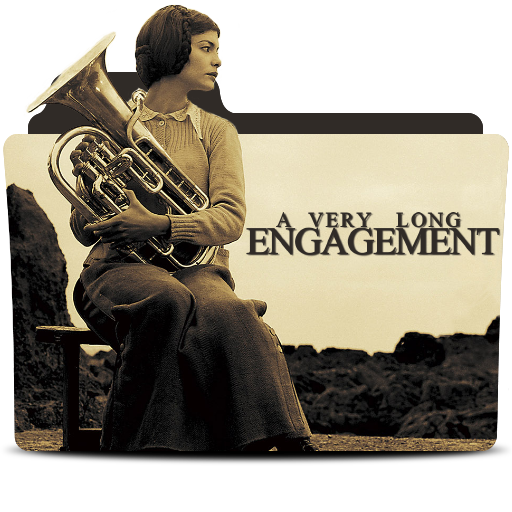 |
| Mathilde solemnly plays her tuba while she waits for Manech to return. |
The Individual
In searching for the truth of her fiancé's death, Mathilde explores the lives of other men who had suffered his same sentence alongside him. She finds the unique truths behind their times in the trenches, as well as the truths of the people they left behind in France. These stories give a very personal perspective on a very large war.
The Sublime
The tragic romance of Mathilde and Manech is the classic type people have loved for centuries. It is terrible, but in a melancholy, heart-aching way that is pleasing to experience at a distance. This film entertains that form of the sublime while pushing against a greater one: war. Machine guns obliterate anyone who goes above the trenches into no-man's land, bombs explode and splatter soldiers' viscera onto their friends' horrified faces, men shoot their fingers off with shotguns in efforts to escape the rot-and-lice-ridden hell of the trenches. This film does not glorify the nobility of dying at war; it depicts death in gory, gut-wrenching detail. I, at least, went away from the film solemn and struck with the horrors of war, not inspired to pick up a rifle.
I'll admit the idea of going to battle has at times sounded to me. It was more in the way of fantasy novels in which people fight on horseback with swords and crossbows. Regardless, with its individual approach and challenge to the sublime elements of war, A Very Long Engagement effectively horrified me against the notion that battle is in any way romantic.
Thursday, November 8, 2018
Musical Time-Travel
I remember at 5 years old sitting at my family's desktop PC in our loft, entranced by the bright green screen as Peter skipped across it to his theme. My Peter and the Wolf computer game wasn't particularly complex or stimulating; it was basically an animated movie set to Prokofiev's music and a narration, but you clicked to move from scene to scene. It was one of my favorites though. Before I started playing music myself, the game—and Prokofiev's composition through it—introduced me to music that could carry you to a different world and completely alter your emotions.
My juvenile computer game served Prokofiev's original goals for his piece well. He was commissioned to write it by the director of the Central Children's Theatre of Moscow in effort to teach children about music and a variety of instruments. The composer himself learned to play the piano out of inspiration from his mother, who played herself, and he wrote his first composition at age 5. He would continue on to write ballets, operas, piano compositions, and more over his lifetime. He began writing music for children after he had some of his own, which is when he wrote his iconic Peter and the Wolf.
Prokofiev's piece is great not only because it is stirring and educational, but also because it tells a story. That's part of why it affected me so much as a kid. I was entranced by the way the instruments, keys, and melodies illustrated the characters and events. The idea has become more common to us now because music is such a core element in movies, but it's amazing how much power of emotion and narrative a piece of music can have.
A few months ago, I listened to Peter and the Wolf again, for the first time in years. I had remembered the game and wondered if I would still enjoy the music—I was not disappointed. If anything, the themes were more stirring than I remembered, and the story even more enchanting. It transported me back to those times I spent in our loft, following Peter and his animal friends on their adventure.
My juvenile computer game served Prokofiev's original goals for his piece well. He was commissioned to write it by the director of the Central Children's Theatre of Moscow in effort to teach children about music and a variety of instruments. The composer himself learned to play the piano out of inspiration from his mother, who played herself, and he wrote his first composition at age 5. He would continue on to write ballets, operas, piano compositions, and more over his lifetime. He began writing music for children after he had some of his own, which is when he wrote his iconic Peter and the Wolf.
A few months ago, I listened to Peter and the Wolf again, for the first time in years. I had remembered the game and wondered if I would still enjoy the music—I was not disappointed. If anything, the themes were more stirring than I remembered, and the story even more enchanting. It transported me back to those times I spent in our loft, following Peter and his animal friends on their adventure.
Subscribe to:
Posts (Atom)