Showing posts with label Translation. Show all posts

Friday, October 4, 2019

Form vs. Content: A Tale of Translation

Lutherbibel.jpg
Original copy of Luther's translated Bible - 1534

Language and communication in the sixteenth and seventeenth century were paramount in shaping the beliefs of the people and the overall social climate. For the first time, religious and secular texts were made available to the masses as a result of the printing press. Translation efforts made these texts available to even more people, changing communication and learning completely. Being a dual-language speaker myself, I was particularly interested in the role that translation played during this era, and how the people responded to that role. What kind of texts were being translated? How common was translation? What problems arose from such translation? 

Friday, September 28, 2018

Calvin, Luther and Joseph Smith


Latter Day Saints have a deep seated belief that the reformers were inspired men that paved the way for the restoration of the Gospel. In the missionary guide Preach My Gospel, leaders of the church mention the reformers as, " 
 truth-seeking men and women [who] protested against current religious practices. They recognized that much of the doctrine and many of the ordinances of the gospel had been changed or lost. They sought for greater spiritual light, and many spoke of the need for a restoration of truth"

While many of these changes of practice and belief influenced Latter-day Saint beliefs dramatically, a few did not.


       Late reformers like Gerrard Winstannly  taught that salvation would come to all men. This universalist ideal came out of the "sola scriptura" movement. In his book, 'The Mysterie of God'  Winstannly uses this scriptural ethos, "for every man shall be saved, saith God through Paul". He attaches the idea of universalism to God himself, building his argument, and denying the traditional Catholic belief of purgatory and hell. This idea of universalism spread like fire. Winstannly helped to found the Quakers, a prominent universalist group in New England. Joseph Smith's dad was also a universalist, which influenced young Joseph in questioning some of the local preachers ideas on salvation and who deserved to be saved. 


      This comes in stark contrast to other restorationists John Calvin and Martin Luther. Calvin taught that salvation was predestined. There were no works, no Eucharist, nothing that would help to save you. Only if God had chosen you could you be saved. Thus, work was no good for salvation, but those good works would grow out of the belief. Luther taught a similar "sola fide" theology. This was the idea that only by faith, not works are we saved. They came together in their opposition of the Catholic churches work based salvation, and authority. Using the new technology of the printing press, Martin published essays against the papacy. They demonstrated an effective control of decorum, using German and newly possible pictures to appeal to the commoner. 


Erasmus
The spirit of ad fontes, found in nearly all the reformationists also inspired early Latter day saint culture. Erasmus' translation of the bible into Latin was an attempt to make the Bible more like the original Greek manuscripts. He did an in depth comparison of the manuscripts to the old latin translation and tried to find the spirit of the words. Others like Wycliffe, and later on, the King James Version  translators would also attempt to make translations that were more accurate and had power behind them. This ideal was what drove Joseph Smith to study Hebrew, German, Greek, and other languages in an attempt to read the original manuscripts, and carries on today in the LDS culture of scripture study.
     

           The Latter day Saints believe that "to hell there is an exit as well as an entrance" (Talmage) and that almost all will be saved. This belief comes out of our scriptures and our interpretations of them. It is a blend of all three reformers beliefs. Where "Sola scirptura" "Sola Fide" and Universalism meet is where you find the core of the Church of Jesus Christ of Latter Day Saints.


photo attribution - Bundesarchiv, Bild 183-60015-0002 / Giso Löwe / CC-BY-SA 3.0 [CC BY-SA 3.0]

By Hans Holbein - Web Gallery of Art:   Image  Info about artwork, Public Domain

"What a Piece of Work is Man"

"What a piece of work is man."
- Shakespeare's Hamlet (Act ii, Scene 2)

As Hamlet gives this famous soliloquy he reflects on both the inspiring and negative sides of the human condition. His deep analysis of the human condition on the level of the individual would not have been discussed without the enlightenment of the secular humanists of The Renaissance, and the Christian influence in The Reformation.

Humanism played a key role in the emergence of both The Renaissance and The Reformation. Although both embraced the ideals that humanism carried, the sources through which they approached their conclusions were different. The Renaissance thinkers took a secular approach as they read from rhetoricians and philosophers of antiquity (Cicero, Plato, Socrates, Isocrates, etc.). However, the pioneers of The Reformation developed their humanistic viewpoint with a realization of the spiritual individual, and through Biblical study.

The Renaissance

With the Black Plague behind them, early thinkers of The Renaissance had the task of re-evaluating the human condition and the meaning of life. These thinkers took it upon themselves to reopen the tomb like libraries filled with manuscripts written in "proper" Latin. Among these writings were the writings of Cicero, and his philosophical interpretations of humanism. Petrarch was one of the most important mouth pieces for Cicero in The Renaissance. People like Petrarch and Quintilian were intrigued by Cicero's articulation of the Latin language and sought to learn everything they could from those writings. This lead to the rebirth of the divine human and the rediscovery of the potential within each being.

The Transition

The early printing of Bibles, lead to experimentation in translation of the Biblical texts. The concept of going back to the sources was engrained in their approach to learning; people like Calvin Beza started printing Bibles with both the Latin text and the original Greek text side by side. The experimentation didn't stop there; despite the Catholic Church's refusal to translate the holy text to "common" language, the humanists wanted to give everyone a chance to live a rich "eloquent" life.

The Reformation

The translation of the Bible into an English printed script tends to take all the credit for The Reformation. There were many individuals who had a strong influence on the movement, but the motivation behind The Reformation stemmed from the original principles written in the Bible. Once the "plowman" was able to read for himself that man was created in the image of God, it made him question what was different between him and the wealthy cardinals. A new wave of humanism stemming from the sacred script was brought to light. These transcendent principles were even more influential than Aristotle, and even more available than any other script written up to that point.

Conclusion

These events are heavy weight-bearing pillars to the great structure we call "Western Civilization".  The Renaissance reintroduced the divine individual through secular Ad Fontes, and The Reformation through spiritual piety. Those of us who enjoy the freedoms of the sovereign individual can thank the great men and women whose works built the foundations where we plant our ensigns of freedom.
"What a piece of work is man."  


Photo Credit:

1. https://sententiaeantiquae.com/2017/05/09/tullys-tuesday-cicero-talks-about-sex/
2. https://commons.wikimedia.org/wiki/File:Christus_(Draft)_by_Thorvaldsen.jpg 


Saturday, September 22, 2018

On (Un)civil Dominion: John Wycliffe as an Inspiration

John Wycliffe and his "Lollards"

This can be considered a follow-up to my previous post, scrutinizing the theme of Ad Fontes.

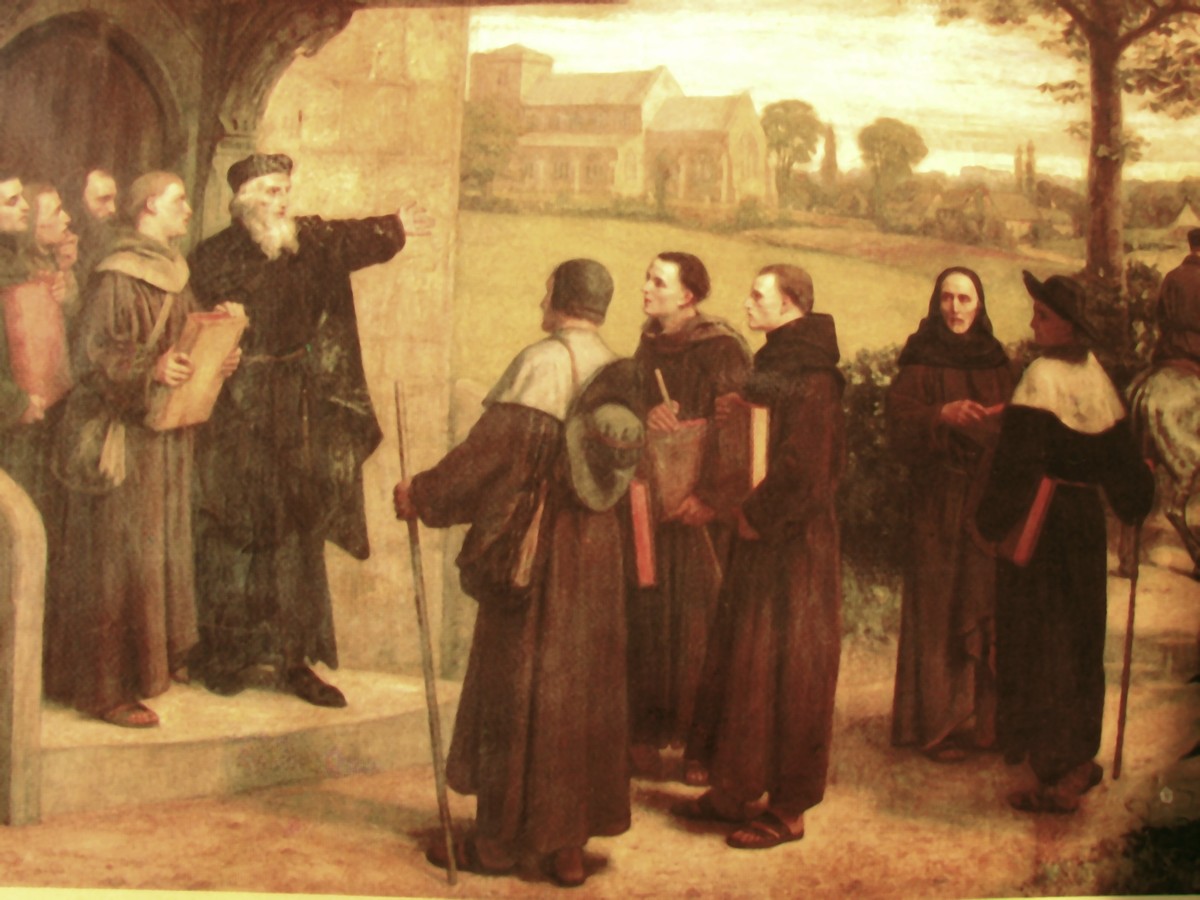
Twenty-Eight Years had passed since the ending of the Black Plague that killed off most of Europe. And in those twenty-eight years John Wycliffe had begun to develop the opinions about the church that would later get him declared a heretic posthumously. The year 1377 would be the first time he would be officially condemned by the Catholic Church, in part due to his book "De civili dominio" ("On Civil Dominion"), which included a set of admonishments stating that the Clergy should hold no property and only use what they needed to survive, essentially becoming more ascetics rather than luxurists. Two years later he would be striking even harder with his work "De ecclesia" ("On the Church") wherein he states that the very concept of Purgatory never existed, and that the issues of clerical celibacy, indulgences and worshiping saints acted as resistance to truly becoming righteous people. The act that he would become most famous for after his death was his English translation of the New Testament, which would serve as the spark required to create outright revolt among the peasant populace.

Perhaps it's a bit farfetched to say, but oddly enough John Wycliffe reminds me of an elderly Joseph Smith. With his efforts in translation, his more ascetic and puritan views on Christianity and the Priesthood and his condemnation by religious and secular entities far greater than him, he seems to share many of the qualities and difficulties Brother Smith encountered in his own life. I cannot help but wonder if the Lord helped John become so popular with the lower classes as to serve as a memetic inspiration for the Prophet's own work. That is to say, that part of the reason people were drawn to the church was because of how similar Joseph's views and teachings were to the rebellious Christians of old. There's a reason, I guess, that John Wycliffe's work is brought up in the Bible Dictionary.

Image Credit - "Wyclif Giving 'The Poor Priests' His Translation of the Bible" obtained via Wikimedia Commons