Showing posts with label scientific revolution. Show all posts

Wednesday, October 3, 2018

Hands-On Anatomy


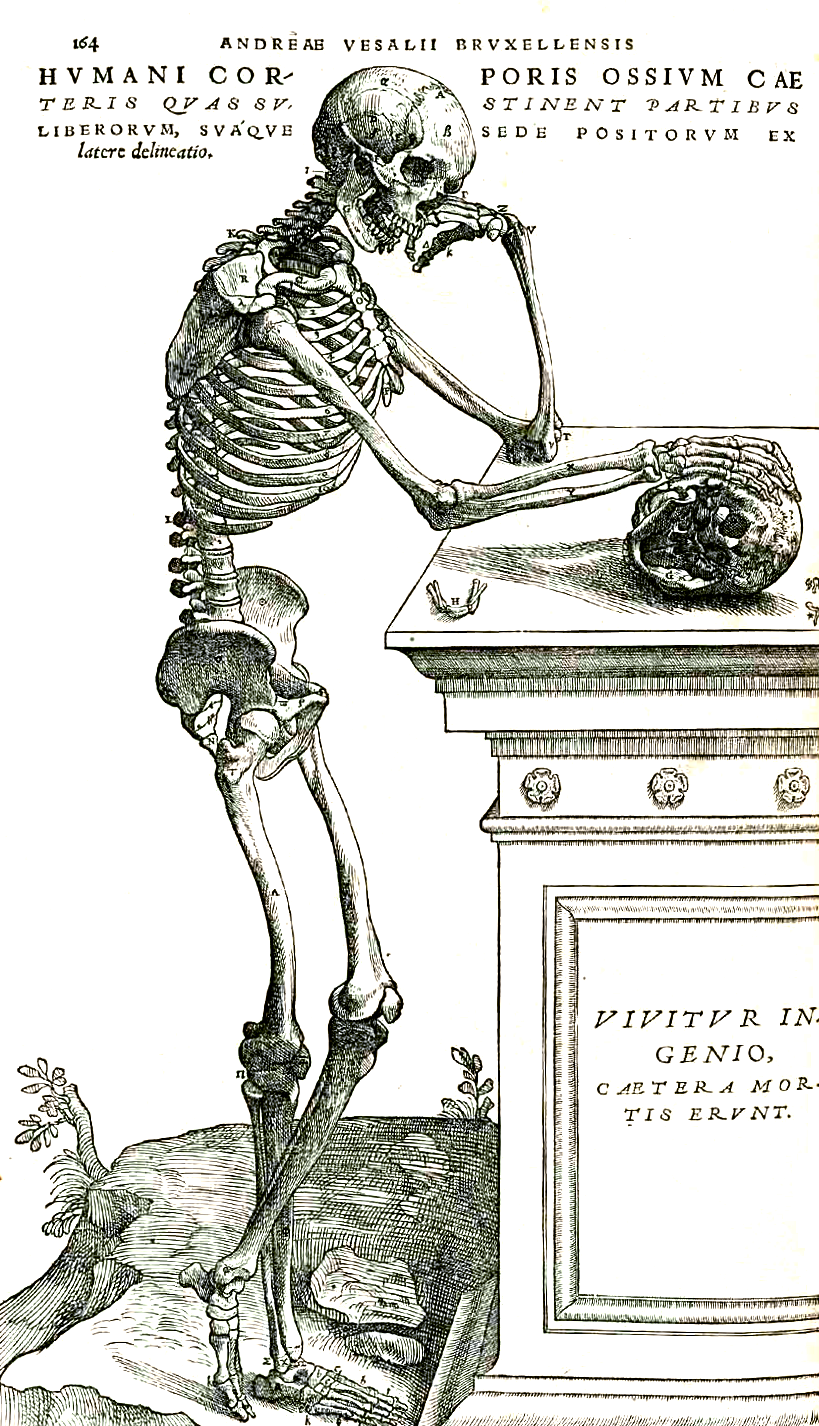
Vesalius had the models in his book
posing in picturesque environments.
We go to the doctor assuming our physicians know the difference between human and dog anatomy. However, that was not always necessarily the case. Into the 16th century, surgeons would teach their pupils about human anatomy by reading them the texts of Galen, a Greek physician in the second century. Physicians rarely if ever dissected human cadavers themselves; they learned anatomy from Galen's 1300-year-old texts, while Galen himself had never dissected a human cadaver due to religious restrictions.
Andreas Vesalius, a 16th-century physician, had a different approach. He dissected animal corpses, but he also dissected human cadavers and studied them extensively. To communicate (and show off) his knowledge, Vesalius wrote the Seven Books on the Fabric of the Human Body, commonly known as the Fabrica.

In the Fabrica, he included detailed descriptions and woodcuts of every layer of the body, from bones to nerves. Vesalius worked with commissioned artists to depict anatomy from multiple previously unseen perspectives. His goal was to clearly communicate the details of human anatomy to physicians and students. The Fabrica was so successful, cadaver dissections began to be more common. 

The Bugs And the Bees

We all go through phases and cycles in our lives, but there's one that I've never been able to escape- I love bugs. It may sound like I'm joking, but I'm not. I fell in love with insects (especially ants) when I was a kid and I've never kicked it. Being a young girl obsessed with bugs wasn't the most popular thing to be, but it was who I was, and I really couldn't help it.

One of Merian's butterflies
I think that's why I felt such a strong an immediate connection to Maria Sibylla Merian, an entomological (bug scientist) painter from the Enlightenment period.  Born in Frankfurt Germany, Merian became intrigued with silk worms, and the possibility of them transforming into butterflies.She collected as many worms as she could find, watched them transform, and recorded their metamorphosis in painting.

Merian went on to record thousands of insects in painting, and her work as a naturalist illustrator has been considered the foundation of modern entomology, a field very dear to me. What's most interesting to me about Maria Sibylla Merian, however, is not just that she made these great contributions, but the circumstances that she made them under.

In the mid to late 1600's when she was illustrating, women were all but completely disregarded in the field of science. Merian's landmark book about the transformation of caterpillars into butterflies was ignored by scientific institutions because it was in German. Regardless of this, she went on a two year excursion to Suriname and discovered and painted enough new species of plant and insect to fill a book.

In a way, I feel like Merian was not only a crucial part of the Enlightenment and Scientific Revolution, but also a symbol of it. She strove on in the face of tremendous odds, she broke ground, she paved the way. But most importantly, she was interested in the metamorphosis of one remarkable thing into another, in observing that change and recording it. When it comes down to it, what else was the Enlightenment really about?

Photo Credit