Showing posts with label ecology. Show all posts

Tuesday, December 11, 2018

ESA: Species Savior

by Haley Brown

The stakes are high when it comes to conserving the earth's biodiversity; is the Endangered Species Act up to the task?


bird wing looking wildlife beak eagle fauna bird of prey bald eagle vertebrate alaska falcon buzzard inflight bif kachemakbay andymorffew morffew naturethroughthelens baldeagle accipitriformes
The bald eagle is one of the ESA's success stories.
The Endangered Species Act (ESA) is generally considered to be a positive program. A poll from 2015 showed that 90% of Americans support it. Since Richard Nixon passed it in 1973, the act has aimed to prevent animal and plant species from going extinct due to human interference.

Ecologists agree that legislation to conserve biodiversity is necessary—each species plays a unique role in its ecosystem, so the loss of any can be detrimental. However, ecologists disagree on the ESA's efficacy. Currently over 2000 species are on the list of endangered and threatened species covered by the act. 99% of species on the list are still around, which some see as a success. However, critics are more focused on the mere 1% of those that have been recovered and removed from the list. So how should we measure the ESA's success? With the condition the earth is in now and all the destruction humans have inflicted upon our natural neighbors, the ESA's success can really only be judged justly by the species it has kept from extinction.

Wednesday, December 5, 2018

ESA: Hopeless, or our last hope?


The passenger pigeon was once the most abundant bird in North America, at about 3 to 5 billion individuals. Accounts from settlers to the continent note that when the pigeons would pass overhead in their huge flocks, the sky would go completely dark. Yet, in 1914, the bird went extinct. People hunted them until the population was so small they couldn't reproduce. There were no kill limits (or those that were finally enacted were not well enforced), and no conservation efforts until it was too late.

We may never see a cloud of passenger pigeons again, but their extinction did lead to something beneficial: an awareness of the importance of conservation and a boom in environmentalism. After that point, countries began to pass acts that would help to conserve species from the same fate. In 1973, the United States passed the Endangered Species Act (ESA), which increased the level and scope of protection given to animals and plants considered endangered or threatened.
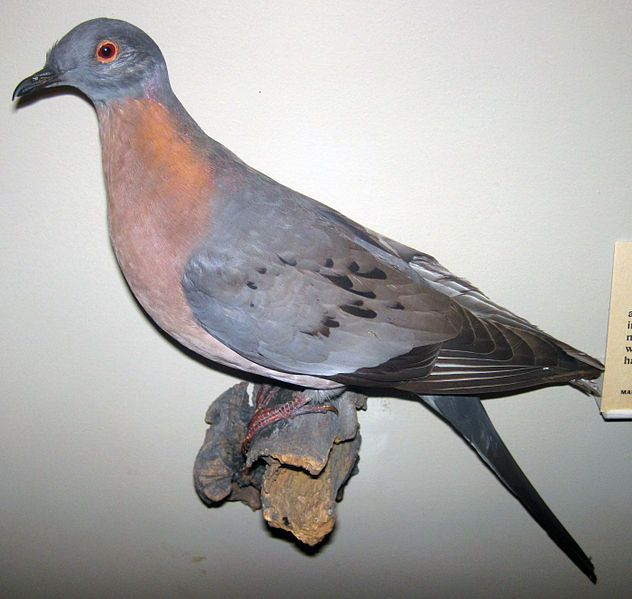
File:Ectopistes migratorius (passenger pigeon).jpg
The passenger pigeon serves as a testament to humans' effects
 on nature and the need for conservation efforts

Since 1973, the ESA has seen multiple successes, some of the most famous being the recoveries of the bald eagle and the peregrine falcon. However, increasingly more species need attention as human population, pollution, and habitat destruction increase. The ESA does not have the funding to save every organism in danger of extinction.

The US Fish and Wildlife Service and NOAA Fisheries recently proposed changes to the ESA. Those changes include reducing spaces reserved for endangered species recovery and reducing the protection for threatened species. Some big businesses in this capitalist society would welcome fewer regulations on land use. It could also open up room for the ESA to even out their species focus.

The open platforms of the internet have allowed for myriad opinions to be shared on the proposition. Some think these changes will allow funding to be better distributed and focus on species with high potential for recovery. Others think these changes would leave regulations too open and, at best, slow the ESA's progress.

What most Americans seem to agree on (about 90%, actually, across both parties) is that we need an act like the ESA to keep our environment safe from ourselves. But is the current ESA, flawed as it may be, our best option? Will changing it further endanger our endangered species, repeating the tragedy of the passenger pigeon? Or do we need to alter our strategy to better prioritize conservation funds?

Image source

Monday, December 3, 2018

Hot Spots in Ecology

  • Biodiversity
    Some ecologists claim that biodiversity has decreased in most of the Earth's land area past "safe limits." This "safe limit" supposedly marks the point at which ecosystems could no longer support human civilization. Critics say the limit—set by the Planetary Boundaries framework—is based on many assumptions, does not take into account the influence of invasive species, and could not easily take into account the complex interactions between species. (See "Earth's Biodiversity Has Fallen Below 'Safe' Levels? Ecologists Disagree.")
  • Saving Endangered Species
    The earth goes through cycles of heating and cooling, and species evolve and go extinct along with it. Most ecologists agree that we are currently going through an extreme, human-caused version of those historical extinction periods and should do what we can to save species from extinction. A few, even if they believe this mass extinction is human-caused, claim that it's pointless to go out our way to save endangered species; we should only worry about the extinction of our own species, and only save other species if it's convenient. (See "What is the point of saving endangered species?" and "We don't need to save endangered species. Extinction is part of evolution.")
  • Journal Impact Factor
    Researchers often choose which scientific journal to submit their work to based on Journal Impact Factor (JIF), a value given to a journal based on its perceived quality. Libraries have also used it to choose which journals to subscribe to. JIF is probably the most prevalent rating system for journals, but many ecologists and other scientists criticize it for misrepresenting the quality of journals and articles. (See "The Journal Impact Factor and alternatives.")
Of these three controversies, I am most intrigued and emotionally affected by the second. I am a proponent for saving animal species; I love animals, and for as long as I can remember I've been taught that we need to save endangered species. All species contribute in some way to their ecosystem, and the loss of one can cause a drastic change. Additionally, myriad species are endangered because of habitat loss inflicted by humans. However, it is interesting to read anti-conservationist arguments from biologists. I can see where some of their claims make sense, which is surprising for me. Maybe what it comes down to is focusing on efforts that will best conserve the human species?

Hot Spots in Ecology


  • Invasive Species:

Burmese pythons are capable of reaching 23 ft.
in length and weighing up to 200lbs. Some of
them get to be as thick as telephone poles.
One of the hazards of living in a global community is the inadvertent exchange of organisms. Invasive species are not a new problem. They've been an issue since ships started sailing to new waters and bringing back foreign mussels. The fact remains, however, that allowing an organism to enter an environment where it doesn't have any natural predators upends the native ecosystem. This has been a problem for a long time in the Everglades with the Burmese python, but it looks like thing might be getting worse. No one knows how to stop them, and no one knows how much they'll affect the ecosystem. See: Giant hybrid pythons in Florida


  • Conservation:

Photo by Michael LaRosa on Unsplash
Ecosystems all over the world have been disrupted by human development. Some of them irreparably so, but others can be salvaged. The mission of many ecologists is to preserve as much as possible and to restore what they can. "Rewilding" natural predators is a technique being used with marginal success in Yellowstone National park, where the reintroduction of the gray wolf has resulted in an ecological rebirth for the area. Adding large predators back into their native ecosystems has its problems- it causes tension with their human neighbors, and in most cases, the animals are unable to re-adapt to the wild. See: 'Rewilding' Missing Carnivores

  • Climate Change:
Possibly the hottest topic of them all, climate change is hotly debated in this country, the split between believers and unbelievers often mimicking party lines. If our actions are effecting the environment, then we need to act fast and act now. If not, there's nothing to worry about. But there is something to worry about. The vast majority of ecologists and climate scientists agree that uncharacteristic changes are happening at alarming and unnatural rates, and we are the driving cause of that. If concern for the climate wasn't politicized, it would be so much easier to try to save a dying world. See: Trump's EPA chief on the Climate Report

This last one is the most concerning for me. All of the data that I have come across is clear, concise, and speaks for itself. Our world is suffering, and it is in our power to do something about it. The biggest problem is the way the data points are communicated. Their either put across as too threatening by those who agree, or too dismissively by those who dissent. There has to be a more moderate, less rhetorically and politically charged way to address this issue. I've got to believe that there is.