Showing posts with label capitalism. Show all posts

Tuesday, December 17, 2019

“Narcissistic and Depressed” (or, one of the great many letters I wish I had the guts to send to my Religion professor.)

Dear Professor —— :

I have a lot of suggestions for how this course could be improved, in order to be more sensitive to the diversity among the members of the class, but right now I want to talk about when I first realized this class was not the right place for me. It happened roughly thirty minutes into the first class session, which was the amount of time before you began pontificating about how and why my generation are all ‘narcissistic and depressed’.

“I’ll tell you why we’re all depressed,” I thought immediately. “It’s because the world is dying and we can’t fix it because we’re all slaves under late-stage capitalism.”

Wednesday, December 5, 2018

ESA: Hopeless, or our last hope?


The passenger pigeon was once the most abundant bird in North America, at about 3 to 5 billion individuals. Accounts from settlers to the continent note that when the pigeons would pass overhead in their huge flocks, the sky would go completely dark. Yet, in 1914, the bird went extinct. People hunted them until the population was so small they couldn't reproduce. There were no kill limits (or those that were finally enacted were not well enforced), and no conservation efforts until it was too late.

We may never see a cloud of passenger pigeons again, but their extinction did lead to something beneficial: an awareness of the importance of conservation and a boom in environmentalism. After that point, countries began to pass acts that would help to conserve species from the same fate. In 1973, the United States passed the Endangered Species Act (ESA), which increased the level and scope of protection given to animals and plants considered endangered or threatened.
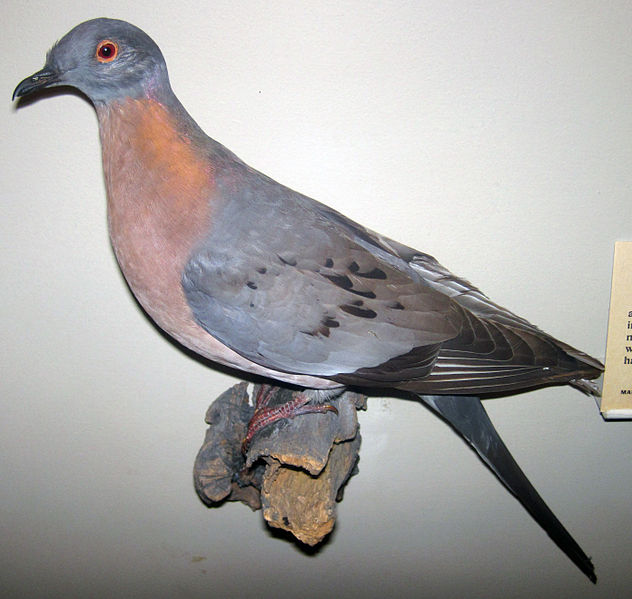
File:Ectopistes migratorius (passenger pigeon).jpg
The passenger pigeon serves as a testament to humans' effects
 on nature and the need for conservation efforts

Since 1973, the ESA has seen multiple successes, some of the most famous being the recoveries of the bald eagle and the peregrine falcon. However, increasingly more species need attention as human population, pollution, and habitat destruction increase. The ESA does not have the funding to save every organism in danger of extinction.

The US Fish and Wildlife Service and NOAA Fisheries recently proposed changes to the ESA. Those changes include reducing spaces reserved for endangered species recovery and reducing the protection for threatened species. Some big businesses in this capitalist society would welcome fewer regulations on land use. It could also open up room for the ESA to even out their species focus.

The open platforms of the internet have allowed for myriad opinions to be shared on the proposition. Some think these changes will allow funding to be better distributed and focus on species with high potential for recovery. Others think these changes would leave regulations too open and, at best, slow the ESA's progress.

What most Americans seem to agree on (about 90%, actually, across both parties) is that we need an act like the ESA to keep our environment safe from ourselves. But is the current ESA, flawed as it may be, our best option? Will changing it further endanger our endangered species, repeating the tragedy of the passenger pigeon? Or do we need to alter our strategy to better prioritize conservation funds?

Image source

Tuesday, November 13, 2018

Distribution of Wealth


Throughout all time and in all societies, the distribution of wealth has been and will always be a problem. I doubt there will ever be a solution that will satisfy the masses. 

It was the English philosopher John Locke who was known as the “Father of Liberalism.” He believed that a person should be able to enjoy individual freedoms, and that the government should protect those freedoms. Locke preceded Adam Smith who was known as the “Father of Capitalism.” Smith also believed that the government should not intervene in the workings of the marketplace. Smith’s ideologies are spelled out in his book The Wealth of Nations. From the problems of the Industrial Revolution came the idea of Socialism: that wealth should be distributed equally. Capitalism seemed to produce too many losers and not enough winners. 

For over fifty years, I have struggled personally with the unfair distribution of wealth. Having come from both a famous and wealthy family, I always feel the need to take care of those less fortunate than myself. Over the past thirty years, I now have had enough experience to realize that people who are really motivated to succeed in life will do so, regardless of their economic circumstances, and that there are people who are willing to accept as much help as you give them, never intending on trying to better their lives along the way. 

                                                                                       Image credit: flickr.com

The irony of my situation is that my dad began as one who did not have many resources to help him fulfill his dream. At age six, he decided that he wanted to be a cartoonist. He served three years in World War II, and upon returning, he began to do all he could to fulfill his dream. His Peanuts comic strip was syndicated in 1950, and he went on to become the most famous cartoonist the world has ever seen. 

Being a part of that legacy causes me to favor the idea of capitalism. The world is filled with people like my dad who would not have been able to contribute to society if it had not been for the freedom to do so. That being said, dad was always bothered by the income he received from drawing the strip. It did not seem fair to him that although he did the same thing every day, for fifty years, his income increased constantly. But, isn’t this what capitalism is? Dad created a product that the world loved. It was the choice of the Peanuts fans that caused his income to increase. 

As a human race, we are here to dream, however big or small. Capitalism allows the dreams of one to be enjoyed by many.