Showing posts with label audience. Show all posts

Monday, November 26, 2018

A Malleable Audience

To see what an impactful orator was Winston Churchill, one need only look at the fact there is an award-winning film, The Darkest Hour, that centers around his ability as a speaker. Phrases from his iconic speeches remain in the minds of even the least historically attuned. One speech that stands out is the "Sinews of Peace" speech he gave at the start of the Cold War. For better or worse, it was powerful, and its message spread worldwide.

Winston Churchill delivering his "Sinews of Peace,"
aka "Iron Curtain," speech at Westminster College
in front of an attentive audience.
An essential part of Churchill's speech is kairos. The former prime minister delivered it at Westminster College in Fulton, Missouri, to as large an audience as would fit in the gymnasium, with President Harry Truman beside him. He knew he had an intelligent, attentive audience that included US officials with power to influence change.

Almost the first half of the speech is written to connect the orator to his audience. He starts off with some rather effective humor, and by linking himself to the president, he cements his authority as a speaker to an American congregation. In the first half of the speech, Churchill makes increasingly bold claims followed by statements recognizing that he and the audience are in agreement (also made apparent by the audience's applause). By the halfway point, there is an evident connection between Churchill and his listeners.

Once Churchill builds a rapport with his audience, he gradually uses that trust to ask them to consider an idea of his: unifying the United States and the British Commonwealth. He leans heavily on both logos and pathos for this. He calls the people to action against fears that most were all too familiar with ("the two great dangers which menace the home of the people, War and Tyranny"), and lists specific ways in which unifying would be logical and beneficial ("This would perhaps double the mobility of the American Navy and Air Force."). I can imagine those calls would be particularly powerful to citizens of a country that had just been through a heart-wrenching war and continued to live in fear of looming catastrophic bombs.

Churchill frequently uses repetition, congeries, and alliteration to drive home his points, and his delivery makes them even more stirring ("For them is all distorted, all is broken, all is even ground to pulp."). It's difficult not to connect with language that is crafted in such a way as Churchill sculpted his.

Image

Friday, September 28, 2018

Audiences Shift

Happiness vs. Utilitarianism
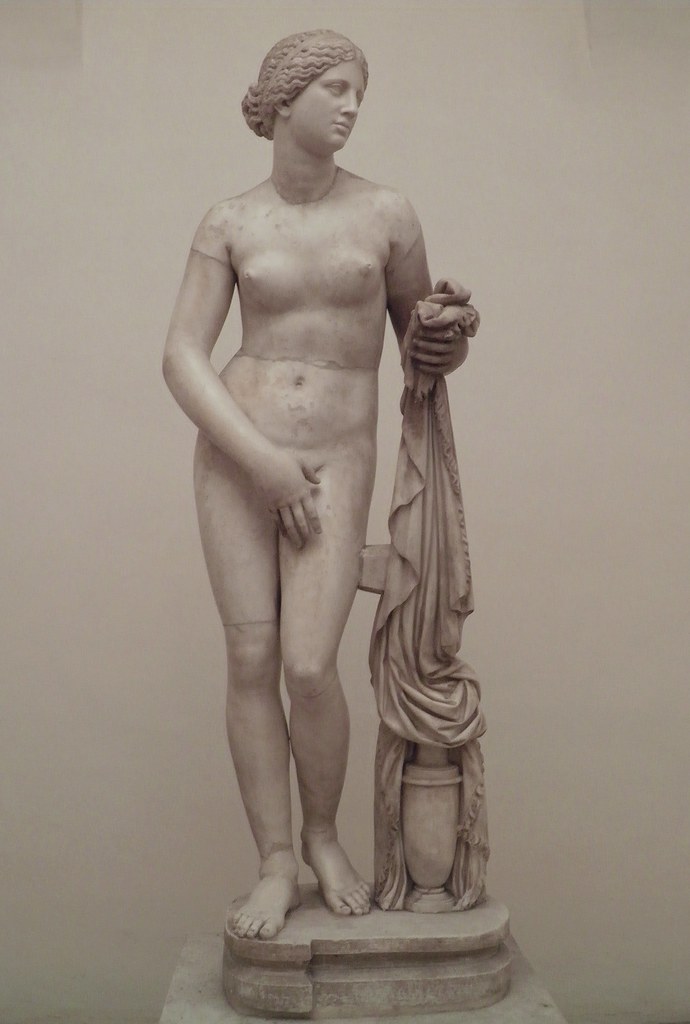
Praxiteles's Aphrodite of Knidos, a
Classical celebration of human form.
“Of all things the measure is Man, of the things that are, that they are, and of the things that are not, that they are not." Here, Protagoras is is basically saying "Man is the measure of all things." A Classical philosopher, he taught that every individual had their own version of the truth—that truth was relative to the person perceiving it. Protagoras taught people to appreciate the individual and the wide array of perspectives people have. To him, humans are not only greater than the beasts of the earth and the angels in the heavens, but higher than truth itself.

This heavily contradicts the beliefs of pre-Renaissance Christianity. The general belief during that period was that people were fallen souls and had to live by the Church’s rules to have a chance at having any worth and getting to heaven. People in anything lower than the upper class were thought of and treated like tools, made to work constantly in a feudalistic society. In any class, though, the Catholic church was law, and any education or art centered around it.

Plato, on the other hand, believed that eudamonia, happiness, was the highest goal of thinking. A fellow philosopher, Cicero also considered the individual variations within his audiences and shaped his persuasive techniques accordingly. He recognized that some people were not educated or willing enough to be persuaded by logic alone and decided it was okay to use emotion as a persuader with those audiences. As Somer discusses in her post, speakers and artists must always take the audience into consideration.

Thursday, September 13, 2018

The Rhetoric of the Divine


In class today, Professor Burton touched on the perspective of rhetoric among some of the first philosophers as being “amoral” and therefore “immoral.” As a Latter-day Saint I have seen the contrary to this statement because as a literary student, I have seen God use rhetoric and rhetorical devices such as kairos (“the contingencies of a give place and time”) and audience (“how an audience shapes the composition of a text or responds to it) to restore the Church of Jesus Christ as it exists today. Therefore, as silly as I feel writing it, rhetoric is divine and used even in the Lord’s communication with us.

With the invention of the printing press, communication, literature, etc. were mass produced and given to the public. This of itself is Kairos because it changed the way people thought and how were educated, especially with the mass production or the Bible. Their religious ideals were changed to accommodate the inevitable restoration of the Church that was going to occur a few centuries later.

Audience was important for the Lord as well leading up to the Restoration. The way He addressed Joseph Smith in the First Vision was most likely accomplished and successfully understood by the fourteen year old boy because the Lord new His audience and knew the audience that Joseph would first preach to after he was given instructions to restore the Church. This was all carefully planned, just as the rhetoric in a piece of literature is carefully planned according to the Kairos and audience of the situation.


Tuesday, September 11, 2018

Audiences for Blog Posts, Building One's Ethos

Commercially-oriented blogs, or those blogs in which a person or organization is consciously trying to create and maintain a brand or a public presence -- these blogs already have a very clear sense of their public. Academic blogs, blogs created in and primarily for education -- these do not.

But I want my students to practice their public presence, much in the spirit of Renaissance sprezzatura (but also as a practical matter of learning to be more publicly oriented when posting online).

Here is a teacher's short video about how audience gives educational technology rigor. I heartily agree. Watch the last minute or so, starting at 2:13:

Katie McKnight Podcast Series #9: Where is the Rigor in Educational Technology? from TeachHub.com on Vimeo.

Okay, if we want our blogging to address real audiences, we need to avoid only speaking to ourselves. How is this done? Well, by avoiding "in-speak":