Showing posts with label Montaigne. Show all posts

Friday, September 28, 2018

Audiences Shift

Happiness vs. Utilitarianism
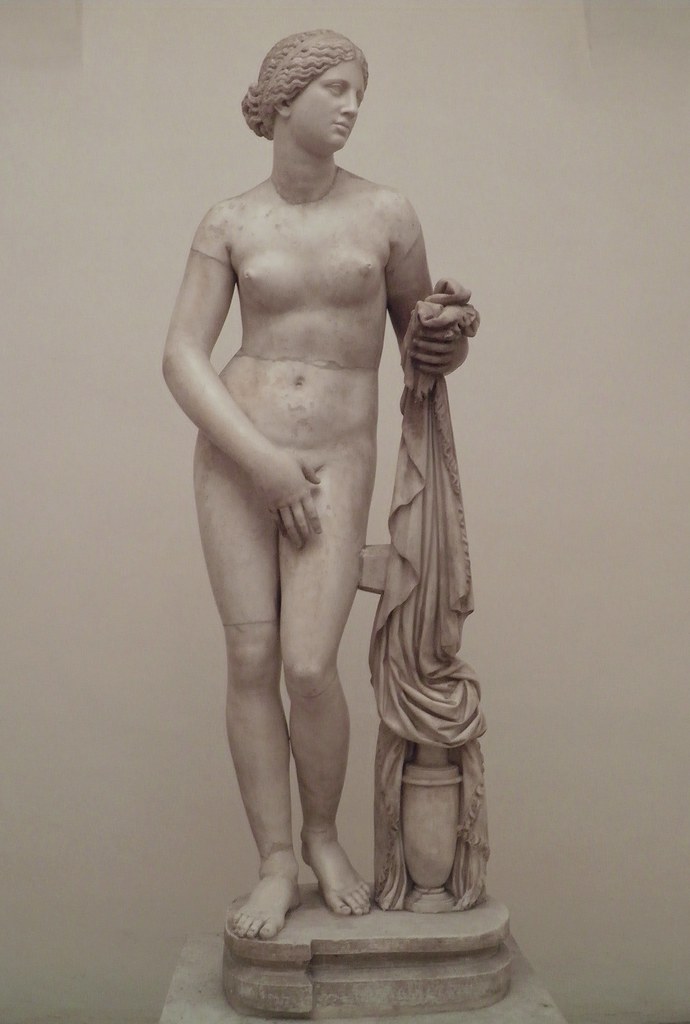
Praxiteles's Aphrodite of Knidos, a
Classical celebration of human form.
“Of all things the measure is Man, of the things that are, that they are, and of the things that are not, that they are not." Here, Protagoras is is basically saying "Man is the measure of all things." A Classical philosopher, he taught that every individual had their own version of the truth—that truth was relative to the person perceiving it. Protagoras taught people to appreciate the individual and the wide array of perspectives people have. To him, humans are not only greater than the beasts of the earth and the angels in the heavens, but higher than truth itself.

This heavily contradicts the beliefs of pre-Renaissance Christianity. The general belief during that period was that people were fallen souls and had to live by the Church’s rules to have a chance at having any worth and getting to heaven. People in anything lower than the upper class were thought of and treated like tools, made to work constantly in a feudalistic society. In any class, though, the Catholic church was law, and any education or art centered around it.

Plato, on the other hand, believed that eudamonia, happiness, was the highest goal of thinking. A fellow philosopher, Cicero also considered the individual variations within his audiences and shaped his persuasive techniques accordingly. He recognized that some people were not educated or willing enough to be persuaded by logic alone and decided it was okay to use emotion as a persuader with those audiences. As Somer discusses in her post, speakers and artists must always take the audience into consideration.

Thursday, September 13, 2018

Trying to be human


“Finding yourself” is a common enough term today. I would say most people are interested in introspective pondering and working to figure out what makes them feel content and fulfilled. This type of thinking also abounded in the Renaissance. Rather than think only what they were told to think and do what they had to do to survive, people in the Renaissance began to think about the world and themselves in different ways than ever before.

Michel de Montaigne, the first essayist.

A leader in this art was the writer Montaigne. He wrote about his daily life, musing about one topic or another, basically recording his thoughts on paper. These writings he coined “essais” after the French word “essayer,” meaning “to try.” Montaigne’s musings were attempts to understand himself and his world, and they often delved into ideas that were deeper than their titles.

People read Montaigne’s essays and were amazed to see the situations they had experienced and feelings they had felt written so brilliantly. A line from We Taste Nothing Purely reads “In sadness there is some alloy of pleasure.” I know exactly the feeling he is talking about, but I would never have even thought to put it into words. His essays also opened people’s minds to new ideas, which was an integral aspect of the Renaissance. On Cannibals, for example, explores the idea that the cannibals Montaigne met in Brazil could be more moral than the “civilized” people of Europe.

The desire to put everyday thoughts and experiences into words never died out; Montaigne has influenced writers for centuries. Personal essays of today still exhibit that humanistic exploration of self. Joyas Voladoras, written in 2004 by the late Brian Doyle, contemplates the heart. “We are utterly open with no one in the end—not mother and father, not wife or husband, not lover, not child, not friend. We open windows to each but we live alone in the house of the heart. Perhaps we must.”

It’s certainly a testament to humanist ideals that, after all this time of people exploring what it means to be human, we’re still trying to figure it out.

Image credit: Portrait of Michel de Montaigne, circa unknown by unknown author is in the public domain.

Saturday, September 8, 2018

Chaos vs Order: The Motivation Behind the Voyages

The Renaissance Man. He had effortless style in his dressed, he was well versed in subjects ranging from math to rhetoric, and most importantly he was a sovereign individual. His ancestors lived in a world where sovereignty remained in the hands of the state and it's constituents were born into their destinies as predicated by fate (or the state). After being introduced to sovereignty, the Renaissance Man saw beyond the tyrannical order that bound his ancestor's destinies and followed his natural instinct to explore the chaos of the outside world. He continually waded through the unknown waiting for an idea to grab hold of him. The drive to comprehend and create resulted in the voyages of people like Sir Walter Raleigh and Michel de Montaigne.

Every individual needs order and consistency in their lives to remain sane. But, when order become tyrannical people are tend to either wreak havoc where they are just to have something to put back together, or set off on an adventure to understand and put together all the unknown puzzle pieces outside of their domain. Leaving the tyranny of the Tower of London in search for gold is not just Sir Walter's story, but an archetype of human behavior. While the description of his adventures is not honest, his narrative of their quest into chaos lives on.

Michel de Montaigne lived out this archetypal ideal as well, however seemed to gain more from his journey than just a bedtime story. Montaigne encountered the unknown when he met the "Cannibals." He could have recoiled in the face of so much chaos and labeled them as barbaric like many other voyagers of his day, but instead he had the courage to take one step further into the dark. By taking the time to observe and contemplate the seemingly chaotic traditions of the natives, Montaigne was able to organize all the new information he observed and concluded that the Tupinamba Indians were very similar to the people he new in his homeland.

This level of understanding would not have been possible without the enlightenment that resulted out of the Renaissance. As an individual continually exposes themselves to chaos and makes a sincere attempt to put in comprehensible order, they will move closer to reaching their full potential of Being. 

Montaigne's Difference Between Novelty and Nature


            Michel de Montaigne was a French essayist of the Renaissance. One of his essays is titled “Of a Monstrous Child” focuses on the concept prevalent in the Renaissance that men have a greater worth and dignity that was previously not believed in the Middle Ages, when men were considered “cogs in the universe” instead of a central part of the universe such as was believed in the Renaissance.
            The essay “Of a Monstrous Child” recounts the experience of Montaigne observing the relationship of a deformed child (the deformity was the abscess of an underdeveloped conjoined twin) and his uncle, who was leading him around the town in which they lived seeking donations for the “freak show” of nature that he has marketed as. Montaigne’s moral of this essay is that though there is something that is not understood because of its oddness, anything alive is still created from God: “Those that we call monsters are not so to God, who sees in the immensity of His work the infinite forms that He has comprehended therein; and it is to be believed that this figure which astonishes us has relation to some other figure of the same kind unknown to man.”
            On the concept of infinite worth of men, this essay further proves that the Renaissance mindset shifted from only the holiest religious man was worth something in God’s eyes to anything created by nature (and therefore God), no matter its strangeness, has dignity and is worth respect.
            Montaigne ends his essay with a citation from Cicero whose philosophical writings also inspired the humanism movement: “What he often sees he does not admire, though he be ignorant how it comes to pass. When a thing happens he never saw before, he thinks that it is a portent.”