Showing posts with label being-human. Show all posts

Friday, September 28, 2018

Audiences Shift

Happiness vs. Utilitarianism
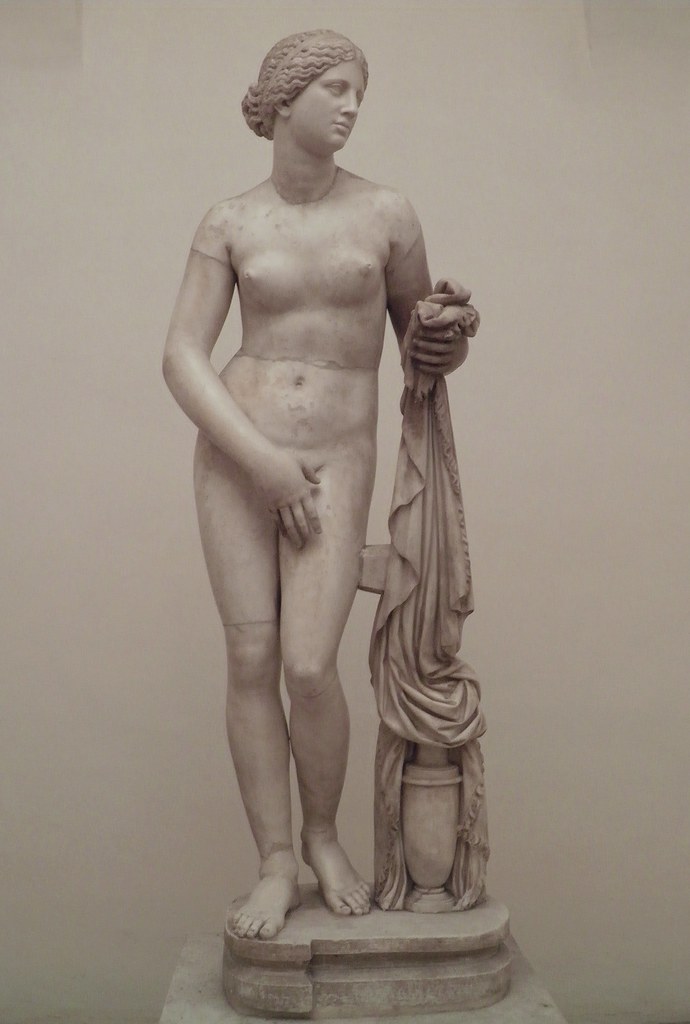
Praxiteles's Aphrodite of Knidos, a
Classical celebration of human form.
“Of all things the measure is Man, of the things that are, that they are, and of the things that are not, that they are not." Here, Protagoras is is basically saying "Man is the measure of all things." A Classical philosopher, he taught that every individual had their own version of the truth—that truth was relative to the person perceiving it. Protagoras taught people to appreciate the individual and the wide array of perspectives people have. To him, humans are not only greater than the beasts of the earth and the angels in the heavens, but higher than truth itself.

This heavily contradicts the beliefs of pre-Renaissance Christianity. The general belief during that period was that people were fallen souls and had to live by the Church’s rules to have a chance at having any worth and getting to heaven. People in anything lower than the upper class were thought of and treated like tools, made to work constantly in a feudalistic society. In any class, though, the Catholic church was law, and any education or art centered around it.

Plato, on the other hand, believed that eudamonia, happiness, was the highest goal of thinking. A fellow philosopher, Cicero also considered the individual variations within his audiences and shaped his persuasive techniques accordingly. He recognized that some people were not educated or willing enough to be persuaded by logic alone and decided it was okay to use emotion as a persuader with those audiences. As Somer discusses in her post, speakers and artists must always take the audience into consideration.

Of Humanity and Monsters


If you start introducing the history of the Black Plague in the right announcer voice, it sounds like the trailer for a great post-apocalyptic flick. The difference between history and fiction in this case, however, is in the rebuilding. One of our movies would focus on struggle, weakness, and the worst of us. It would look at human goodness with a scarcity mentality, celebrating moral grayness at the end of the world.

But, the Humanists didn’t. They found their glory in the strength and beauty of humanity. These thinkers came through a tragedy where they had very little control or ability to save lives (and were essentially at the mercy of fleas) celebrating the greatness of man. This seems counter-intuitive, but I’m still working on my cynical tendencies. I could be wrong.

Whether I’m biased by a darker glass than others or not, I’m not the only one. If entertainment like The Walking Dead is a reflection of societal thoughts and fears, then we lost the Humanist mentality somewhere along the way. We’ve come to believe that we are not only the apex predator, but monster in the closet. Montaigne found nobility in humans that others referred to as savages, while we make movies like Arrival where we have to be saved from—and despite—ourselves.

While we celebrate the printing press and the effect it had on inspiring generations, there’s a good chance that this straying from Humanist thought began with the printing press as well. The printing press showed us that we were hungry to understand the world, but it also gave us the belief that we could want to understand it. That we deserved it.

That need turned into the telegram that gave us news of the American civil war and the sinking of the Titanic. It gave us the radio that filled us with reports of a war-torn Europe. Then it gave us the film that showed us the holocaust and the atom bomb. In the grand scheme of things, it didn’t take us very long to go from criticizing the Catholic church for burning Bibles to wondering how we can control information in our day and age.

So, after seeing in graphic detail just what kind of evil humanity is capable of, do we get to say “What a piece of work is man!” with sincerity or sarcasm? Can we still look on the human form with joy? Or with only with trepidation?

I think we have to create a personal answer to that. And mine, with all of the value, experience, and cynicism that it holds, agrees with the humanists. Just with a word of caution. What a piece of work is man! And how important it is to guide that incredible power along moral lines.

Image credit to pixaby.com

What is the Value of a Life?

The Classical Ideals: Arete and Pietas
Image result for famous greek pottery battle
The ancient Greeks remain infamous for many reasons--among them, a substantial lust for glory. Arete was the virtue of the day, a word primarily denoting individual courage and excellence in areas such as battle and public affairs. 'What a primitive way of life!" some of us might think in a lofty mental tone. But is today really so different?

Instead of battle, we have business; instead of heroes, we have celebrities; instead of public oratory, we have the internet. The ideals of society have come full circle over the last three thousand years. The question is: where did the journey take us?