Showing posts with label WWII. Show all posts

Wednesday, December 5, 2018

A Brief History of Poorly Written Agreements

Contract disputes (whether between artists and streaming services, artists and record labels, etc.) are not limited to the music industry, or even to the modern day. Throughout history people have drafted all sorts of agreements, contracts, and treaties to be more beneficial to one party at the expense of another. Sometimes this stems from greed, much like the problematic artist contracts of Spotify, or from some desire for justice after being wronged.


The latter was the case for the Treaty of Versailles, the document that ended World War I, and unintentionally started WWII. The Treaty of Versailles, specifically the Way Guilt Clause found within, was worded in such a way so as to basically punish Germany for the role that they played in the war, forcing them to pay costly reparations, give up some of their land they had gained, and restrict their military power, among other things. These conditions were extremely harsh and Germany tried to negotiate them after some time, but they were hardly given any breathing room by the other countries they were paying. As such, they started the Second World War in an effort to get their punishment repealed.


Thankfully, contract disputes in the present day aren't causing any global-scale wars. However, when people get the short end of the stick from a contract they were hesitant to sign in the first place, especially well-known celebrity musicians, odds are that they will try to fight against it. Thankfully, with the help of their fans, they are often able to make the positive changes that are needed or at least makes changes happen that will eventually lead to their goal. Hopefully, we will actually make sure to read contracts ahead of time and hopefully will get to a point as people where we do not use contracts as a means of personal gain alone.

Image Credit: https://www.iamexpat.nl/career/employment-news/new-dutch-labour-laws-conversion-of-contract-from-fixed-term-to-permanent Public Domain

One Language Under God

When my parents took a month long vacation in Europe, they anticipated that they would have difficulty communicating with the various people they would come across, as they don’t speak any European languages other than Spanish. They were pleasantly surprised that with every place they visited (with the exception of one), they were met with English-speaking Europeans who were able to take their orders, show them around, and answer their questions. My parents said that this heightened their experience because they were able to effectively communicate with the locals. 
Image result for flags
Different Countries' Flags
Whether or not English should be made the official language of the world has been under debate for some time. Heck, the issue has even been pushed against in the United States, where most of its occupants speak English. That leads to a bigger question: if not English, should some other language be made the official language of the world?

When the printing press was invented, people had access to works such as the Bible in great quantities for the first time ever. New ideas spread like wildfire and new freedoms were able to stretch their toes. However, the ideas would have oftentimes been limited to those who spoke the language that was printed. Were the world to have had a universal language at that point, unique ideas might have spread more rapidly.

During World War II, at least a dozen different languages were spoken by participants. It is doubtful that poor communication contributed to the War on a larger scale, but perhaps as people fought in smaller battles they could have worked things out a little better. After the war, Winston Churchill, in his speech Sinews of Peace, referred to the audience and others as the “English speaking peoples.” Perhaps people may have felt more united if all people could have been roped under a common language?


Image Credit: "National Flags" by Wikimedia public domain

Monday, November 26, 2018

A Malleable Audience

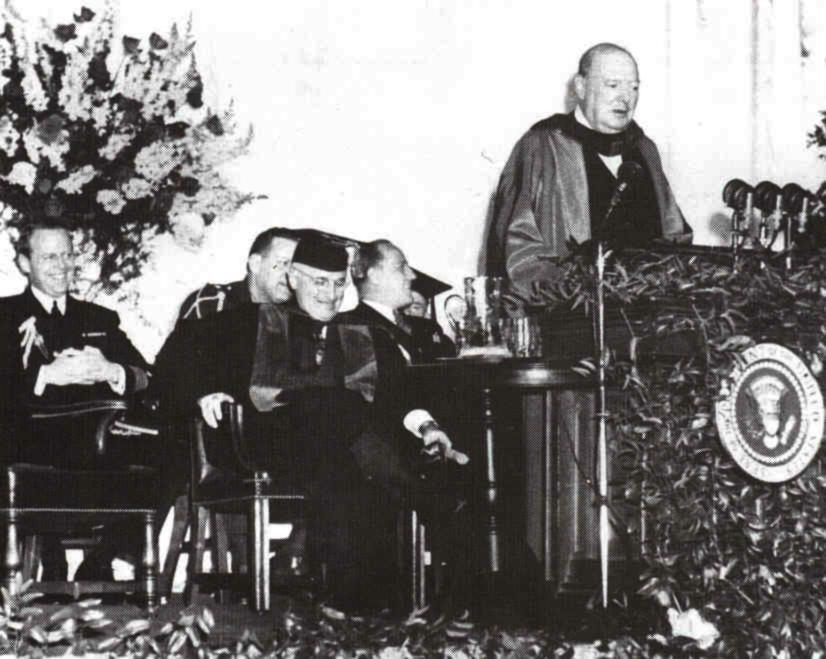
To see what an impactful orator was Winston Churchill, one need only look at the fact there is an award-winning film, The Darkest Hour, that centers around his ability as a speaker. Phrases from his iconic speeches remain in the minds of even the least historically attuned. One speech that stands out is the "Sinews of Peace" speech he gave at the start of the Cold War. For better or worse, it was powerful, and its message spread worldwide.

Winston Churchill delivering his "Sinews of Peace,"
aka "Iron Curtain," speech at Westminster College
in front of an attentive audience.
An essential part of Churchill's speech is kairos. The former prime minister delivered it at Westminster College in Fulton, Missouri, to as large an audience as would fit in the gymnasium, with President Harry Truman beside him. He knew he had an intelligent, attentive audience that included US officials with power to influence change.

Almost the first half of the speech is written to connect the orator to his audience. He starts off with some rather effective humor, and by linking himself to the president, he cements his authority as a speaker to an American congregation. In the first half of the speech, Churchill makes increasingly bold claims followed by statements recognizing that he and the audience are in agreement (also made apparent by the audience's applause). By the halfway point, there is an evident connection between Churchill and his listeners.

Once Churchill builds a rapport with his audience, he gradually uses that trust to ask them to consider an idea of his: unifying the United States and the British Commonwealth. He leans heavily on both logos and pathos for this. He calls the people to action against fears that most were all too familiar with ("the two great dangers which menace the home of the people, War and Tyranny"), and lists specific ways in which unifying would be logical and beneficial ("This would perhaps double the mobility of the American Navy and Air Force."). I can imagine those calls would be particularly powerful to citizens of a country that had just been through a heart-wrenching war and continued to live in fear of looming catastrophic bombs.

Churchill frequently uses repetition, congeries, and alliteration to drive home his points, and his delivery makes them even more stirring ("For them is all distorted, all is broken, all is even ground to pulp."). It's difficult not to connect with language that is crafted in such a way as Churchill sculpted his.

Image

Unification Through Pathos

My great-grandfather's Pound
When I was a baby my great-grandfather left me with a silver Pound that had the face of Winston Churchill on the back. He gave it to me because he thought that, as a baby, I looked like Churchill. It may have been a nice way of saying I should aspire for Churchill's wit because my looks wouldn't get me very far. Churchill was always just the funny looking guy on the back of that coin until I the Sinews of Peace Speech. Or, more commonly referenced as the Iron Curtain Speech. 

Considering the Kairotic nature of the situation, Churchill wanted to express the need to spread democratic western values through the unification of western countries. The speech was carefully pieced together such that it would convince those who hold close to western values join in the grand unification of the world's force for good against evil. The United Nations. Churchill uses many rhetorical devices to prove his argument. I will discuss his appeal to Pathos through his oratory delivery and his literary devices.

Oratory

Churchill delivers his address as slowly and as carefully as he wrote it. The times where he mixed up his words he would redo until it was said exactly right. His careful delivery could be heard in the way that he emphasized the first word in each of his major phrases. "OUR supreme task and duty is to GUARD the homes of the common people..." (7) This was a common strategy in dramatic speech delivery of the time. The dramatic tone carried over to develop a serious mood for the listener, so as to give incentive for the listener to pay close attention. 

Literary

"Let us preach what we practice--Let us practice what we preach" (13) This is one of many figures of speech that were employed in an effort for Churchill to appeal to the pathos. In this case, the antithesis is used to offer inspiration to the listener. He also uses amplification to create a climax.

"The dark ages may return, the Stone Age may return on the gleaming wings of science, and what might now shower immeasurable material blessings upon mankind, may even bring about its total destruction." (18)   

In conclusion, while pathos was only one of the three persuasive appeals used by Churchill, it may have proven to be the most useful. His words were meant to resonate with people of different backgrounds who shared an emotional value that was thoroughly challenged throughout the previous three decades. A value common to westerners of all nationalities. Freedom.
        

Prophet of his time: Churchill's call to stand together

In 1946 with the damage caused by World War II fresh in everyone's mind, most people were thinking of peace, proclaiming that the "war to end all wars" had ended. No one wanted to hear of the potential for another war, but in March when Winston Churchill spoke at Westminster College in Fulton Missouri, he came as one looking ahead to the next great problems that the Western world would face. As he examines the future based upon the past he shows how it is only through working together and seeking to avoid a nuclear war that the world will survive.

Image result for winston churchill iron curtain
Churchill at Fulton Missouri
Churchill begins by recognizing his location and audience and humanizing himself, proclaiming that these were his thoughts, and not necessarily Britain's. He continues by identifying his audience, praising America and its democracy, accepting them as the superpower of the world and essentially tells them that "with great power come great responsibility." He then uses assonance to describe the three important qualities necessary to promote democracy: "constancy of mind, persistency of purpose, and the grand simplicity of decision."

With this framework in mind, he presents the crux of his speech, the "over-all strategic concept" for the future, with three steps to bringing peace and identifying two main aggressors - war and tyranny. He personifies them as "gaunt marauders," that "swoops down" upon the hardworking people of the west while the threats of communism and Asia "glare them in the eye." This helps the audience visualize what is occurring under communist rule and the threat it poses to Western democracy.

As he continues to flesh out the three steps necessary for avoiding war, specifically addressing the need for the United States to stand with Europe in a world organization (UNO), reminding without need to say how well the United Nations worked without the US. In what is one of the most powerful parts of his speech he declares that they all needed to ensure that it would not be a sham or "a frothing of words" or "a cockpit in the Tower of Babel" but a "true temple of peace." He concludes this part by calling for camaraderie among English speaking people, uniting Britain and America with thier desire for peace.

As he moves to the second part of his speech, Churchill famously identifies the "iron curtain" that had fallen to demonstrate the ideological differences between communism and democracy. He uses repetition to both call for American cooperation and to prevent the dangers of another war breaking out. 

By identifying these major problems and proposing cooperation and understanding going forward Churchill advocates for deliberate action through a united body as the way to avoid war. Although he may not have been heeded on every account, Churchill undeniably helped identify the problems that would come as the world moved forward and solutions that would help bring peace. 


Monday, November 12, 2018

Becoming a Man?


World War I
In the movie All Quiet on the Western Front, boys, straight out of high school, some even younger, are shipped off to save the “Father Land.” As they march in formation, three little boys are trailing behind, wishing and waiting their turn.

A young soldier begins his war experience traumatized by the shooting of innocent horses. He can’t stand the pain, crying out in anger, “Shoot the wounded horses…shoot them!”

Arriving in the battle field, their leader tells them, “I’ll teach you how to kill ‘Frenchies’.” When Paul (the main character) finally has the experience of killing a “Frenchie,” he is overcome with grief. Lying in a trench, next to the soldier he has attempted to kill, he has to listen to the man slowly die. Paul whispers, “I didn’t want to kill you. I never even met you before, face to face. If we threw all the bayonets, rifles, and grenades away, we could be brothers. But they don’t want us to know that.”

There is agony in the belief that they have been transformed from decent human beings to those who “can destroy and kill. When we see their faces, we become wild beasts…murderers. If your own father came…you wouldn’t hesitate to fling a bomb into him.”

Paul asks his leader, “Who is right?” “The one who wins,” his leader responds, saying that one country offended another. “That is the reason for war.”

World War II
It was 1943. My dad was drafted at the same time that his mother lie dying of cancer. He had only been at Fort Snelling, near his home, for a few weeks before coming home for the weekend. He went to his mother’s bedside; she looked up at him and said, “I suppose that we should say good-bye, because we probably never will see each other again.” She died the next day. My dad remembers crying in his bunk that evening. He says that his mother’s death “was a loss from which I sometimes believe I never recovered.”


These boys all had dreams and ambitions, and my dad was no different. Speaking of his dream of becoming a cartoonist, he remembers thinking, “When in the world am I going to get a chance to do this? The war is still going on, and none of us knew if we were going to return. It was so depressing.”

World War I
After a short convalescent leave from the war, Paul returns. His mother is dying, so from his bedroom, he writes her a letter. “I used to live in this room…all my things are here…but they no longer speak to me…for I am no longer what I used to be. I am a soldier…my business is not reading…it is killing. Out there, all men think as I do…there is no argument about the meaning of life because it has no meaning.

World War I…World War II. Boys sent off to become men––the men they never wanted to be.