Friday, September 28, 2018

Twitter and the Printing Press


Image result for gutenberg's printing press
Photo credit: Pinterest


Gutenberg’s Printing Press is arguably the most revolutionary invention of all time, simply because of the impact it had on history.  Just think- if not for the invention of the printing press, we might all be Catholics right now.  You definitely wouldn’t be reading this right now if not for Johannes Gutenberg.  However, as amazing as the printing press was, it definitely had some drawbacks to it, some of which we still suffer from today. 


Plough Boys and Bibles


With the printing press, material could be mass produced and distributed to pretty much anyone all over the world!  The issue was no longer about the resources available, it was now about language!  The Bible could be printed and sent all over Europe, but if it was in Latin, a very small percentage of people would be able to read it.  Therefore, at this time, printers started to become much less concerned about how the material looked.  It became a matter of practicality to make things as simple as possible.  For example, during the Reformation, it wouldn’t do any good for Martin Luther to print anti- Catholic propaganda in Latin.  Only the Catholic priests would be able to read it!  The printing press introduced a much larger audience and in turn, required authors and printers to begin “dumbing down” their content so their wider audience could comprehend it.  

It was also matter of practicality when printing large numbers of books to forego the beautiful lettering and pictures that had previously characterized handwritten bibles.  This was a wonderful thing because it made revolutionary ideas and beautiful concepts available to the general public, but it also began a dangerous trend that we experience today in the 21st century. 


A Modern Day Communication Revolution


Image result for twitter
Photo credit: Twitter
In today’s world, we have again experienced an incredible communication revolution with the advent of computers, smartphones, and the Internet.  In a matter of seconds, you can communicate with almost anyone around the globe.  (Of course, if you are in a remote jungle in South America, it’s a little difficult to find cell service). The Internet makes it possible to communicate to a much wider audience than Johannes Gutenberg or Martin Luther could have ever dreamt in the 15th century.  If any Christian (not just Catholics) of their time were to read a modern translation of the Bible, they would be absolutely mortified.  As the years have passed, and our mode of communication has changed to incorporate a wider and wider audience, our communication skills have become less and less proficient.  What started with an attempt to reach the lower classes in Europe has left the sprezzatura and flowery language of the Renaissance behind, where in today’s world, it seems to have no place.  Today, the Internet has given rise to all different sorts of social media.  For example, we have Twitter, which requires each user to keep their messages to less than 140 characters for the sake of brevity.  What a contrast to the communication of earlier years, when the beauty of the prose was valued more than the efficiency of the communication.


The printing press completely changed the way people communicated in the 1400s.  Today, in the 21st century, social media, (Twitter especially) has pushed us to communicate only the necessities.  When was the last time you thought about aesthetics or prose when you posted something on Twitter?  While we should always be grateful for these advances in communication given to us by Gutenberg, we should be careful to not forget the beauty and sprezzatura that was brought to our culture by the Renaissance.

Mankind Through The Ages

The Renaissance (literally rebirth) was a period characterized by heightened interest in Classical Greece and Rome, a radical new and positive view of human nature, and an emphasis on individual growth through learning. The Italian scholar Petrarch is known for igniting the sparks of the Renaissance by his stumbling upon some lost letters of Cicero, a great orator and statesman of ancient Rome. His discoveries led to a rapid, widespread interest amongst scholars in ancient Greece and Rome. The values of classical civilization fit nicely into Europe's new hopes for herself; the strength of the individual, the spirit of enterprise, and the importance of education in ongoing self-improvement-- or in one word, humanism-- took center stage. Consequently, the arts and literature shifted from a Medieval focus on God to a more secular (though not Godless) glorification of man. As Jessie Bruner stated in her blogpost “When the Renaissance came into full swing, the emphasis lifted off of religious rituals and rites, and shifted to the actual worth and importance of the human soul”. (https://rhetciv.blogspot.com/search/label/worth%20of%20souls) This individualist spirit also led to a change in the political and economic sphere, as local nobles and princes increased in power and explorers sailed into the unknown in search of economic dominion and world influence. As put by Jenna Ahern, “The new sense of self-improvement launched a search for more knowledge, riches, and power.” (https://rhetciv.blogspot.com/2018/09/what-piece-of-work.html)
Michelangelo's David showcased the physical figure of man 
and embodied Renaissance humanism.
While Medieval Europe was grounded in heavy religious philosophy (or rather, religion was philosophy), Renaissance thinkers had turned away from this in favor of classical scholars such as Socrates and Aristotle. This, however, didn't come without backlash; Petrarch himself groaned at his love of Pagan philosophers. The solution came forth in Christian Humanism, which merged the ideas of glorified man from classical civilization into the backdrop of medieval Christianity. It was a liberation from dogma-- a doctrinal backing of the belief that man was truly of great worth. Christian Humanism primed society for the sparks ignited by Martin Luther in the early 16th century, who turned religion in Europe upside-down by successfully speaking-out against the Catholic church. The new wave of Protestantism challenged the institutional power of the Church by inviting and empowering individuals to gain spiritual knowledge for themselves. In this sense, it coincided with the Renaissance's ideals of personal growth and inquiry. Protestantism even promoted political sovereignty on a more local level. However, the religious frenzy somewhat overshadowed Renaissance views of man as a beautiful, powerful being full of divine potential, as seen in doctrines like Calvinist predestination. Even Protestantism's core Sola Fida stole the limelight from man by acknowledging his complete dependence upon God, thus echoing the Medieval ages. In a discussion on this topic, Somer Leathen simply phrased it this way: that during the religious Middle Ages, man was seen as fallen and dark; the more pagan Renaissance era elevated the glory of man and his endless potential; and the Reformation blended the two beliefs by seeing man as “not so bad” though still dependent upon God for salvation.

Audiences Shift

Happiness vs. Utilitarianism
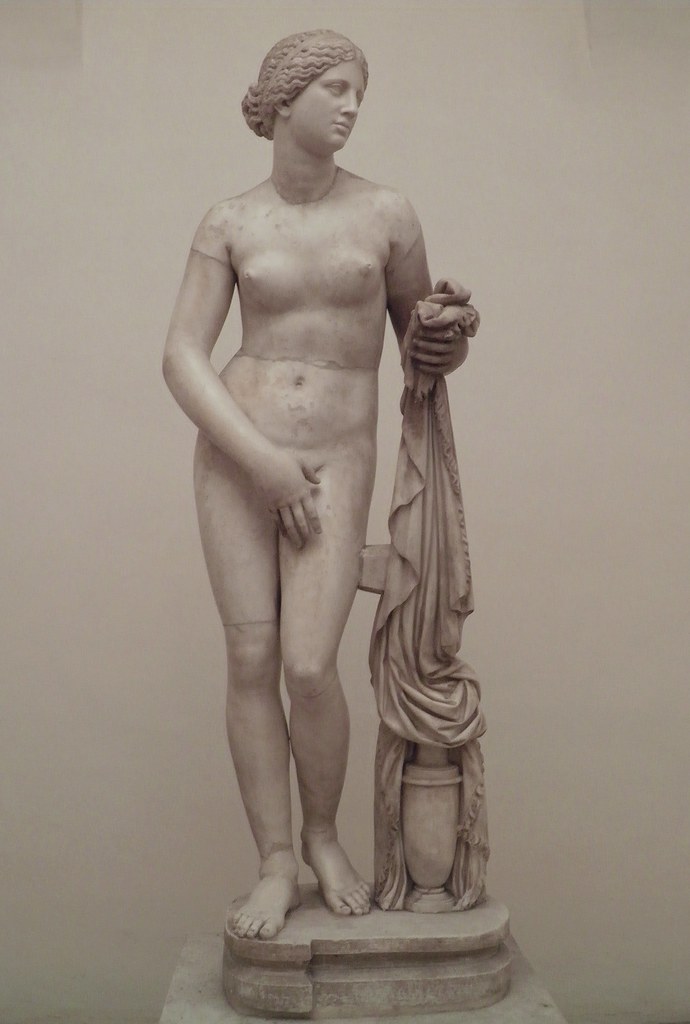
Praxiteles's Aphrodite of Knidos, a
Classical celebration of human form.
“Of all things the measure is Man, of the things that are, that they are, and of the things that are not, that they are not." Here, Protagoras is is basically saying "Man is the measure of all things." A Classical philosopher, he taught that every individual had their own version of the truth—that truth was relative to the person perceiving it. Protagoras taught people to appreciate the individual and the wide array of perspectives people have. To him, humans are not only greater than the beasts of the earth and the angels in the heavens, but higher than truth itself.

This heavily contradicts the beliefs of pre-Renaissance Christianity. The general belief during that period was that people were fallen souls and had to live by the Church’s rules to have a chance at having any worth and getting to heaven. People in anything lower than the upper class were thought of and treated like tools, made to work constantly in a feudalistic society. In any class, though, the Catholic church was law, and any education or art centered around it.

Plato, on the other hand, believed that eudamonia, happiness, was the highest goal of thinking. A fellow philosopher, Cicero also considered the individual variations within his audiences and shaped his persuasive techniques accordingly. He recognized that some people were not educated or willing enough to be persuaded by logic alone and decided it was okay to use emotion as a persuader with those audiences. As Somer discusses in her post, speakers and artists must always take the audience into consideration.

Gaining Perspective

Masaccio's The Holy Trinity
In 1424, something remarkable happened. Masaccio, a fresco painter in Italy, delivered his commissioned work, The Holy Trinity, the first known work to feature perspective. Prior to this innovation, relative size in a painting signified relative importance. However, as Lewis Mumford
says, "in the new picture of the world, size meant not human or divine importance, but distance." This shift indicated a larger cultural shift toward emphasis on the individual that came with the humanism movement.

In embracing perspective, painters no longer pressed an interpretation on their viewers. Similarly, humanism advocated for the development of individual thought and character. Just as figure's importance in painted works was no longer defined by position, so was the common man no longer defined by his position in the world, but by what he decided to make of himself.

The concept of the individual came with the concept of an individual's responsibility for their own development. In The Courtier, Castiglione discusses traits that a good courtier should seek to develop to be truly useful to his prince. Those qualities, as discussed in this blog post, ranged from an understanding of history and philosophy to athleticism and romantic proficiency. As stated before, Castiglione implies heavily throughout the work that development of these traits ought to be the purpose of 'the courtier's' life. Responsibility belonged to the individual to become whatever he desired to be. The idealists of the time believed that it was innate in man to desire to become more.

Pico della Mirandola, a philosopher of the time, mused in his Oration on the Dignity of Man,
"Let some holy ambition invade our souls, so that, dissatisfied with mediocrity, we shall eagerly desire the highest things and shall toil with all our strength to obtain them, since we may if we wish."  (More on Pico and humanism here
As the Renaissance moved past its peak in Italy, humanism and the perspective it brought with it swept into the rest of Europe. The tide of that movement collided magnificently with the surge of reform that blazed both within and without the Catholic church to create Christian humanism, an ideology that existed and thrived on both sides of the Protestant rift. This evolution of the Renaissance ideology brought with it a new dimension to perspective and the notion of 'self'.

Before, it had been enough for a man to develop himself into whatever he might wish to become. The Christian aspect of Christian humanism, however, demanded not only development, but forward progress. Erasmus, widely acclaimed as the father of Christian humanism, made this point quite poignantly in his work In Praise of Folly, an essay written from the point of view of Folly herself. Erasmus, through Folly's advocation of it, condemns the notion that being stupid and happy is a better state of being that being uncomfortable and aware of the potential for growth.

Far from the lack of perspective that defined the age before, man's development of self grew to become the focus and expectation for those who had sufficient means to pursue that course. Not only that, but the responsibility for the development of self had become compounded with the responsibility for improvement of self. These developments set us soundly on the path to achieving the deep and widely resonate sense of self that permeates out global culture today.

Photo Credit

Same Roots, Different Times


I've got to say this, I really have a soft spot for the Reformation. Maybe it's because people standing up for what they think is right strikes a chord with me, maybe it's because I love the idea of challenging tradition or maybe it's because Dr. Christine Blasey Ford's testimony has the media world currently ablaze. I love when people realize that something is wrong, and that they have power to do something about it.


Traditional Catholic Church
The Reformation was sparked when people started to say, "Hey, I don't need this guy telling me what this scripture means anymore, I've got it right here in my hands." and the more they got into the book that was in their hands they started to say, "Wait a minute, what you're preaching isn't what I'm reading". The further they delved into the scriptures, the more dissonance was realized. Fast forward and jump across the pond to a young fourteen year old boy who is holding that exact same book. He's having the same experience. A classmate of mine shared, "I have noticed in particular how God’s hand played a role in the very details of events transpiring in this time span." And I completely agree (read her blog post here). Another classmate similarly pointed out the parallels between the protestant reformer Martin Luther and Restoration reformer Joseph Smith. He says, "Martin Luther no doubt paved the way for Joseph Smith to do, in his way, the same thing that Luther did: dare to question the churches around him." (read further here)


How Mediums and Rhetoric Shaped the Renaissance

We witness changes in communication today at the very localized level. For example, the way I speak to my friends now is very different from the way I would if I had never been exposed to cell phones and the internet. Between texting and conversing via tagging each other in Facebook memes, today’s social interface hardly resembles that of the Renaissance. While forms of communication in the Renaissance Era is fairly difficult to track there are certain factors and events that can indicate changes in trends.

Image result for printing press gutenberg
Caxton showing specimens of his printing to King Edward
Medium:

One such event was the birth of the printing press. With tools like computers, we take the magic of printing for granted. The printing press allowed print to be faster and less costly, causing a spike in the availability of the written word.

Arguably one of the most adept users of the new medium of communication was Martin Luther. His 95 Theses were not the only things he published. He wrote and published many short sermons and pamphlets. These were cheap and short enough that someone could have it read to them if they didn’t know how to read themselves. Luther was a genius who recognized quickly how printing could help him spread his ideas.

Even if the information that was published wasn’t accurate, it’s accessibility gave more people who wouldn’t normally read the option to do so. With more people reading, more people were talking about what they had read and learned.

This led to discussion and debates at Saoirse’s and the birth of the idea of “sprezzatura”, which described a certain wit, sophistication, and eloquence of speaking at these gatherings. An example of the accomplishments of one who possessed this can be found here.

Discussion in the public square acquired a different flavor when the Protestant Reformation took hold. Because open discussion was now the norm, people began to publicly critique, criticize, and even protest against aspects of the Catholic Church.

Back, Forward, & Back Again


Petrarch looked back over his shoulder nearly thirteen centuries to glimpse sight of works that would make mankind wonder and marvel for centuries to come: Cicero’s letters.  This demonstration of ‘ad fontes’ triggered a new perspective of communication.  Somehow, diving back into the past allowed our forefathers to move more quickly forward. 

Letters to Cicero
Petrarch’s discovery didn’t stop there.  He continued to dig deeper into the past and introduced ideals of humanism—that man was capable of great things.  “What a piece of work is man!”  Shakespeare would later exclaim, which is the very sentiment that fueled and sustained a new awareness of communication.

The two letters Petrarch wrote to Cicero were only the beginning; humanism ideals couldn’t be contained to the written word alone.  Artists like Leonardo da Vinci and Michelangelo communicated their ideas and passions through arts, and for others, it was speech.  Castiglione’s The Courtier masterfully illustrates how the Renaissance-theme of sprezzatura shifted the communication-focus to speech.