Tuesday, September 18, 2018

She's a Witch!


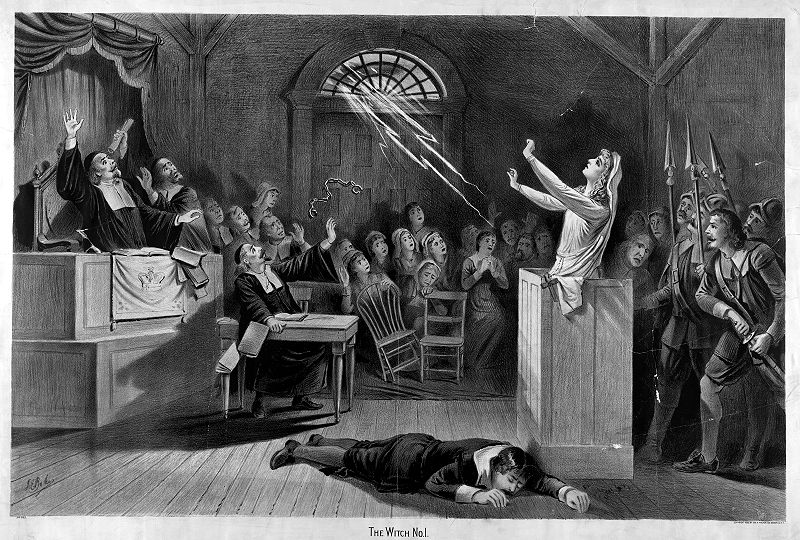
By the sixteenth century, Europe had experienced a great deal of change. People had rediscovered the works of ancient Greek and Latin writers, causing an explosion of art and culture. People were exploring the world, information was being spread faster than ever before thanks to the invention of the printing press. This also helped Europe to go through a religious reawakening, the reformation. Yet despite all of these advancements, one of the tragedies of history took place; the Witch hunts. What pushed Europe to burn over 30,000 people on the charges of witchcraft? Well the answer is still discussed, but a combination of social, political, and religious conflict combined with a healthy dose of misogyny is a good start.

To begin, Europe was at this time was "fraught with wars and rebellions, with economic depression and famine, and with social violence" to quote Drogin. Although many wars occurred during this time, one of the most influential and devastating was the 30 years war. in this long and complicated war, over a third of the German population was killed. Around this time there many farming issues, caused in part by what has been called the "little ice age," which caused colder winters and shorter crop growing seasons. 

At this same time, there was a great deal of religious instability caused by the reformation. The reformation may not have directly caused the witch hunts, since both Catholics and Protestants conducted witch hunts. There was certainly fear-mongering on both sides though, starting with the protestants who were more wary of witches. It should be noted that the common people had fostered a belief in witches for centuries, but during this time period people had an increased fear in the devil and that the devil could affect the world around them. 

It should also be noted that before this time period, both men and women were accused of witchcraft, but during the witch hunts, it was primarily women that faced the blame. This was due in part to a book called Malleus Maleficarum. It was not the only book published about witchcraft and did not start the Witch hunts, but it created a foundation for treating witchcraft as a heretical offense. It was the best known of its kind, thanks to invention of the printing press, which enabled people to widely distribute the book. This book claimed that witchcraft was mostly found among women because women were more extreme in both good and evil, had weak intellects and that women's lust is the cause of witchcraft. 

All of these factors let to a climate where all kinds of difficulties made people try to find a reason for them all and witches were the perfect target to blame. The Witch trials would have its greatest impact during the seventeenth century, but continued into the early eighteenth century.  
Photo credit: The Witch, No. 1 by Joseph E. Baker in 1892 is under public domain

It's Only a Kiss...


In "The Courtier," Pietro Bembo states: "...Love is simply a certain longing to possess beauty; and since this longing can only be for things are known already, knowledge must always of necessity precede desire..." In relation to the printing press and other inventions circa the Renaissance era, the mass production of rhetoric (knowledge) changed the desire (mindset) of every society; however, this was only possible if the governing force of that society allowed the production of that rhetorical knowledge.


For example, Peter the Great of Russia created a precedent of strict control over the country and forbade customs that deviated from the vision of Russia he had of Russia (Drogin). Meanwhile, the American colonies were based on a free-for-all society, where if a religious or financial institution attempted strict control, there was plenty of other space to create one’s own institution. Therefore, while Russian leaders filtered more undesirable rhetoric out of their society, American ideals were based on freedom of speech and expression, creating drastically different pools of perspective and opinion.


Joey Franklin’s essay “The Lifespan of a Kiss” further exemplifies how rhetoric creates differing desires in different societies. In the 20th century, France offered to display the now world famous sculpture from French sculptor Augeste Rodin aptly named “The Kiss” in Tokyo but Japan refused the offer, not because of the nakedness but the gesture of kissing. Japan told the French that they would put the sculpture on display if a cloth was placed solely over the faces of the kissing couple. France refused: “morally, the French just couldn’t allow it” (Franklin).


The reason for this denial from Japan, as Franklin writes, is that the Japanese don’t kiss in the open, their romance novels and soap operas never portray kissing, meanwhile France is stereo-typically known for their vehement displays and literature of romance and expressions of the body.; essentially, varying rhetoric creates differing, collective desires for an entire country. 

 Image Credits: "The Kiss by Auguste Rodin" (public domain images via Wikimedia Commons) 

Monday, September 17, 2018

Looking Past the Mark

In Castiglione's book on The Cortier, Pietro Bembo takes a classic rhetorical approach to portray love and beauty as divine qualities, distinct from the body. The most fundamental tools he uses to display his argument is definition and division. Pietro says he will "make it clear" exactly what love is, and how we experience it. He goes on to divide our perception and understanding of the world into the senses, rational thought and intellect. He defines love as an ardent desire for beauty,  which cannot be satisfied by sensual love, but by cherishing your partner, serving them, and rationally enjoying their divine beauty. While Pietro is correct that beauty cannot be enjoyed through sensual desires, he misses the mark of the true reasons behind love.


Portrait of a Young Man- Bronzino (1530's)
Beauty and love cannot only be enjoyed through rational thought and intellect. In Bronzinos' Portrait of a Young Man renaissance thinkers humanist ideas can be seen. As n Haughtan points out in her thesis, "Portrait of a Young Man not only depicts his subject's idealized appearance but also his scholarship, background and potential. " The book cracked in his right hand suggests that reading was so normal that he would have been caught in the act, not wanting to stop when the painter came. Bronzino does not simply add the book as an afterthought, but the ornate background furniture, and the book as a symbol of knowledge, class, and wealth at the time add to the viewers concept of beauty. This idea however falls as flat as the painting itself. To love only through looking or listening to someones thoughts and ideas is as futile as trying to understand the Young mans true character by simply looking at the painting. 

Pietro concedes that a kiss may be appropriate at certain times because the rational lover can mingle his soul with that of his lover. He contends that beauty is supernatural, and loses its nobility when fused with our bodies, but what he doesn't realize, is that by expressing our natural desires in love, we take part in the supernatural and divine. What Pietro thinks of as only sensual and evil, is a part of and a symbol of the divine creation of all mankind. The mingling of souls in a kiss is amplified and completed as are dedicated to each other, and become like the Ultimate Creator. While beauty is divine, and cannot be only fulfilled in the body, trying to exclude all physicality from love is looking past the mark of what love is.

Bronzino - Portrait of a Young Man, (1530's)- public domain

Haughton, Neil. “Perceptions of Beauty in Renaissance Art.” Journal of Cosmetic Dermatology, vol. 3, no. 4, 2004, pp. 229–233., doi:10.1111/j.1473-2130.2004.00142.x.

The Smartphone: A Modern- Day Communication Revolution


Image result for first smartphone everWhat was the greatest invention ever developed?  Many would argue that it was Johannes Gutenberg's printing press.  Surely, there have been few other inventions that could rival the profound impact that the printing press had on society.  The printing press absolutely revolutionized the way we communicate with each other!  Before the mid 1400s, knowledge was very limited to the wealthy and to those who were already well educated!  This created a great inequality in the society at that time.  Thankfully, in 1440, Gutenberg developed the printing press, and it opened up a whole new world to those who had previously lacked the ability and opportunity to educate themselves.  The impact of the printing press on humanity cannot be overstated.  There were so many wide reaching effects that transcended time and space.   

Today I want to also talk about the great- grandchild of Gutenberg's printing press.  The picture included here is a picture of the very first smartphone ever, released in 1992 by IBM.  The smartphone has revolutionized communication much in the same way that the printing press did.  Now, I don't want people to misunderstand and think that I am suggesting that the smartphone is a greater invention than the printing press.  I believe that the two cannot be compared.  However, the advent of the smartphone has absolutely changed the way that we communicate, much as the printing press did.  It has made knowledge much more readily available than Gutenberg could have ever imagined. Within seconds, we can have whatever information we could desire at our fingertips.  We can communicate with anyone in the world, face to face, over video chats!! Again, the impact of the smartphone on the way we communicate cannot be overstated.  

Did the people in Gutenberg's time know that they were experiencing something that would change the world forever?  Who knows? But one of the many great advantages we have is being able to recognize history when we are living in it.  

Picture credit: telegraph.co.uk


Sunday, September 16, 2018

Spiritual Literacy and the Power of Translation

Most people associate the idea of gaining spiritual knowledge on one's own with Martin Luther. But prior to 1515, the year Luther posted his famous 95 Theses, there was popular demand for the word of God. A certain preacher in England named John Wycliffe believed that clergy and layman alike should be exposed directly to the Bible. His followers, known as Lollards, carried scripts of Bibles around the countryside and taught the common people. The best part? Those Bibles were in English! John Wycliffe had translated the Bible during the late 14th century. Bear in mind that this was before Gutenberg's printing press; these Bibles, as had been the case for centuries, were painstakingly written by hand.

But what was so significant about the word of God in common vernacular?

I could probably write another 15 blogposts on the history of Biblical translation, printing, and distribution; I'm passionately interested. But to answer this question, I point instead to a modern
A Nepali family reads the Book of Mormon digitally
 in their native language
example: the translation of the Book of Mormon into Nepali. Just last summer, the Book of Mormon was released in Nepali after seven years of translating. It brought immense joy to Nepali church members; Branch President Ghanashyam Sarki said, "I am so happy the Book of Mormon will finally be translated to Nepali. With the translation, I can help others to understand and appreciate the Book of Mormon. ... It will help us to know the truth." To empathize with President Sarki, I look back on my own life to when I began to read the word of God with a sufficient understanding of the language. Indeed, I found truth, and every other facet of my life has hinged upon it. The impact of "spiritual literacy" has been immeasurable.

In short, breaking down the barriers of language allows us to access knowledge-- both spiritual and temporal. The old adage "knowledge is power" only applies when we meet linguistic criteria. Wycliffe and countless others have understood this-- and put everything on the line because of it.


Image credit: Valerie Johnson, 2017.
 https://www.lds.org/church/news/celebration-commemorates-translation-of-the-book-of-mormon-into-nepali?lang=eng  

Copyright: Friend or Foe?

French Author, Priest, and Secretary Jean MiƩlot Writing
On September 1, 1486, Marco Sabellico walked the streets of Venice with his chin a little higher. Amidst the recent invention of the printing press and the plethora of works being printed by colleagues and strangers alike, Sabellico was the first to petition for and receive printing privilege—the first copyright.

Sabellico’s proposed work, Decades rerum Venetarum, was a history of Venice. His laborious efforts could have been published just like any other author’s, but this “was a form of reward…which promoted the public interest, rather than the inherent rights of the author” (Kostlyo). If any unauthorized entity published his book, they would be fined, and replication of it was illegal.

For our Renaissance friends, this measure was largely viewed as a wise business move, the authors being more concerned about protecting their work than necessarily claiming it. They pored over their work, doing extensive research with limited resources, then meticulously drafting it by hand before taking it to a publisher, often only to be hired to proofread and/or publish his own work (Kostylo). It was no easy task, making it clear why the author would want his/her work protected.

For many of us, an alarm goes off when we hear the word copyright; we usually hit ‘snooze’ and settle into our indifference to copyright and its complexities, yet there’s the occasional nag, warning us to tread carefully. It’s almost fitting, given twenty-first century culture. For our voices to be heard, we simply download an app, push a few buttons, and announce how we feel about homework. The process doesn’t begin to compare with what Sabellico surmounted. 

Author Roy Leeper pointed out that “copyright was the best means of encouraging the development of new knowledge that benefitted society,” suggesting that the very Renaissance ideals that inspired the invention of the printing press would in turn inspire more people to discover more ideas (emphasis added). Although copyright laws clearly exist and are enforced in many situations, would stricter policies, particularly regarding social media usage, promote originality and unearth golden ideas? If so, what possible ways would this be implemented?


Works Cited:

Kostylo, J. (2008) ‘Commentary on Marcantonio Sabellico's privilege (1486)', in Primary Sources on Copyright (1450-1900), eds L. Bently & M. Kretschmer, www.copyrighthistory.org

Leeper, Roy V. "Copyright." Encyclopedia of Public Relations, edited by Robert L. Heath, vol. 1, SAGE Reference, 2005, pp. 201-202. Gale Virtual Reference Library, http://link.galegroup.com.erl.lib.byu.edu/apps/doc/CX3439100108/GVRL?u=byuprovo&sid=GVRL&xid=872b759a. Accessed 16 Sept. 2018.

Image Sources: 

Russia: A Cross Section of Europe

Peter the Great- Tsar of Russia
I have always had an inexplicable fascination with Russia. As early as seventh grade, I found myself drawn to the policies and history of Russia. I guess I always found it confusing as a nation. Something about it seemed so irrevocably stuck in the past, yet simultaneously striving to snag a slice of Western Europe's power pie. It seemed to exist in two states of being concurrently. Until today, I could never quite account for that duality.

During the Renaissance, when there was a surge toward the new and innovative, Russia didn't budge. They clung to their traditions. Rather than returning to their roots to find the future, they stubbornly stayed medieval. Right up until the end of the 17th century, this remained unchanged. Then, Peter the Great took the throne.

Widely regarded as the most beloved leader in Russia's history, Peter the Great was a bridge between Western and Eastern Europe. Unlike previous Tsars, Peter was not only educated at
home with tutors, but went abroad and gained an interest in science and technology. When he returned to Russia, he made a full push to bring his country into the 17th century. He sponsored a generation of scholars to study in Western Europe so that he could cultivate that new learning. He even went so far as to ban certain traditions in Russia, forbidding his courtiers from wearing beards.

As is indicated by their continued love for him, the Russian people appreciated what Peter the Great was trying to do. They loved the western-style city he established- St. Petersburg. However, much of Russia continued to hold on to their traditions. Moving so abruptly from their near-medieval way of life to the end of the Renaissance era was too much for many people, and they stubbornly tried to remain the same.

Thus Russia became, and to a certain extent, continues to be, a link between the old and new in Europe. A perplexing place, where both ways of life coexist. All thanks to the Tsar who dreamed of more for his people, Peter the Great. 

https://www.biography.com/people/peter-the-great-9542228