Wednesday, September 19, 2018

Great Ambition, Great Love

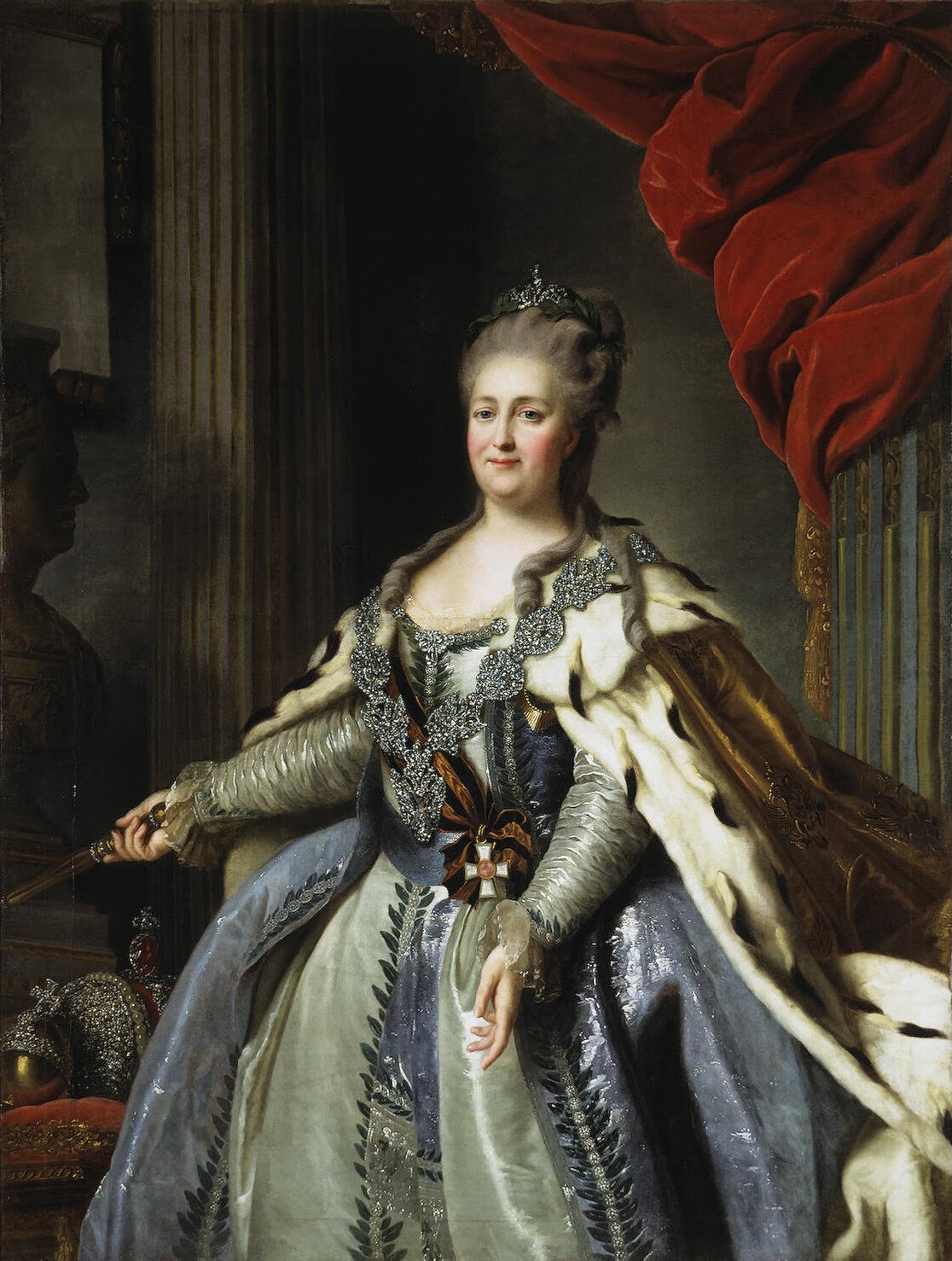
Catherine the Great relied on charm and intelligence
 to gain popularity; she exemplified sprezzatura.
Throughout history, women were generally expected to be passive; ambition was a negative trait for them to have. Even today, female leaders are often described as bossy or overbearing when acting similarly to their male counterparts. Women like Catherine the Great, however, demonstrate the good a determined woman can do. Although she made some controversial decisions, I argue that those decisions are exactly what allowed her to keep Russia afloat in turbulent times.

Catherine the Great was inarguably an ambitious woman. As a teenager she was set on becoming the next ruler of Russia, even though she was German. She begged her tutor to give her more schoolwork, and she even caught pneumonia staying up late to study Russian vocabulary. Her dedication earned her marriage to her cousin, the empress of Russia's nephew. He was a terrible ruler and husband, so Catherine forcibly took the throne from him.

Like many women today, Catherine wanted fulfillment and love. She had lovers, anywhere between 3 and 12 over her lifetime. In addition to finally giving her the love and intellectual fulfillment she sought, her relationships helped her keep Russia on good terms with other countries. It seems like a few lovers would be worth Russia's stability.
Catherine promoted education, health, and the arts, as well as equal treatment of people from all classes. She wrote the Rule of Law, a 22 chapter document for which she consulted people from every class (but serfs). She tried to free the serfs, the indentured servants of the upper classes. She gave up this feat in fear of losing the nobles' support on which she depended, but I don't think she should be blamed too much because she did more good in power than she could have out of it. 

Ambition carried Catherine the Great to uplift Russia to heights that it never would have achieved if not for her. Although she ruled in a less "respectable" way than a woman would have been expected to, she achieved her goals of power and love while ruling Russia responsibly. I argue that her greatness stemmed from her controversial deeds, rather than being hindered by them.

Image obtained from wikicommons.


Observe, Record, and Explain


Unfortunately, we can only do justice through writing to what we know and have experienced. When we step outside of that sphere of knowledge, we often leave a trail of butchered truths and realities that are easily seen by our audiences. Even if we think we’ve studied hard enough on a subject, it won’t translate to the reader as smoothly as the words of someone who really knows.
Dog Flea

Enter John Donne, a poet and preacher so witty and understanding that many of his metaphors still register today. He saw the world around him and how it moved and shifted his emotions and being. He saw those effects resonate in the lives of those around him. And what he saw, he internalized. John Donne didn’t know everything, but what he did know, he endeavored to know well.

Modern humanities students are encouraged to do the same. It isn’t enough to be told about the world, we have to experience it as well. That doesn’t mean we need to spend our early years throwing away opportunities before having a change of heart and devoting ourselves to the clergy (even though some of us do). But, it means that when we do experience, we need to be aware and invested. If we can observe, record, and explain what we see, we’ll be able to affect the changes we feel our world needs.

Or, at the very least, be able to relate a flea to adultery.  


'A dog flea (Ctenocephalides canis): adult, pupa, egg and larva. Coloured etching.' . Credit: Wellcome CollectionCC BY

Not the First Man There, But the First Tale Told: Marco Polo

A More Modern Makeover for Marco

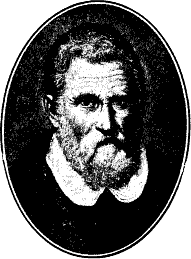
"Ad Fontes" is the belief in "going back to the sources", which is to say in the context of the Renaissance, to learn from the Greek and Roman philosophers of the past. However, just because it implies such, doesn't mean we can't go back to a more... recent source. Marco Polo, the man whose journey to China would inspire Columbus' search for India, was born in the year 1254 to a large merchant family, where he himself took up the trade (literally). At the young age of 17, he left with his father and uncle on a return trip to China. This journey would serve as the inspiration behind his work "The Travels of Marco Polo". While some historians argue over the book's authenticity, it has been noted that the book contains less errors compared to other travel logs of the time, as well as containing far less "miraculous" events within. On the other foot, it has also been noted that there are a few glaring omissions of China in the work, such as the itty bitty little issue of the Great Wall of China. Regardless of whether you believe that he made the actual journey or not, what can be confirmed is that he is the first to have a detailed account of their "journey". This account would serve as "the source" of inspiration to explorers for centuries to come.

Throughout my life, I've had to take both people and works on the basis of faith. Whether it be my friends, classmates or even my church, these things at various times have required me to place my trust in what they had said. Some times my faith was well-placed, at other times I wish I could go back and change my mind. Such experiences have made me empathize with Columbus, who had no way to verify what Marco Polo told was a true account. Despite that, he took his word as the motivation necessary to try his own journey to what he presumed was "Asia". And really, such faith? It's admirable.
Image Credit: "Marco Polo" via Wikimedia Commons

The Imperfect Heroes of History


What do you think of when you hear the name "Martin Luther?" Maybe you think of his accomplishments, such as his 95 theses and open rebellion against the Catholic church. Perhaps you think of Martin Luther King Jr. who shares his namesake because of the mark he (Martin Luther) made on religious history. Truly, Martin Luther has much to admire about his character even centuries after his death.


However, Martin Luther was not a perfect man and did not always stand for things that we would consider to be right in the modern age. During the Peasant Revolt 1524-1525, German peasants rebelled against their local authorities, fueled by Luther's preaching of equality. However, Martin Luther didn't support their cause and wasn't opposed to the social inequality that was present at the time (Drogin). Had this sort of event happened in a modern context, Luther would've lost way more followers than he did in his time and he would not have had the support to form a church of the same caliber as the still-thriving Lutheran church.

Civilized Dispute

Martin Luther was undoubtedly a controversial figure of his time, calling into question the authority of the most powerful people in Western Civilization. Yet on reading his writings, it is undeniable that his goal is not to destroy the Catholic Church, nor make it look foolish. 

He is genuine in his attempt to reform the church rather than make mockery of it. He quite genuinely showed courtesy to those with whom he disputed and tried not to lay too much blame on them. He concedes that his sources may not be reliable, but nevertheless uses them to show how indulgences are being perceived by the common people.

This is a sharp contrast to the manner in which our politicians now debate. As made clear by the 2016 U.S. Presidential elections, subtlety or courtesy have been completely erased, making way for a blunt and accusatory form of debate. Trump and Clinton both made no effort to see each other's position. This is dangerous. Its purpose is not to persuade, but to ridicule, heightening tensions rather than loosening them.

https://www.ydop.com/wp-content/uploads/2016/07/trump-vs-clinton.jpg
 I believe that to foster an effective political environment, we need to take a leaf out of Luther's book. His criticism is sharp, and his points clear, but he uses a tone of respect and considers the position of his audience before writing. With that kind of foresight, the level of distress between political parties would assuredly be better controlled.

We're all in this together!

In John Donne's Selections, a theme that continually reappears is that of togetherness and the interconnectedness of humanity. For example, in his poem Meditation, talking about baptism (spiritual birth) and death, he says "when she baptizes a child, that action concerns me; for that child is thereby connected to that body which is my head too, and ingrafted into that body whereof I am a member. And when she buries a man, that action concerns me: all mankind is of one author." This passage gives a lot of insight into the perspective of John Donne, showing his view of how we as humans are all members of one singular group, and what happens to one person concerns all. Further along in this poem he clarifies this idea further when he says that "no man is an island, entire of itself; every man is a piece of the continent, a part of the main."


Image result for linking arms imageIn reading from John Donne, I begin to notice a shift in culture as history moves forward. As we look back to the Renaissance period, we see that it was a time of individualism and personal growth, that lead to a  culture of creating a life that you desire. Moving forward in time to the reformation period, we now see a shift to an interconnectedness, while still maintaining the ideal of improvement and growth. I feel that this idea of interconnectedness can be seen as a monumental shift in the course of humanity. In this framework we see that individuals in society are recognizing the value of working together. Rather than seeing each other as enemies, people are beginning to recognize the value in relying on one another and being one single continent in unity, rather than individual islands.

Oftentimes I have thought about the drastic change that has occurred in the world over the past couple of hundreds of years. Humans have been on this earth for hundreds of thousands of years. But the majority of the development of humanity by mean of cities, economy, and technology has occurred within the last 500 years. It appears to me that this growth in humanity began at the same time that John Donne and others during his time period began to see others as allies rather than competition. Today we have achieved so much because we can work together. Thanks to this shift in the culture during the time of John Donne, we still rely on one another today, and will continue to in the future as society continues to develop.

Manifest Destiny

In the process of reading about explorers during the Renaissance voyaging out to "Brave New Worlds" and experiencing new peoples and cultures I pondered on what may have prompted their voyages. Governments surely dispatched some for reasons such as trade or imperialism. Others were prompted by a desire to experience new things and bring that knowledge back to their homes. 

We all are explorers and adventurers facing our own Brave New worlds
Continuing on with this thought process I thought of others who left their homes to venture to new places and thought on their reasons. I ended up in America in the 1800s where Manifest Destiny was in full swing. Manifest Destiny was an attitude that America was a virtuous country who had an obligation to bring this virtue to the world and that this mission was divinely appointed to them from God. One of the big outcomes of Manifest Destiny was the settling of the west. I feel this expands the theme from the Renaissance of a Brave New World. While those who were settling the west weren't traveling oceans, they were expanding into their own new worlds and bringing American traditions with them. They were expanding their country and proliferating its values in new areas. Whether is was right or not for these people to spread and often force American culture onto the areas in which they settled is a discussion for another time. But their manifest destiny mindset and them traveling into their own "Brave New World" is something I think many people can relate to.

Many people grow up being taught values and principles which they hold close. In my own case, I was raised in the Church of Jesus Christ of Latter day saints and grew up with a specific set of beliefs and morals. I served a mission to spread the Gospel of Jesus Christ and in a way went out with a manifest destiny mindset, feeling I had a mission from God to bring those beliefs and morals to others. I ventured out into the unknown, ready for new experiences and too meet new people, all the while desiring to bring my beliefs to them. I think many people have experiences and beliefs that connect them with the theme of A Brave New World and Manifest Destiny.