Friday, October 4, 2019

Power to the People: How Humanism Prompted Martin Luther's Success


Martin Luther once said: “I am more afraid of my own heart than of the pope and all his cardinals. I have within me the great pope, Self.”

I have always wondered what allowed Martin Luther to be as successful as he was. He made bold statements against an institution that seemed to be untouchable, and still managed to reform one of the biggest powers of the time period with only, as Luther calls it, Self.

As I was discussing with my friends Bella and Fay on Tuesday, we considered the effect individualism (an importance Renaissance ideal) had on the Reformation. One thing that was said during the conversation really stood out to me: 

Resurgence of Reform

Throughout history, there has been a constant human characteristic of seeing something wrong with the way that things traditionally are and going about finding a way to change it. From religious to social to educational reform, movements throughout history have made the privileges we have today realities rather than hopes or dreams.


One of the main forms of reformation was religious. When Martin Luther pinned his 95 theses to the door of a Catholic church, he evoked a movement throughout his German community that made it possible for the separation of the Catholic and the Protestant church. He gave those that agreed with him, in that the Catholic church in a way was corrupt, a voice. He allowed for them to formulate their own opinions and decide where they stood. He facilitated his fellow Germans to think for themselves rather than be told what to believe.


Reform is not only religious but there are many different kinds. As we follow reform throughout history it leads us to our Suffragettes. Women, who were tired of not being heard and trampled under the feet of men making policies that did not account for the other half of the population,
decided once and for all it was time for them to put their foot down. Through their courage and resilience, I have the ability to vote; for my voice to be heard and make a difference within my nation.


Moving forward we can see that these are only two types of reform and there are plenty more that have stimulated growth for the human race. Educational, technological, informational, judicial and literature reform have all helped to shape the world into what we see it as today. Our world is constantly changing because of people, like Martin Luther, George Washington, Susan B Anthony, Isocrates or Steve Jobs, have all shaped our world. Whether it be in the past or present, their influence is still being felt and will continue to be far into the future.

The Necessity of Individualism


Despite claims that individualism leads to narcissism and is an overall menace to society, individualism can be seen to have profound positive effects throughout history particularly during the Reformation, as well as the Renaissance.

A recent article in the New York times, titled “The Age of Individualism”, explains that because of individualism, our country and our world will eventually become a disaster of self-absorbed individuals only concerned with trivial, self-centered things.

However, the Reformation and Renaissance are clear indicators of what happens when a society turns to individualism. The society flourishes. Without individualism, there would be no-one standing up to age-old theories, accepted as absolute truth and successfully prohibiting any forward progression. In his journal article about religion and modern individualism, Herbert Butterfield explains, “The individual must be able to confront the tyranny of majorities, the prejudices of prevailing culture, and the dominating spirit of the age itself.” This is why individualism is needed. Personal ideas and convictions were recognized by our predecessors as something that needed to be shared and addressed, especially if it went against what was popular and accepted at the time.

It was mentioned in one of my discussions that individualism was the reason that Martin Luther experienced success in his fight for religious reform. Martin Luther is celebrated throughout the world for the courage he had to “oppose the dominating spirit of the age itself.”  Without individualism inspired by Renaissance humanism, the Reformation could be a very different story. Without the few who believed strongly in humanism and the individuals potential to be moral and good, the higher powers against change would have destroyed the Reformation before it even really began.

I’m sure, much like individualism is presented today, some in the reformation viewed Luther as an extremist, a fanatic, someone so blinded by their own ideas and ideals that they were past reason and actually detrimental to the good of everyone around them. People feared individualism because they knew it would bring change. Their solution? Persecution.  However, despite the animosity and violence they experienced, reformers endured, bringing the world all kinds of new religious and social possibilities.

Individualism continued to change society. It encouraged Thomas Moore to write about brave new worlds that could lead to literal new worlds. It was what allowed plough boys to receive bibles of their own and Shakespeare to become a theatrical genius, despite his poverty. America itself was born from ideas created by individualistic minds during the enlightenment. That is why we continue to need individuals who celebrate individualism, who have enough conviction in their own ideas and ideals to do something about it. And through that, we can continue to change the world for the better.


Adoniram Judson, D.D. "The Burman Apostle"

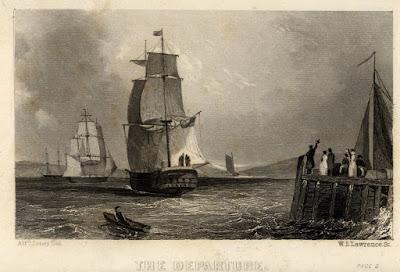
 A message of missionary work had sunk "down into [Judson's] heart, as lead goes down into the ocean... and led him to abandon home, country, and all the joys of civilized life, for chains, and dungeons and torture." Adoniram Judson was on his way to Rangoon, Burma  (Yangon, Myanmar) to preach the Gospel of Christ to a 'heathen' nation. He left as a Congregational theologian and arrived to Calcutta as a Baptist convert because he tried to use scripture to prove the baptists wrong and when he realized his belief was mistaken he had the humility to change even though rejecting his own organization meant the loss of funding and support for his 40 year long mission. He is a hero to me.

'The Departure' of Rev. Adoniram Judson, D.D. 
(found in BYU Library 'Judson Offering' 1847)
200 years later I was leaving Thailand and the Thai language behind as one of the first twenty missionaries from the Church of Jesus Christ of Latter-day Saints to serve in Myanmar and I thought few could understand my position. I felt like I was starting from scratch until I began to learn of the man who was the reason behind the Burmese Bible which I now held. 

Brave New Words


In his book, “The Renaissance in Perspective,” Philip Ralph says that Italian humanists first regarded the printing press as a “barbarous German contraption” that would devalue education. He highlights and explains the various growing pains associated with the cultural transitions of the Renaissance. One of the “new worlds” explored by the contemporaries of the era was language, both in terms of form and delivery. As witnesses to a period of technological discovery and expansion, maybe we can understand a little of what they felt.
I talked with my colleagues in Rhetoric 212 about the subject of language and communication, and we agreed that shifts in the way that people communicate have a huge impact on individual and cultural identity. The printing press was vital to the liberating message of Martin Luther, but that same message, combined with a revolutionary form of mass delivery, forced people to redefine their scope of influence. As the world opens up to include everyone within printing distance, the common person can evaluate where he stands in that world.
The world was also expanding in a more literal sense. Daniel and Aubrey, my Rhetoric 212 classmates, are both bilingual in English and Spanish. They have experience with translation and interpretation, and were able to tell me how difficult it is to convey meaning across a language. In fact, if I understand correctly, exact translation is nearly impossible. Each language builds its own framework of meaning. In the English version of The Book of Mormon, one of the writers says to “feast upon the Word of God.” In the Spanish translation, the word “feast” is replaced with a synonym for “study,” because a Spanish word for feast would be nonsensical in that context. As Renaissance adventurers braved new continents and territories, they were taking on the challenge of embracing entirely new cultures through language.
 The same principles apply to the transfer of meaning between oral and written methods of communication. The written word has been around for millennia, but as the Italians knew, it is a whole different story in the hands of the common man. Martin Luther’s translation of “verbum” into German angered the Catholic Church because it implied a more vulgar form of “word” to represent God’s Word. Similarly, if one wants to reach the (largely uneducated) masses, one has to be willing to dumb it down a little. This takes a great deal of understanding, not only of text and language, but also of culture and context. It also takes a willingness to embrace change, knowing that change is difficult and often painful.
The use of language builds worlds. I would like to quote Daniel as saying that it takes bravery to explore new worlds of communication and language. I agree, and I hope that we approach our daily communication with one another with Renaissance-level bravery, tempered by modern experience.


Thursday, October 3, 2019

The Right Tools in the Right Hands

Christoper Columbus exemplified what it means to be a human. Known as a prominent explorer, his sprezzatura, or being “the right guy at the right time” enabled him to network with people that had the resources he needed and help him on his quest to explore. By taking advantage of his sprezzatura as well as new technology of his day, he was able to discover a new continent where settlers were able to design and establish a fresh form of government.

By developing in ourselves the good traits of Columbus, we can discover ourselves new talents and find unexpected discoveries. I think a personal example will help illustrate. Last summer I worked as an arborist and removed many hazardous trees. I decided to take on a project of making benches for a wedding as a way to make some extra money. Removing the trees was no problem given my experience and training, but I needed more resources to process the logs into usable lumber.

Felling a hazardous tree

For Columbus, ship design in the late 1400's had just developed the caravel ship, which was able to sail into the wind, unlike other ships that could only sail with the wind. Astrolabes and magnetic compasses were also being refined during this time to a point that they were becoming very useful in maritime navigation. His skills alone combined with these tools allowed him to sail, but without money or a crew, he had no hope of becoming the world’s greatest explorer. 

A Gift of Tongues – A Gift for All


When thinking about the Renaissance and the Reformation, it can be hard to separate the events that happened during each time period because of how fluidly everything ran together. Without one thing happening, another could not have been possible. One of the most major and important events, in my mind, was the power of the printing press and all the good that came from that for the future in terms of religious purposes.


The printing press was so crucial in helping all people to read, and most importantly read the Word of God. Because words could now be read by all people, everyone was able to educate themselves more and reading was not only for those that were considered elite or with power.


The only thing that negates the positivity brought from the printing press is now everyone can print the things they want to have read. Now negativity and un-true works can be read by all. Another problem that stood in the way of everyone reading the things that were now being printed was that things needed to be translated. We know that Martin Luther translated the bible to German and then William Tyndale translated it from German to English. We are forever grateful for these efforts to spread the word of God to all.


Ryan brought in his Burmese bible and we talked about translation and how things can get lost. The Burmese language apparently is not known for having words that are known in the “Christian” verbiage. For example, Ryan told us that the word atonement is hard for people to understand, and the words repentance. How hard it must be to correctly translate all languages in a way to get the same and important message of the gospel across.


Ryan bringing this up made me realize how very truly important it was that we have things like the Joseph Smith Translation. I am so grateful for the gift of tongues and the effort people put in to helping all to gain knowledge. Without the gift of tongues, I am not sure that we would even have the gospel brought back in its fulness when it came through Joseph Smith.


Thinking about these men and their perseverance in doing good, made me so grateful and excited for all the good works that have come from the printing press and the gift of translation.

Kelsi Hicken