Wednesday, October 10, 2018

Social Contract of the New World

The writings of Locke were highly influential in the creation of the current government that exists in the United States today. The social contract is a concept that had been breached by degrees in the past, however, it was usually only under extreme pressure that power or liberty is ceded to another.

One of the earliest examples that I find is the Magna Carta. in 1215 King John was forced to sign a document giving certain rights to some of his rebellious nobles. In the past, kings were all-powerful within their realm. Because of abuses, the rich barons rose up and overpowered the king, forcing him to sign over certain rights to religion, freedom, and power that had not existed in the past.

A more modern example is the social contract that exists within most governments today. The declaration of Independence used by the United States to formally secede from the British Commonwealth was written by Thomas Jefferson. This document was strongly influenced by writers such as John Locke.

At the time the Declaration was written, the "United Colonies" were in no position to bargain with the British. However, the Declaration and later the Constitution combined would eventually make up a document that is not too different in content from the Magna Carta. It would define specific liberties that the government or "king" could never take away. In exchange for these rights, the common people promise to follow the law, pay taxes, etc. otherwise these liberties would be revoked. This was the contract between the government and the governed that would directly affect how we interact with governmental institutions today.

Image credit: by WikiImages: Declaration of Independence, Pixaby licensed under CC by 2.0

Searching for order

Change was abundant during the enlightenment era. People find out that the universe doesn't revolve around them, there are discussions of how religion may not have all the answers,while there is also a reexamination of the past and of truths that had not been questioned before. All this challenging of the created for some a sense of confusion, which led many to seek for some concrete order in the world. This need manifested itself in many different parts of society.

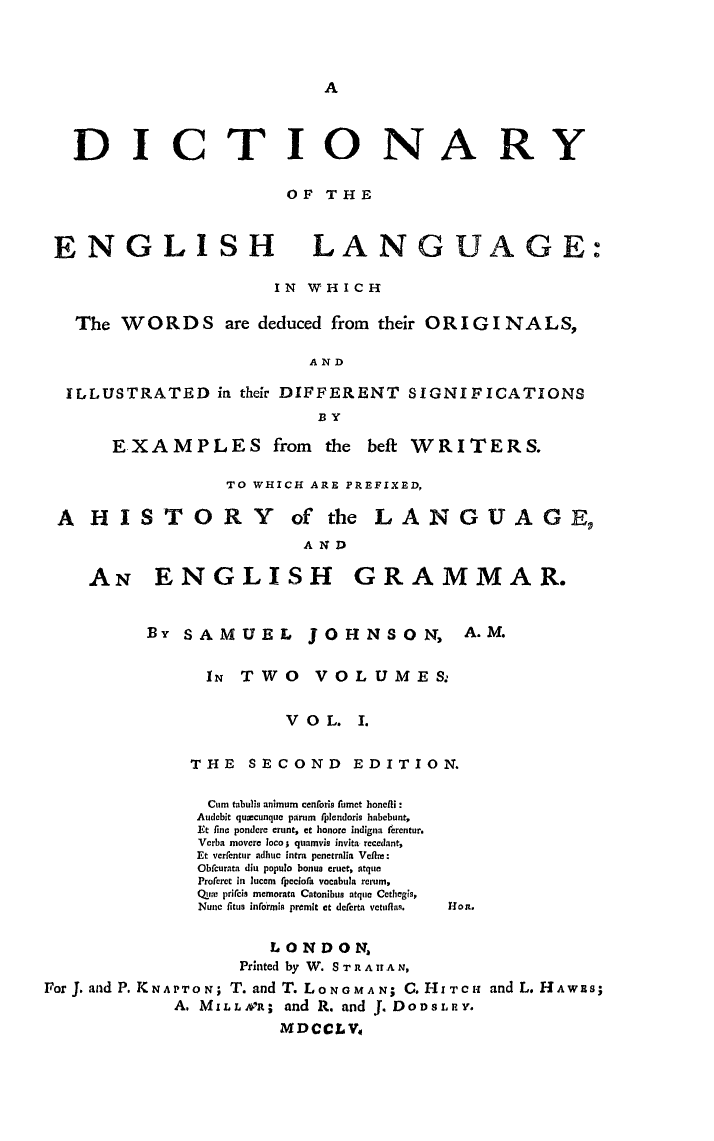
JohnsonDictionary.pngOne way that this search manifested itself was in language. In 1755 Samuel Johnson published the first modern dictionary in English. Due to the explosion of printing and rising rates of literacy books, pamphlets, and even newspapers were becoming more available to the public. With this came the need to have some kind of order in grammar, definition, and spelling. Others had published dictionaries in the past but there had been several issues with them. The main problems that came from these dictionaries was, in fact, a lack of order. They were often poorly organized and had little research put into them, usually providing a reference to some of the more "difficult" words, that weren't used very often. At the same time, people were often unsure how to use the words given in early attempts. Johnson's dictionary showed the meaning of words by using them in sentences, described how they were used, and painstakingly ensured that words as thoroughly defined as possible. 

How fit with the rest of the Enlightenment? To begin, Johnson provided the most comprehensive reference for the English language, and was the dictionary used for the next 150 years. It is also indicative of the growing need for accuracy, order, and the need to know definitions and how to properly use words. It also became a model that some other European countries used. 

Nothing Modest About It

If there is anyone in this world that you don't want to piss off, it's an Irishman. I'm not entirely sure how they came by it, but the Irish are full of a fire and glib that no one has yet succeeded in silencing. I wouldn't advise trying.

I used to live in the U.K., and my first encounter with an Irishwoman is seared into my memory forever. She couldn't have been more than five feet tall, but she was terrifying. It wasn't me, but someone had done something wrong and Ciara was full of an eloquent, hilarious anger the likes of which I had never before seen. I didn't know if I was allowed to laugh, but I definitely wanted to. Thankfully, I never ended up on the receiving end of that vitriol, and she and I ended up becoming really good friends. My relationship with Ciara helped me gain more understanding of these people and how they came to be the way they are.

Poster for a short film based on Swift's essay
The Irish have pride as deep as the land and a memory as long as their heritage. Right and wrong are certainties in that culture, and offences are remembered to their dying breaths. Through centuries of being deprived of identity, they developed their wit- the only defense that can't be stripped from them. They're brash, they're brave, and they're not afraid to be heard.

It's no surprise then, that arguable the world's greatest satirist, Johnathan Swift, sprang from Ireland. Swift is brutal in his analysis of government and society at large. His most famous piece A Modest Proposal, suggests that the solution to the famine in Ireland could be as simple as eating their children. It's a genius piece of writing and a scathing critique of Parliament's negligence.

Before the Enlightenment era and the advent of the public forum, the Irish and their unique perspective was confined to their island. But with the popularization of the press and a second swell of individualism, voices bubbled up from all kinds of forgotten places. Voices that become essential in shaping the future.
Photo Credit

Tuesday, October 9, 2018

A False Sense of Security


                           Image result for door lock
Feeling secure is very subjective. Some people spend a lot of money on the very latest home security systems that sound an alarm and inform the intruder that the police are on their way. Others purchase simple alarms that attach to the top of the door frame and the door, and when the mechanisms inside are separated far enough (when the door is opened) they beep loudly. Some merely post an octagonal alarm system sign in the front flower bed without having any actual system installed. Still others do nothing other than locking their doors and windows.

I remember the first time I tried to pick a lock. It took me five minutes. I had purchased the pick set off Amazon for $15.97. With a little bit of practice, I was able to pick a lock within 15 seconds.

If it’s so easy for anyone anywhere to purchase a cheap pick set, then why do people bother locking their doors, anyway? Even my youngest sister picked a lock with 7 seconds as her fastest time. Clearly, locks do little to nothing to truly protect us.

I think we have locks on our doors because it provides us a SENSE of security.

Image result for burglar picking lockThomas Hobbes wrote that men have a natural sense of distrust against one another. Men go against each other competitively, because they distrust the other party, and for glory. Hobbes says that men continually act as though they will be attacked, and that men essentially are at war even during times of relative peace.

It is true that locks are enough to deter many low-bracket criminals. Is this enough or do we need more? If we are continuously at war with each other, is it worth it to bother with higher-end securities?


Image Credit for the Doorknob: https://www.hometips.com/repair-fix/door-lock-latch-problems.html
Image Credit for the Burglar: https://www.komando.com/happening-now/268699/3-d-printed-bump-keys-let-burglars-walk-right-into-your-home/all

When an Unstoppable Force Meets an Immovable Object

In the Batman movie called "The Dark Knight", the Batman repeatedly passes up opportunities to kill the Joker because of his internal sense of justice; his morals. One of my favorite scenes is when the Joker is mocking Batman for "flaw", as he calls it. The Joker laughs as he says that this battle between them will never end because "this is what happens when an unstoppable force meets and immovable object." In analyzing the similarities and differences between John Locke and Thomas Hobbes, I can't help but see similarities to this quote from the Joker.
Related image
1) "What happens when an unstoppable force meets an immovable object"

Aside from the topic they argue about, Locke and Hobbes appear to be polar opposites. Locke has an optimistic view of the nature of man, arguing that men are capable of governing themselves and that they are inherently good, with the ability to exist in peace in the state of nature without governing authorities. On the other hand, Hobbes' view of the nature of man is a dismal one, saying that men are incapable of governing themselves and that if given that opportunity, they will resort to malice instead of peace. In this situation, I view Locke as an unstoppable force and Hobbes as the immovable object. They both make great points, and on the surface it appears that no one can be satisfied at the same time as the other.

Image result for locke and hobbesThe American Revolution was a result of the colonies' innate desire to have basic freedoms (Locke), while being governed fairly (Hobbes). In this situation the views of both men seem to describe perfectly what men desire most. While men desire to govern themselves, they also desire stability. In the case of the American Revolution, you couldn't have one without the other, or in other words, it was necessary to combine the unstoppable force and the immovable object in order to create a more perfect union and a country in which people had freedom to govern themselves under the authority of a government they elect and direct. While on the surface it appears that Locke and Hobbes  had views that contradicted, the joining of these two ideas was the perfect solution.

Images:
1) https://www.quora.com/Why-did-the-Joker-laugh-even-though-he-was-falling-to-his-death-in-The-Dark-Knight
2) https://www.google.com/search?rlz=1C1CHBF_enUS767US767&biw=1242&bih=569&tbm=isch&sa=1&ei=mgy9W_mfFMSr0gLam7aIAQ&q=locke+and+hobbes&oq=locke+and+hobbes&gs_l=img.3..0l9j0i5i30.137105.138736..139704...0.0..0.104.1520.12j4......1....1..gws-wiz-img.......35i39j0i67.Zb2JxX7iE8A#imgrc=m8PTTlRfT5NSQM:

"That all men are created equal."

When John Locke wrote his Second Treatises: Of Civil Government and Thomas Hobbes wrote The Leviathan, intellects were still trying to unpack everything the sovereign individual idea had to offer. It was generally accepted by both Locke and Hobbes that all men were equal (Even though "man" was a pretty exclusive group, but it was more progress than ever before), but they were equal in different ways.

John Locke

Locke believed that men were all equally good and needed very little authority to govern them. According to Man's "State of Nature," no one has power over another and all are equally free to do as they please so long as they don't infringe on other's freedom. Locke had a relatively optimistic outlook on human nature.

Thomas Hobbes

Hobbes, on the other hand, thought that man needed a parent authority to create "good laws" that he could abide by. He determined that because people were continually in competition for honor and dignity, they tended toward envy and hatred. Hobbes also generally believed that people were equal despite their differences because no matter how weak, the "weak" person could still use strategy to have a "strong" person killed.

The Hybrid

Over the weekend I attended a lecture by a well-known psychology professor from the University of Toronto. He analyzed the line from the declaration of independence, "We hold these truths to be self-evident, that all men are created equal..." We know that all men are not "created equal" socially or economically, and the founding fathers who owned slaves obviously didn't think so. So what did they mean?

At the lecture, Dr. Peterson said that the self-evident truth is not that all people have equal opportunity when they come into the world, but that they all have equal capacity for good and evil. This could be thought of as a hybrid of the thoughts of Hobbes and Locke. He explained because all people have equal capacity for good and evil, they have an equal responsibility to the collective not to pursue evil and to seek out good. Because the state is made up of sovereign individuals in a free society, whether or not the state is inherently good depends on the individual.   

Monday, October 8, 2018

You're so vain, you probably think the world revolves around you.

In June 22, 1633 The Catholic Church issued this statement to Galileo, the father of Astronomy.
Galileo on trial

“We pronounce, judge, and declare, that you, the said Galileo… have rendered yourself vehemently suspected by this Holy Office of heresy, that is, of having believed and held the doctrine (which is false and contrary to the Holy and Divine Scriptures) that the sun is the center of the world, and that it does not move from east to west, and that the earth does move, and is not the center of the world.” (Read more here.)