This last spring and summer, I received enough wedding invitations to cover my entire refrigerator. This is not an exaggeration one bit. For two months, every single weekend was booked with wedding receptions. And get this. There were even weekends where I attended multiple receptions, just to make sure that I could congratulate my newly married friends. I’m sure many of you can relate to this, especially those of you who are in my same stage of life. What were your thoughts going to the mailbox day after day and seeing another one “bite the dust?” Now, you might think I am crazy for how I felt about it, but I’m not going to hold back. Each time I opened another invitation, my heart did a little jump.
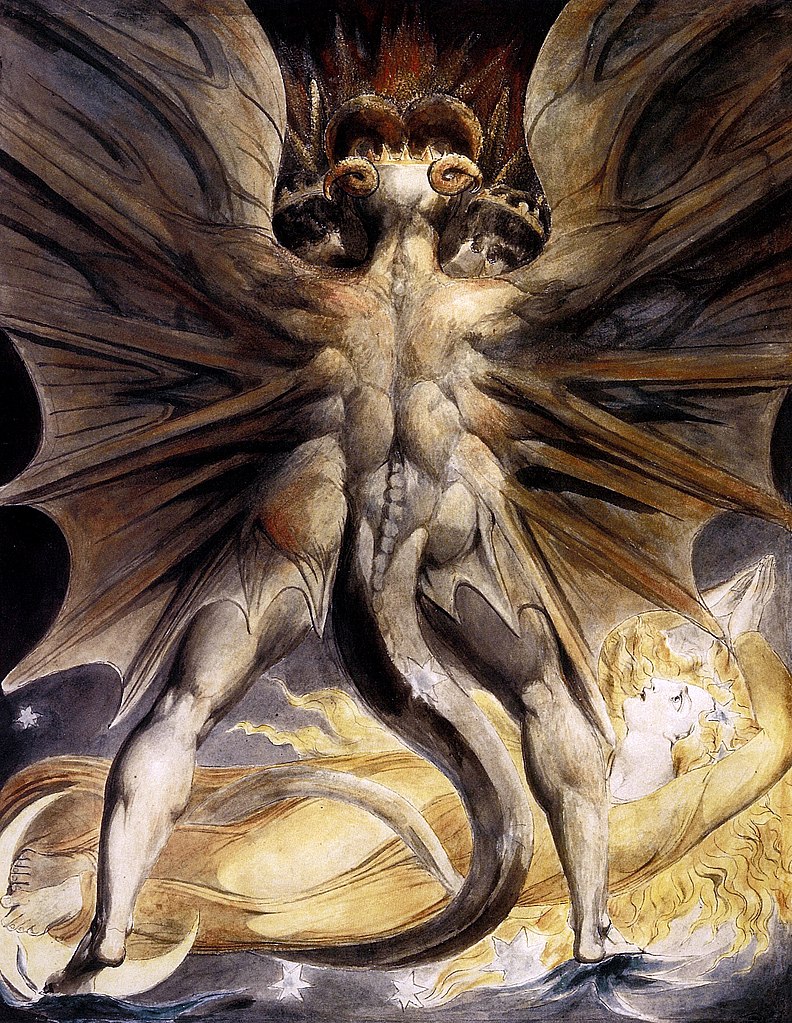
When I first learned about William Blake I was in high school, and my education on him was far from complete. I had known him from his poetry for which he was mostly famous, but until I saw a reference to one of his works of watercolor in a movie that I watched a few years ago. After seeing that movie, I did some more research and found more of William Blake's work and was instantly turned on to his style.
Part of the reason that this painting spoke to me is that it came from someone who I thought was known solely for his pieces of literature. Blake being so artistically rounded exemplifies the emphasis on inspiration and aesthetic common in the romantic period.
Blake's work, both in literature and painting focuses extremely on emotion and symbolism, but this painting in particular also focuses on horror and terror to a degree that I would not have thought common for someone such as William Blake. The painting itself is a depiction Blake made for a version of the Bible to include illustrations, and this example is an illustration for the book of Revelations. Revelations, as a whole, is a pretty mysterious and confusing book that is easy to romanticize. The symbolic nature of Revelations bleeds into this painting to create something bizarre, yet intriguing, that is a little bit off-putting for even some today.
This piece of art showed to me that a person does not have to simply stick with one avenue to impress the world, but it stuck out to me because of its dark, eerie style and mysterious stance, showing only the rear of what horrible beast was described in revelations. The piece itself is not logical and does not appeal to any reasonable image that man would see in real life, but it is the basis on the unseen and the emotion, rather than a basis on the seen and factual, that defined romantic art and gave the world masterpieces such as this.
I remember at 5 years old sitting at my family's desktop PC in our loft, entranced by the bright green screen as Peter skipped across it to his theme. My Peter and the Wolf computer game wasn't particularly complex or stimulating; it was basically an animated movie set to Prokofiev's music and a narration, but you clicked to move from scene to scene. It was one of my favorites though. Before I started playing music myself, the game—and Prokofiev's composition through it—introduced me to music that could carry you to a different world and completely alter your emotions.
My juvenile computer game served Prokofiev's original goals for his piece well. He was commissioned to write it by the director of the Central Children's Theatre of Moscow in effort to teach children about music and a variety of instruments. The composer himself learned to play the piano out of inspiration from his mother, who played herself, and he wrote his first composition at age 5. He would continue on to write ballets, operas, piano compositions, and more over his lifetime. He began writing music for children after he had some of his own, which is when he wrote his iconic Peter and the Wolf.
Prokofiev's piece is great not only because it is stirring and educational, but also because it tells a story. That's part of why it affected me so much as a kid. I was entranced by the way the instruments, keys, and melodies illustrated the characters and events. The idea has become more common to us now because music is such a core element in movies, but it's amazing how much power of emotion and narrative a piece of music can have.
A few months ago, I listened to Peter and the Wolf again, for the first time in years. I had remembered the game and wondered if I would still enjoy the music—I was not disappointed. If anything, the themes were more stirring than I remembered, and the story even more enchanting. It transported me back to those times I spent in our loft, following Peter and his animal friends on their adventure.
My dad is a graphic artist by trade, so growing up, I learned a lot about art. The art gene missed me. On a good day I can maybe draw a respectable stick figure. But art theory and art history permeated my childhood. I cannot tell you how many hours I spent wandering through museums with my dad, talking to him about different paintings and why they were good. All this to say, I have an interesting relationship with paintings. I feel like I know when one is good, but I could never tell you what it is that makes it that way.
Le Desespere, Gustav Courbet
Le Desespere by Gustave Courbet is a painting like that for me. I feel like I know this man. There is something about the expression in the eyes and the gentle tugging of the hair that is striking to me. I can see in this man's face that same kind of blank panic that grips me more often than I like to admit. The warm tone of the painting, and the sharp contrast between light and shadow makes my breath catch- it stills my heart to a stop. When I look at this painting feel like I'm caught in a moment that I've been in a million times. The moment before simmering stress breaks into full panic.
This painting meant a lot to Courbet, too. It was a self portrait, and he carried it with him wherever he went, even into his exile from France. I understand that, on a certain level. As much as desperation and panic are unsavory parts of my life, I have to remember them. Somehow, remembering the times of disorientation makes reality seem more real, and the present more tangible.
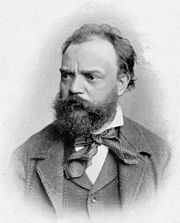
The first time that I had ever heard the 4th movement of Dvorak's 9th Symphony was in a video game called Asura's Wrath in 2013. In that game, the rebellious god Asura challenges his old teacher Augus to a battle to the death. As the two deities clash on the lunar surface, the finale to the New World Symphony begins to play as an accompaniment to the clash of fists. Watching this hot-blooded conflict as a high-schooler gave me stars in my eyes, and the song which played stuck around in my head for weeks, and I would find myself humming to it's tune as I walked to class. It was only later, of course, that I would even find out the symphony's name, and could listen to it on YouTube in it's entirety.
Antonin Dvorak (Ahn-toe-nin Di-vor-shack) was the typical musical prodigy common among famous composers having been proficient at the violin since the age of 6. He became famous after his death for mixing African spiritual melodies as well as Native American dances into his most famous work, the 9th or New World Symphony. Considered one of the greatest musical works of all time, a recording of it was brought by Neil Armstrong onto the Apollo 11 mission. Within 30 seconds of the 4th movement's beginning, we have the sort of leitmotif a nefarious warlord would have, as he crushes the world beneath his feet. It transitions into a lighter, but still gray repeating continuation, before descending into quiet, but hopeful stillness with the usage of the flute. Thus proceeds an optimistic march which is interspersed with several brief returns to that oppressing opening. Eventually, we reach the "Largo" of the piece which had been used by Dvorak's student William Fisher for the spiritual song "Goin' Home", which wears it's African influence on it's sleeve. We then transition to long stretches of tranquility before moving into the climax, a true return to the opening once more before the final minutes of victorious trumpets, marking the end of the piece.
Ultimately, the 4th movement tells a story, a story of darkness which conquers all and destroys peace before finally in the end being defeated by a simple good. It's a piece of music which I hold close to my heart.
Authors have a gift that for me, transcends that of music or paintings. They depict life as we feel it, a beautiful depiction of the human consciousness hitherto unreached by other mediums. Whoever said a picture was worth a thousand words was wrong, for what we see with our eyes cannot compete with the images we created ourselves in our minds, unfettered by the imaginations of others.
Growing up, I had a fascination with Edgar Allen Poe. I was too young to understand his work at the time, and barely read or listened to any of it. I'm not sure why I was fascinated with him, but I was. His name had weight to it, it carried with it mystery, the macabre, and a darkness that should have scared me away, but instead drew me in. Today I think I understand why I was fascinated by Poe. The one story I remember by Edgar Allen Poe is, "The Raven".
This dark poem tells of a man, who in mourning for his deceased love Lenore, finds himself in his chamber late at night. An ominous tapping from outside his chamber startles him, and as he seeks to find its owner he discovers a raven who enters the room. Curious at first, the man questions the raven, seeking to learn the name of his new companion. To his surprise the Raven responds with "Nevermore". Fascination rising, the man continues to question the raven, each inquiry more serious than the last. To each the Raven responds, "Nevermore". By this grim declaration he is told that he will never see again his lost love and that he will never have respite of the pain of losing her. As the poem progresses he descends into madness, tormented by the raven who will leave him, "Nevermore".
Edgar Allen Poe published this poem in 1845, and two short years later his wife died. Two years after that Edgar himself passed away. This poem seemed to foreshadow the remainder of Poe's life. "The Raven" is a masterfully crafted poem which gives us a glimpse of the darkness within each of us and in the world. I feel as though the raven in this story represents our own demons, deep within us, that want us to fail, that want us to grieve and suffer. If we engage our demons at the wrong time or in the wrong way, they can pull us down into the depths of misery and despair. We can break ourselves if we aren't prepared for the darkness inside of each of us. Like the grieving man in the story who curiously engaged with the raven and soon found himself shattered and broken even more than before, each of us deal with our own hardships and losses and we too can engage with our own ravens. But when we do we walk the razors edge between madness and sanity.
The mysteriousness and eerie feeling in this poem connect with me because I have those feelings in myself. I have suffered loss and I have let myself descend into darkness before. I enjoy this type of art not because I like those feelings, but because they are part of me and I need to recognize them and see them for what they are. We all need to stand up to our own ravens and not let them define how our life will go, or how it will end. We need too shoo the ravens within us and give heed to them "Nevermore".
I highly recommend you watch this video in the dark on full screen to get the full effect of this poem.