Showing posts with label posted by Stephen R. Show all posts

Thursday, December 13, 2018

Teachers Unions, the Necessary Revolution

By Stephen Rackleff

With salaries failing to compete with other job fields of similar caliber, teacher's need to unionize in order to protect the profession and the education of our children.  

Image result for teacher images
If you were to explore various polls and online debates about teachers' unions and whether or not they help the current situation, you would find varying opinions. You'd be able to find some decent arguments on both sides, and some completely rational people that believe one way or the other, and you would also find hordes of people flocking to one side because of their political alignment or background with no real opinion as to why unions are either good or bad. The clarity of what unions accomplish and what they are good for is hard to find amidst the posts and rants that abound when you search this topic from a public opinion standpoint. Many wholeheartedly condemn them, while many embrace them without a second thought. So are unions really all that great? Do teachers really need them?

Wednesday, December 5, 2018

Unionizing the Educators


     Teacher's Unions have been around now for over a hundred years, with the first official union having been founded way back in 1916 in Chicago, Illinois. This union, The American Federation of Teachers, accomplished many helpful things for teachers as a whole, such as helping raise salaries and making sure female teachers were treated fairly in a time when sexism was rampant in the public and private sector.
     Other unions would emerge, strikes would take place, laws were passed to raise wages, and the educators across America benefited greatly. This emergence follows very closely the theme of challenging traditional systems that we would see come forth in the Digital Age, and in many instances mirrors some of the ideas about protest so common in the Reformation. Teachers were going on strike in states and areas where wages were not high enough in an active protest against unfair payment for their work. This new way of challenging the way things were done was prolific, and it's still going on today.
      Unions today have similar strategies as those of the 20th century: negotiate wages, organize strikes, and protect the rights of hard working teachers across America. However, contemporary unions also focus more on political movements and supporting political candidates that will help their interests more than before. Other developments such as tenure would make their way into unions as the time passed, and thus unions had changed to some degree from what their original ideas were.
Image result for teachers union     Some states today support unions wholeheartedly, while other states make laws that push against the power of the unions in an effort to retain some control over the ever changing field of education. States that allow more room for unions generally have better wages for teachers and less strikes occur because of this. It seems that unions and education might be better handled at a federal level, that way the quality of life for educators can be consistently better across the board.

Photo Source:
http://www.alternet.org/files/styles/story_image/public/story_images/shutterstock_80227045.jpg

Monday, December 3, 2018

Hot Spots in Education


Image result for classroom
  • Prayer in School: Prayer in school has been a hot topic of debate for many decades now. Proponents of prayer in school of late have not been satisfied with voluntary prayer, and want to instead go back to the way things used to be with prayer as a classroom institution. Those against this idea refute this as a violation of freedom of religion. Through the media, news sources paint either side in a light that makes it hard to know what is really at stake. Most people, I think, would be okay with voluntary, private prayer in schools, and most I feel would not be okay with forced prayer, especially if it was to a deity or religion that was not favorable for their children, yet the media drives the two sides away from the large amount of common ground these two sides really have. 
  • Protest in School: Currently, there is a big debate over professional athletes standing for the national anthem. In public schools, that debate has been going on for some time as well, with students refusing to stand for the pledge of allegiance that in many schools is a daily routine. In some cases where students do not stand school suspension has been instituted, begging the question, do students give up their first amendment rights to freedom of speech and expression when they walk into the classroom doors? 
  • Unions in Education: Unions add many benefits to the ever difficult lives of teachers, however, some believe that unions benefit special interest groups more than it really does the teachers. Certain benefits such as tenure and wage bargaining have dark sides to their gleaming face. In many instances, teachers who have committed heinous acts are still on tenure soaking up resources without actually teaching, and wage bargaining on behalf of the teachers can cause stalemates between the state governments and the union resulting in long, arduous strikes that leave children without proper teachers or class sizes. 

The first hot spot I mentioned is one that I feel is currently most compelling. Many of my friends and family argue vehemently on both sides of the argument. I feel as though the issue lies in getting past the rhetoric tools that each side uses to veil the reality of the situation.

Image Credit: https://upload.wikimedia.org/wikipedia/commons/thumb/2/26/Andrew_Classroom_De_La_Salle_University.jpeg/220px-Andrew_Classroom_De_La_Salle_University.jpeg

Monday, November 26, 2018

Multiple Appeals for a Multitude of Ears


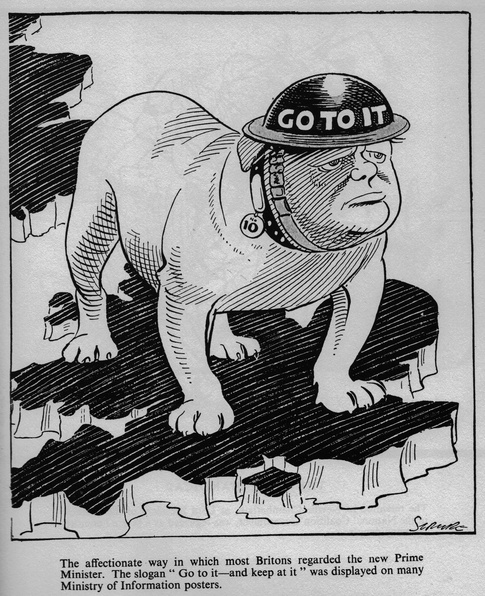
Image result for winston churchill political cartoon

     The greatest orators, both in recent history and in ancient times, will use more than one kind of appeal within their speech in order to truly reach their whole audience. Winston Churchill in his address Sinews of Peace is no exception to this. 
     In the 19th and 20th paragraphs of his address, Sir Churchill mentions the ominous consequences that lay on the horizon if the shade left by the ending of the second world war is not dealt with properly. He uses phrases such as "A shadow has fallen" and "time may be short" within these paragraphs. These somewhat dark and foreboding words touch upon the emotions of fear, anxiety, and worry. Churchill uses his authority as access to these emotions, for if someone as great, as powerful, and as influential as he believes there should be fear and urgency regarding his subject matter. This is a stark example of the pathos appeal. 
     The appeal to ethos, or appeal to one's character is present in this speech right from the very beginning. Sir Churchill begins his address by discussing directly some of his impressive education credentials. He does so in a playful, yet candid manner that allows him to tread into self aggrandizement without drowning in the depths of bravado and boastfulness. This plays to one of his great strengths throughout the speech, his own authority. The respect that the audience currently has for Sir Churchill also greatly adds to his ability to appeal in such a way to himself that others might be criticized for. 
     By using these appeals in tandem, Winston Churchill weaves a powerful and moving speech regarding the importance of proactive peacefulness in the world theater. His word choices play to the emotion of fear that is currently still effervescent in the world, and he discusses to some degree his station as Prime Minister and various other accolades to hammer in to the audience that this topic is both serious and of great import.  

Picture Credit:
https://www.google.com/url?sa=i&source=images&cd=&cad=rja&uact=8&ved=2ahUKEwi969qp_PPeAhWMZd8KHalaCHgQjRx6BAgBEAU&url=https%3A%2F%2Flincolnandchurchill.org%2Fchurchill%2Fchurchill-in-cartoons%2F&psig=AOvVaw0F52venkwj-dqilIVVD2Mn&ust=1543387364390661

Monday, November 19, 2018

The Birth of Film

     1878 marked the year that the first ever "movie" or moving picture was introduced in the world. The title was The Horse in Motion and it was created by Eadweard Muybridge. Following this short sequence of moving pictures that Muybridge brought into the world, many other creators latched onto this idea of moving photography and thus film was born.
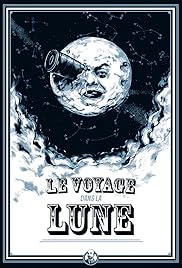
     I was surprised to find that many movies of this time period already began to explore the realms of horror and science fiction. There was a film by the name of Le Voyage dans la Lune, (A Trip to the Moon) that depicted a man landing on the moon in what is recognized by all as the first sci-fi film. Many other genres emerged from this genesis of an art form, such as the western, animated cartoons, and horror films.

Image result for trip to the moon
     It is interesting to note that many of these filmmakers hung on to many of the ideas and themes of the romantic period such as horror and the exploration of the illogical. Film, like many other mediums, would become a vessel for the ideas and aspirations of society, helping turn the wheels and grease the axle of progress in its own, new way.
     While certainly not as timeless as written literature or many other forms of visual art, film today is certainly one of the most lucrative as well as one of the most talked about art forms. Movies such as documentary have the power to raise awareness, social issues could be represented on a accessible scale in adventure films to help spread ideas and highlight certain injustices, and inspiration for the future of technology could be found in many great science fiction films in a way that words written on a paper or motionless drawings simply could not.
     There were many different political and economical calamities of the Gilded Age, and those should not be overlooked, but the emergence of such a universal and beautiful form of art is often overlooked in the wake the great depression and the two world wars. I often wonder why film is not studied as seriously as a part of general education among public schools and universities, as the richness and depth of this particular form of art is still being uncovered to this day.

Photo Credit:
https://www.google.com/url?sa=i&source=images&cd=&cad=rja&uact=8&ved=2ahUKEwiO_aSOrOLeAhXFnuAKHUQNDFwQjRx6BAgBEAU&url=https%3A%2F%2Fwww.imdb.com%2Ftitle%2Ftt0000417%2F&psig=AOvVaw3VANW47pvehHu4a9I07SPt&ust=1542781772315509

Thursday, November 8, 2018

Meeting Blake's Dragon


     When I first learned about William Blake I was in high school, and my education on him was far from complete. I had known him from his poetry for which he was mostly famous, but until I saw a reference to one of his works of watercolor in a movie that I watched a few years ago. After seeing that movie, I did some more research and found more of William Blake's work and was instantly turned on to his style.
      Part of the reason that this painting spoke to me is that it came from someone who I thought was known solely for his pieces of literature. Blake being so artistically rounded exemplifies the emphasis on inspiration and aesthetic common in the romantic period.
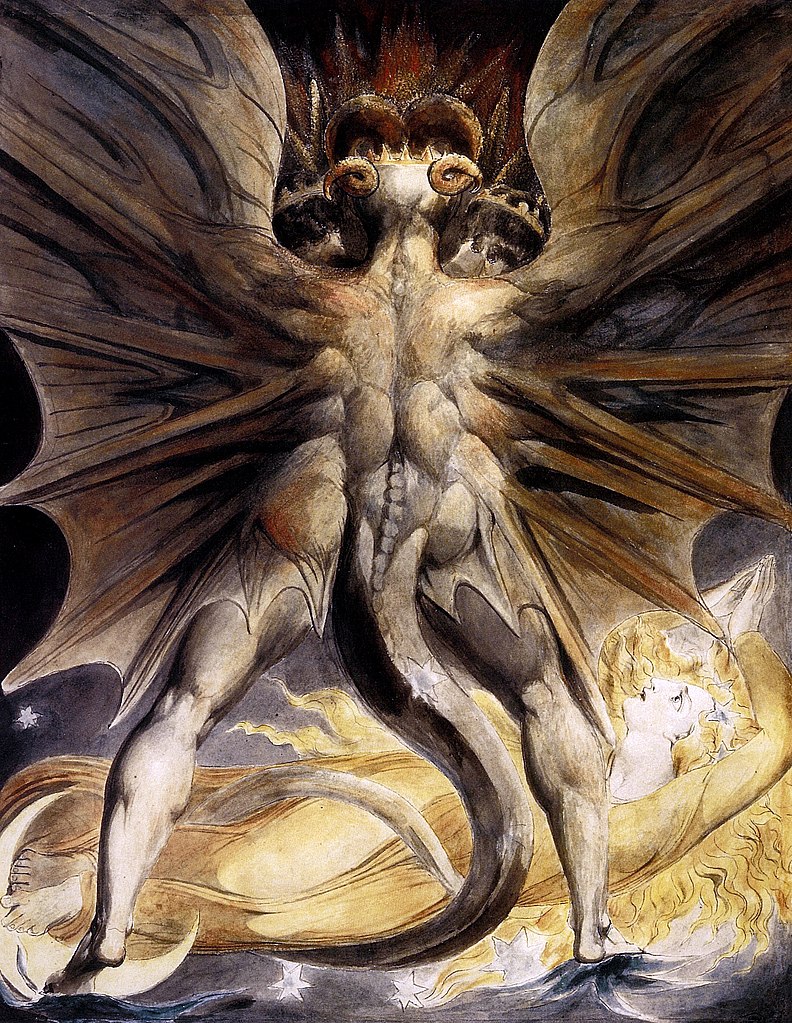
Image result for the great red dragon paintings
   Blake's work, both in literature and painting focuses extremely on emotion and symbolism, but this painting in particular also focuses on horror and terror to a degree that I would not have thought common for someone such as William Blake. The painting itself is a depiction Blake made for a version of the Bible to include illustrations, and this example is an illustration for the book of Revelations. Revelations, as a whole, is a pretty mysterious and confusing book that is easy to romanticize. The symbolic nature of Revelations bleeds into this painting to create something bizarre, yet intriguing, that is a little bit off-putting for even some today.
     This piece of art showed to me that a person does not have to simply stick with one avenue to impress the world, but it stuck out to me because of its dark, eerie style and mysterious stance, showing only the rear of what horrible beast was described in revelations. The piece itself is not logical and does not appeal to any reasonable image that man would see in real life, but it is the basis on the unseen and the emotion, rather than a basis on the seen and factual, that defined romantic art and gave the world masterpieces such as this.

Photo Credit:
https://www.google.com/url?sa=i&source=images&cd=&cad=rja&uact=8&ved=2ahUKEwiNrcOG0cbeAhUC2IMKHY7wCK4QjRx6BAgBEAU&url=https%3A%2F%2Fcommons.wikimedia.org%2Fwiki%2FFile%3AReddragon.jpg&psig=AOvVaw2K3PmcSXH-MU5idDiYmtzs&ust=1541829615427911

The Immensity of Space

Something Big: Hypothermia
When I was much younger I attended a Boy Scout camping trip into the mountains with my fellow ward/troop members. I did not enjoy the outdoors a whole lot, but I was optimistic that this would be a good trip. I had my friends and even my father attended as one of the adult leaders. On the mountain, my troop got caught in a terrible storm that was both heavy and cold. I had not brought all the proper rain gear I should have, and as such I got hypothermia and had to be carried off of the mountain by my comrades and some of the medical team that was at the base camp. While we waited for the medical team, I realized that in some ways, man is completely helpless to nature. That is what was irrational to me, why would we go out in such conditions? How was I so fragile?

Something Broken: Mental Health
Members of my extended family and several people close to me personally, including myself in some degree, struggle with issues of mental health. Since early childhood, I had always believed that everyone could simply be happy if they did the right things in life and followed God's laws, and while that may be true for the next life, there is no way to ever guarantee happiness in this life. The idea that many of us are afflicted by real diseases and conditions that prevent the simple states of happiness or calmness breaks my heart and puzzles me to this day. 

Something Artistic or Man-made: The Lamb
https://www.youtube.com/watch?v=h-mSmEfLmZc

John Tavener's choral adaptation of the famous William Blake poem, The Lamb is bewilderingly beautiful. The way that John composed the notes for the different parts is far from conventional. Instead of writing simple counter-melodies and harmonies, Tavener inverted the notes of the melody with seemingly complete disregard for the key of music it would end up resembling. The link above includes a professional recording of it, but the time I best resonated with this song is when I had the opportunity to perform it in my high school choir. I had never before experienced so much beauty from something that, from a theoretical standpoint, made no sense at all to me. 

Something Mysterious: The Immensity of Space 

In one of my classes here at BYU, my professor stopped his regular lecture to show us a video of some of the deep space images produced from the Hubble Telescope. The video included music that inspired wonder, but the music seemed like nothing in comparison to the images displayed. 
Image result for multiple galaxiesEarth was lost to the size of our galaxy, and then the galaxy lost amidst a wash of other galaxies in such a manner that perplexed me more than I can describe with words. What was out there? If space really is infinite then is there no end to what could be out there? When I watched this video I felt like I was having an out of body experience viewing places and spaces that I would never, ever be able to visit, and seeing so many planets and stars that mankind may never be capable of reaching or really learning about. 


Image Credit 
https://www.google.com/url?sa=i&source=images&cd=&cad=rja&uact=8&ved=2ahUKEwirw_6V5cXeAhUI2oMKHSCfApIQjRx6BAgBEAU&url=https%3A%2F%2Fwww.space.com%2F25303-how-many-galaxies-are-in-the-universe.html&psig=AOvVaw0JHHhbD32kucBq3mRZ3bxv&ust=1541800656385252


Thursday, November 1, 2018

Aestheticism in the Age of the Selfie

     After delving deeper into The Picture of Dorian Gray by Oscar Wilde one of the themes that becomes every more present in the book is the idea that society during this time of aestheticism was indeed extremely superficial in its focus and values. The main character, Dorian Gray, personifies in almost every way that superficial nature as he buys into every pointless party and becomes a slave of fashion and looks as much as he is to Basil's painting that prolongs his youth. We can see this clearly from a passage from the second chapter in which Dorian says "I know, now, that when one loses one's good looks, whatever they may be, one loses everything. Your picture has taught me that. Lord Henry Wotton is perfectly right. Youth is the only thing worth having. When I find that I am growing old, I shall kill myself." This statement draws a bold line limiting value to only that which is beautiful.
     In this time period, Oscar seems to be prodding at while simultaneously praising the idea that all art has to offer anyone is beauty. Mr. Wilde would be perplexed, I think, to see how droves of young people capture not merely capture one grand painting, but in some cases thousands of photographs of themselves to preserve their beauty and looks on a medium that is even more permanent than canvas or paper. The idea of beauty and looks being all important is the reason we have entire industries to this day. Social media, the fashion industry, and in tandem with the fashion industry the cosmetics and beauty industry would not exist were it not for such a hyper-focus on aesthetic that pervades society today. It is amazing to see that the way that one looks can drive their decision making more than almost any factor in their life. 
Image result for selfie of dorian gray     Aestheticism seems to me at times to be a step away from the humanist ideas of enlightenment. Instead of focusing on tolerance, equality, and inclusiveness, society decided to try to widen the gulf between some social classes in order to foster exclusivity, secrecy, and the elite. Society today, from politics to media and Hollywood still exercises these vain ambitions. The industries of art and literature of all kinds seem to focus on the surface and the social status of the creator now more than ever. The idea that all art has to offer is beauty may have been what Oscar was going for and a big part of how life was lived then and even now, but should that be the case? Is beauty the only enrichment there is? I would say no, completely not. Art is meaningful, and society can be, too, the focus just has to dig deeper than the placid surface to reach that meaning. Enlightenment and the ideas founded therein could help readers and viewers get there by showing them through rational method the different ways to find value in art and society. Oscar Wilde came after the enlightenment with a story that simultaneously criticized and praised aestheticism. This self awareness definitely rings with familiarity of the enlightenment era, however, the main idea about art expressed is lacking the rationality and depth that would've come from the enlightenment era.

Picture source:
https://www.google.com/url?sa=i&source=images&cd=&cad=rja&uact=8&ved=2ahUKEwj9zqGuvLTeAhUDmoMKHRHPBoYQjRx6BAgBEAU&url=https%3A%2F%2Fwww.pinterest.com%2Fpin%2F415949715562639767%2F&psig=AOvVaw1X-YH8EFQOl_b8lnGDeE8c&ust=1541205560843267

Thursday, October 18, 2018

A Banned Book by A Banished Man

     The Picture of Dorian Gray was the last novel that Oscar Wilde wrote before being called on trial and banished for the United Kingdom. It was used as evidence against him being amoral and a poor influence on society. The book, therefore, was a very controversial piece for it's time period.
Image result for dorian gray
     The story itself focuses on the painting of a famously talented artist who paints a portrait of a young, handsome man who longs to trade places with the portrait. Dorian, the painting's subject, realizes that the painting will never age and will retain its beauty throughout the eternity, while Dorian ages and withers with every passing second. Somehow, Dorian switches his fate with the painting and gains the ability to resist mortality and stops aging altogether. He then proceeds to live life to its full and engages in morally questionable behavior.
     This book, being shunned as immoral and avoided by many of the time period as such, begs a question of society and literature: are there novels that we should not be allowed to read? Surely society had seen some books as evil, but this was a novel. It seems strange to us today, as we are so open to varying morals within our media, whether we like it or not, but for people back in its time the use of this novel as negative evidence against Oscar might have made sense.
     However, even today some artists face such scrutiny from the public eye. Marilyn Manson, a rock musician from the 90's, was blamed by many conservative news anchors for influencing the two teenagers who committed atrocities at Columbine. It was later found that the two were not fans of Manson, and scrutiny on his account decreased.
     The Picture of Dorian Gray and other controversial pieces of literature, be they movies or music, that push the boundaries of our moral conventions might not be for everyone, but would banning them be the right thing to do? Certainly age restrictions and cautionary labels are good, but this book goes to show that too much censorship will stifle the world of literature, and that art will always push against boundaries, for better or for worse.

Picture Source:
https://www.google.com/url?sa=i&source=images&cd=&cad=rja&uact=8&ved=2ahUKEwiiksXaqZHeAhUN21MKHecjAacQjRx6BAgBEAU&url=https%3A%2F%2Fwww.star2.com%2Fculture%2F2017%2F10%2F04%2Fdorian-gray-oscar-wilde-ageing-issues%2F&psig=AOvVaw2CUW9YY17G610en6ri9Uxw&ust=1539997979239276

Wednesday, October 10, 2018

Other Planets, Other Suns

     Alexander Pope's writing in his philosophical poem, An Essay on Man, displays an awareness that particularly interested me. Pope mentions the idea of different planets revolving around different suns, and muses on what kind of beings might inhabit those "other planets". While the discovery of a heliocentric (sun-centered) galaxy was modeled by Copernicus around 200 years prior to Alexander Pope's famous essay, I think that Pope philosophically expands upon a scientific finding in such a way that is still very pertinent to our day. 
Image result for copernicus model

     In the first epistle of his essay, Pope writes two lines that makes one really think about the unknown, "What vary'd Being peoples ev'ry star, May tell why Heav'n made us as we are." (Pope, Essay on Man). It seems as though Alexander Pope is suggesting to his audience that by learning more about the universe and astronomy, mankind can learn more about both God and mankind, itself. This is truly insightful. Words such as these helped mankind reach beyond whatever knowledge was within close grasps of its fingertips. Even today, there are scientists and writers who seek to explain the stars and push the boundaries of human knowledge to better mankind. This kind of thinking was both rational and inspirational at the same time, helping humankind to push past barriers, to revolutionize science, politics, and law. I think that often we do not value pen as much as we do the microscope in such instances of innovation and change. Would revolution and science be even allowed in our society today to the degree it is without having great writers and speakers to convince others to action and defiance of complacency? The body of humankind moves forward via many muscles, and I submit to you that great literature such as The Declaration of Independence, the Bible, Martin Luther's Theses, Dr. King's great speeches, and essays just like the one written by Pope I have mentioned, would be the heart. 

Image Source: <https://upload.wikimedia.org/wikipedia/commons/thumb/2/28/Copernican_heliocentrism_diagram-2.jpg/300px-Copernican_heliocentrism_diagram-2.jpg>

Friday, September 28, 2018

One Small Typographical Error, One Giant Leap For Mankind

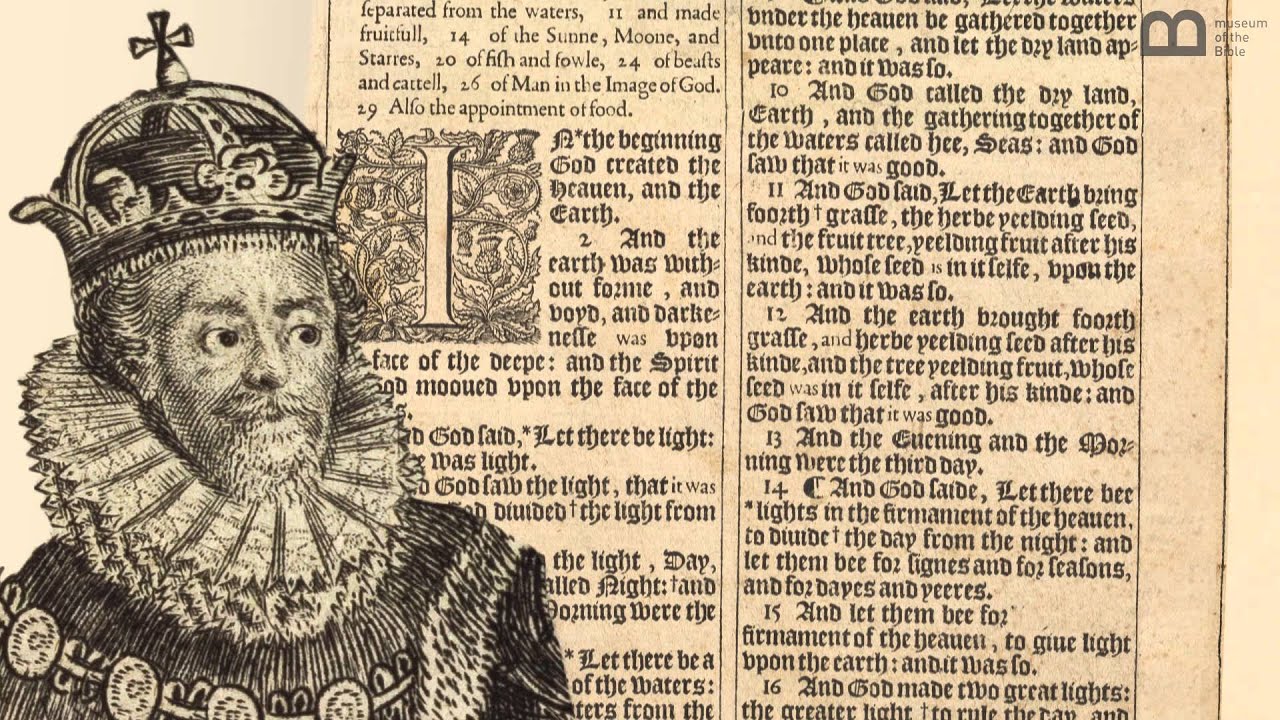
     In 1631, the then royally appointed printer, Robert Barker published a reprinted version of the King James Bible, within which a small error was made that drastically changed the way that Exodus chapter 20 read when listing the 10 commandments. In the 7th commandment, where it is written "thou shalt not commit adultery" the single word "not" was omitted. Resulting in the commandment now reading as "thou shalt commit adultery." One can easily see how troublesome this error could be especially concerning the fact that many Christians of the time were just beginning to have access to reading The Bible for themselves. This great invention, the printing press gave many advantages to those who wanted to spread authentic writings and truth, as Berlyn Flake points out in her blog post titled "The Printing Press and the Weakening of Catholicism," but the invention also proved to enable the hasty spread of misinformation in some cases. 

(Below is a depiction of the type and text.)


Saturday, September 22, 2018

Duality of Humility and Exaltation


     In his article about the poetic styling of the King James version of the Bible, Leland Ryken dissects the simplicity and the majesty that is pervasive in this, one of the earliest English versions of the religious text. He describes the build from simplicity to majesty in many passages, and how the sort of simplicity does not imply that God or His prophets should be reduced, but rather highlights the majesty in other passages.
     My personal experience with religion and God has been similar within religious texts as well as within religious structures, both old and current. I have seen some splendid older chapels that more resemble the type of art and culture that the Catholic churches might've looked like with their bravado and elegance, and I have also seen some very simple religious structures, depicted and in person, that cause me to pause in their simple beauty. I feel that the dichotomy of cultures in religion that began to split in this time period is a good description of what Leland Ryken is describing here. There are times when religion is mighty and elegant with dazzling color and wondrous detail, and there are times when it is simple and accessible in a beautiful way. The prime example that I have seen of this dichotomy is within Temples of the Church of Jesus Christ of Latter-Day Saints. There is simplicity in many of the rooms and a clean accessibility that pervades the building as a whole, but the artwork and the detail of some of the rooms display artwork of some of the highest caliber. This duality helps believers feel both humbled and exalted by God, resulting in an experience that both relishes in the good of humankind and disdains its shortcomings, a sort of happy medium between the humanists of the reformation and the Catholic institution that played heavily on the humility. This, I believe is a great tool in any situation, and rewards readers of the King James Bible in the same way.

Image result for image of the first king james bible


Image Source 
<https://www.google.com/url?sa=i&rct=j&q=&esrc=s&source=images&cd=&cad=rja&uact=8&ved=2ahUKEwj39PnMktDdAhVJ64MKHeolDS8QjRx6BAgBEAU&url=https%3A%2F%2Fwww.youtube.com%2Fwatch%3Fv%3DTsPtb8pkAuY&psig=AOvVaw1LM4U1t3HRDrJKXvWqrs0W&ust=1537758400246695>

Wednesday, September 19, 2018

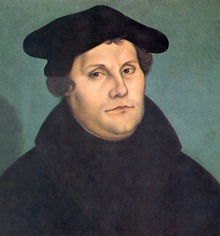
Martin Luther and Anti-Materialism


Image result for martin luther
      Martin Luther was not only a religious revolutionary, but also an anti-establishment, anti-materialist. In article 32 from his 95 Theses he plainly sets forth the idea that those who seek for and offer indulgences will be damned. This is much more of a serious accusation than simply pointing out that the Catholic church has erred in a small way. Furthermore, his argument goes into the idea that an individual's worth is not based on their wealth, nor should any part of their morality be tied to temporal possessions. This idea of worth outside of wealth is an important one to humanity as a whole and is still pertinent today. 

    This sort of anti-materialism pervades in humanists today, but not within some popular institutions. There are other methods with which we "damn" those who do not have wealth, such as access to knowledge and or education. Martin Luther questioning the Catholic Church paved the way for questioning other religious institutions, but also paved the way, at least in part through article 32, for questioning society's hyper focus on money and using it to buy some version of salvation. This idea also allows room for great individuals to come out of low stations and reinforces some of the main ideas of humanism as a whole. Great scholars and politicians do not have to come from a place of great wealth in the same way that great Christians do not have to achieve salvation by pecuniary means. Martin Luther's theses were of such great impact that they still echo into the culture, politics, and religion of today. 


Sources: 

Elmer, Peter, et al. The Renaissance in Europe: an Anthology. Yale Univ. Press, 2000.

Image from https://en.wikipedia.org/wiki/Martin_Luther (Public Domain)

Wednesday, September 12, 2018

A Time of Black and White Thinking

Right and wrong, intelligent and unlearned, holy or heathen. Going off of what was mentioned in Of Cannibals by Michel de Montaigne, there seemed to have been a pervasive idea that there was absolutely a right way and a wrong way to live life. Cultures that differed from the monolithic towers of Catholic religion and Roman philosophy were regarded as refuse if regarded at all. For a time that is considered so forward thinking, there was a lot of tribal belligerence plaguing the masses. Montaigne’s essay seeks to delve into the lives of so called savages and help set them on a similar plane with others, but this was not normal, hence the essay is looked back at as controversial for its time.

Image result for uncivilized natives     Today, similar thought patterns seem to be creeping back into society and modern “tribes” begin to emerge. Take political discourse for example, there are fewer and fewer people willing to compromise for a general consensus, and more and more people who will unabashedly shame someone, no matter their character or demeanor, simply because they have not chosen the obvious high road. I think that it is vitally important to take from the Renaissance the zeal for learning and history, but I also think we should be careful not to emulate the pompous pride that plagued society as a whole in that time period.

Monday, September 10, 2018

Preservation: the Key to Knowledge

Preservation: the Key to Knowledge

“The shame of failing to cultivate our own talents, thereby depriving the future of the fruits that they might have yielded, is not enough for us; we must waste and spoil, through our cruel and insufferable neglect, the fruits of your labours too.” (Petrarch).

Image result for cicero


 I chose this picture because it is a depiction of Cicero doing what he does best, but I also chose it to point out what his left hand is holding and why I think it is significant to the renaissance. He is holding onto and unbound piece of writing material, most likely vellum or parchment as the Romans were beginning to substitute the two for papyrus as early as 200 B.C. due to the scarcity of papyrus. Papyrus was becoming scarce in this time period due in part to the library of a place called Pergamon. This library is compared by some historians to the great Library of Alexandria, a place of knowledge and learning that was eventually destroyed during Caesars pursuit of Pompey into Egypt. This event has been thought of as a great loss of knowledge that captures the essence of what Petrarch was trying to say in his letter to Cicero from the aforementioned quote.
            It is interesting to see that societies have been trying to find ways to preserve knowledge for thousands of years and that information is so valuable that many inventors spend all of their time trying to create apparatus to retain it. I wonder if perhaps those at Pergamon thought of their new parchment in a similar vein that people during the Renaissance viewed paper, and if so, did they too take pride in building upon inventions of the past the same way that people in the renaissance did. It seems that every time there is a surge of knowledge-seeking in a society, there too is a surge of technology that can retain it. Or perhaps there were other civilizations who achieved similar ideologies, but perhaps they failed in preserving what was learned and we are robbed, as Petrarch would say, of the fruit of those labors.