Showing posts with label the gilded age. Show all posts

Wednesday, November 14, 2018

Change of Pace, Change of Scenery


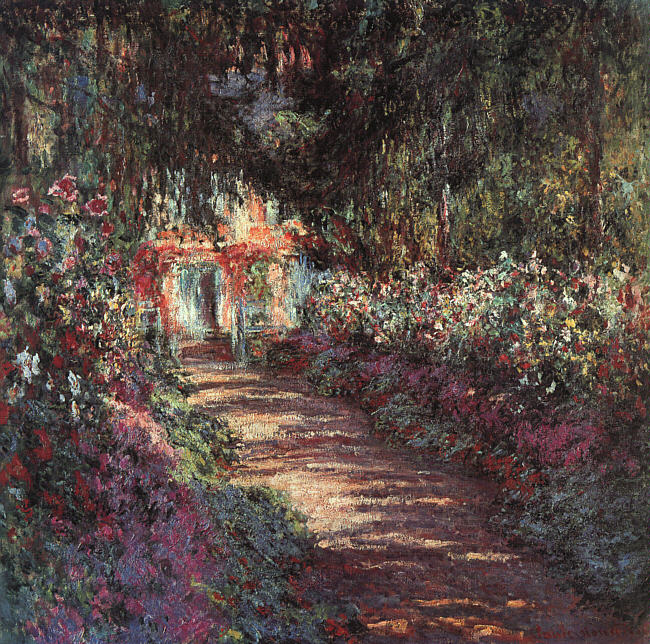
The Garden in Flower Claude Oscar Monet 1900.jpgBorn and raised in Northern Delaware, I was always a stone’s throw away from some of the art hubs of the East Coast, like 25 minutes away from the Philadelphia Mueseum of Art and the about 2 hours away from the Metropolitan Museum of Art. These were easy for field trip destinations for my schools growing up and day trips with my mom when I didn’t want to go to school. Whenever the museums had exhibits of impressionism, specifically of Claude Monet.


When I graduated high school, I skipped the normal ceremonies, took all my savings, and travelled around Europe with my cousin. On my itinerary was the Museum d’Orsay which houses a rather large selection of impressionist-era paintings, including works of my favorite childhood painter Claude Monet.


Patrons of the museum weren’t allowed to photograph anything inside, and for the first time in a rather hectic vacation of two poor East Coast girls, one of them freshly tossed into the world and having no idea what to do with her life, I just sat and looked at the famous paintings that literally wrapped around the room. I took in the thoughts and colors of a dead painting and suddenly felt full of life.


With a weekend for attending international cinema movies and a debate of dead soldiers from WWI, the heaviness of those topics were elevated when I decided to spend some time writing this post about the tranquility of Monet’s impressionism the generation before the War to End all Wars. I think that some of the beauty that came from the impressionism era is that it add beautiful color to the stark, gray contrast of battlefields, shell-shock, and the carnage of war. Like my experience in stepping out of the chaos of a busy city in the quiet of Monet’s gardens, art like impressionism preceded the war in what I can only hope was a serendipitous therapy offered to the war via nature-art.

Photo Credit: The Garden Way (Public Domain Image via Wikimedia Commons)

The Forgotten Man


I dug my spurs into my horse’s flanks, urging her forward to cut off the cow before she wandered off the trail, dragging half the herd with her.  She complied but bellowed to let me know she wasn’t happy, and it wasn’t too long before a heifer tried the same thing.  My horse diligently obeyed, though I could feel her heavy breaths as her sides expanded and deflated, moving my legs out and in with each pant.  Her mane was damp and her hide glistened with sweat, but on she went. 

It’s not a perfect parallel, but to coincide with William Sumner’s ideas, we could call this horse “the forgotten horse.”  William Sumner was an American social scientist who taught at Yale during the Gilded Age.  The uprisings of monopolies and flourishing of the middle class starkly contrasted with the life the new immigrants and lower class were living.  Efforts were put forth to hinder the growth of booming businesses and others sought ways to assist the immigrants and lower class.  So what does this have to do with a forgotten horse?

In Sumner’s work, What Social Classes Owe to Each Other, he passionately argues that “every effort to realize equality necessitates a sacrifice of liberty.”  He sees many people working diligently and seeing success, yet the fruits of their labors are laid at the feet of those in poverty.  There is no motive to rise above that condition when “social doctors flock about him, bringing the capital which they have collected from the other class, and promising him the aid of the state to give him what the other had to work for.”  With these circumstances, the social reformers and philanthropists, A and B, dictate what C will do for the poor, D.  And what does he call C?  The Forgotten Man. 

Image Credit: Scale (via mesosyn)

The Seventh Art and La Belle Epoque


La Belle Epoque, as people would later call the period leading up to World War I, was a time of discovery. People had been playing with the idea of moving pictures since the 1820s, but it was not until the 1880s that discoveries really began to take place that created the ideal situation for film. There was fierce competition to create a viable way to show moving pictures, causing people from England, America, France, and many other places to compete against and build off each other. Thomas Edison in America was particularly infamous for the amount of clout he used in trying to monopolize the industry before it had even begun. However it was the Lumiere brothers in France that would ultimately succeed in creating the first projected motion picture that could be sold to a wide audience. 

Image result for cinematographe
The original Cinematographe 
At the heart of the history of film is the idea of, bricolage. The closest English equivalent would be a bringing together of bits and pieces. The cinematographe that the Lumiere brothers "invented" was merely the reflection of a longer chain of changes to previous creations. Newton's statement that he "stood on the shoulders of giants" greatly reflects this period of history. Like many other inventions of the time, the end result reflected the work of hundreds of hands. 

Initially film focused on presenting reality. The first films were documentaries, but they also presented their own narrative through framing and shot. However La Belle Epoque generation's desire for entertainment quickly manifested itself in film through one of the greatest early filmmakers, Meliese. He is best known for Le voyage dans la lune, which was the first fantasy, science fiction, and comprehensive story told through film. Many others would come afterwards but there is still something captivating in watching these early films. This semester I have been studying French and Italian cinema and have come to have a greater appreciation for early film and its contributions to society. Now looking at film and its impact specifically on the gilded era has helped me understand better how film came about and why the two most important filmmakers of the time, Lumiere and Meliese, focused on documentation and Entertainment. Documentation was linked both to the greater desires of the world of science in its continued quest to understand the world around it - the first "moving pictures" was actually of a horse in motion as well as people's desire to improve the world and show the real world to others. The entertainment industry was a growing phenomenon as modern inventions helped make life easier and gave people more time to do what they wanted. Meleise captures these desires for the fantastic through pyrotechnics, special effects, strange transitions, and story driven narratives. 

Today film is a staple of entertainment consumption for people world wide, but from its humble beginnings people have sought to use the medium to express society's needs and desires by transporting us to other worlds. These other worlds may be just down the street or in another universe, but in each in their own way reflect society's problems, desires, and fantasies.