Showing posts with label peace. Show all posts

Tuesday, November 27, 2018

The Words left Unspoken

The United States has always followed an isolationist policy. With the memories of foreign oppression fresh in its mind, the United States did not send a delegate to any foreign convention until 1863, when in desperate need of help from outside powers. This trend, which began with the Monroe Doctrine was critical in the start of World War Two. The United States would not join the League of Nations, and would not concern itself with Europe after the horror of the first World War. Winston Churchill called for a new era of peace and cooperation in his speech, "The Sinews of Peace".  Winston uses an impeccable sense of decorum and invention to communicate the urgency and  necessity of his message of unity.

Winston Churchill Speaking
Churchill appealed to his American audience with a combination of  division and flattery. Churchill divides the world into the English speaking peoples and everyone else. He lifts the English speaking above the rest of world claiming the "principles of freedom" as the "inheritance" of the English speaking world. He goes on to flatter his american audience by stating that these ideals were best expressed in the Declaration of Independence. Churchill knows that his american audience does not want to be scolded for waiting so long to join the war, or reprimanded for leaving the league of nations powerless. Rather than doing either of these, he starts out joking, connecting the two countries through the name Westminster, and building his ethos through praising the president of the United States, who introduced him. Churchill widens the gap by taking these freedoms of the English and showing that only "glorious Greece" under the hands of the allies has free elections, while those behind the iron curtain are leaning towards totalitarianism.

Winston further shows his decorum by appealing to his audience with religion. American religious leanings were on the rise, and would continue to rise into the 50's.  Churchill compares a powerless United Nations to a cockpit in the tower of Babel, and then calls upon the old maxim to build upon the rock and not the sand. This religious language resonates with his american audience, and lends the ethos of the Bible, and even God to his speech. Religion, and English enlightenment ideals were the "Sinews of Peace" that could hold the world together.

These devices: division and religious maxims serve to drive home Churchill's point. If the United states isolates themselves, peace can never survive, the world will be as the tower of Babel, no cooperation, and no progression. Had Winston come out and outright lampooned the late effort of the United States, and criticized its isolationism, his audience would never have acted or believed his message. With his humor, flattery, division, and especially the harsh words that he did not speak, Churchill set up an alliance that would assure peace through the Cold War.

Picture: Winston Churchill speaking, wikicommons

Monday, November 26, 2018

Spheres of Influence

The timing of this discourse is important to how receptive the audience will be. With the war having ended just months before, the world was beginning to see the lines of influence being drawn by the Soviet Union and the democratic nations. With war being so vivid in the minds of the people, all sides were anxiously on alert for how diplomacies would take place.

Churchill understands what the audience wants to hear. The main topic of interest is the tension between communist and capitalistic states. In paragraph 21, he states this and proceeds to state the facts as he sees them. This is important because he does not tell the audience what to believe but tells them what he believes and allows them to make their own judgments accordingly. He does weigh in on what he believes by using an artful display of words as described by the following quote:
“From Stettin in the Baltic to Trieste in the Adriatic an iron curtain has descended across the Continent.
               Churchill understands the power of metaphors and likens the situation in Europe to that of a curtain. As is well known, curtains are used to block out a person’s view or to establish privacy. In this case, Churchill emphasizes that the Iron Curtain has blocked much of Europe from the influence of democracy. By using this unmistakable metaphor, Churchill establishes his view on the matter in a powerful way.


               Churchill concludes with a powerful explanation of the consequences of what their actions will have on the future. He makes it clear that war is unlikely, however, the Soviets desire the fruits of war and the spread of their influence. His call to action is to assert that World War II was the most preventable war if timely action was taken. If timely action is taken now, future devastating wars can be prevented as well. He names the title of his discourse “Sinews of Peace” which illustrates just how delicate peace can be.


Image credit: Iron Fence, by eliver22. licensed by CC through Pixaby 2.0

Friday, November 23, 2018

The Temple of Peace


In Winston Churchill's speech, Sinews of Peace, he outlines a metaphor for peace that builds his credibility and appeals to the audience’s both emotional and logical senses. 

Churchill's painting of the Parthenon; conveys destruction of war
Churchill sets the stage for his metaphor by preceding it with an outline of the tragic and painful consequences of war the United States (and Britain) have already experienced.  Vocabulary such as “two gaunt marauders,” “frightful disturbance,” “the curse of war,” “distorted,” and “broken” evoke haunting memories and fear of the future that cause the audience to open their ears to a solution.  Before diving into the solution just yet, Churchill carefully creates for his audience a sense of ownership—this is “our supreme task,” not just mine, and not just yours.  Only by recognizing this responsibility will his listeners heed his suggestions.

In that moment of vulnerability, he expands on the already-proposed solution of a world-wide organization whose purpose is to prevent war by emphasizing that this method must be a "true temple of peace…not merely a cockpit in a Tower of Babel."  By labeling this proposition as a temple of peace, Churchill connects with the audience, appealing to their desire to live lives free of war and worry.  Whereas they beforehand might not have seen the self-applicability of the world-wide war-preventing organization, they are now on board.  They consider temples places free of war and full of refuge, and this can now be their goal.

Churchill specifies that this must be an immovable temple--"built…upon a rock"--that won't crumble and fall, thus building trust with his audience by assuring them that this is no half-hearted endeavor; he’s committed to doing all he can to bring this to pass.  Churchill's following paragraph outlines his "definite and practical proposal."  This word-choice and the s
ubsequent explanation provide a logical appeal to his audience, and now they not only feel the validity of his proposal and understand how it can happen.

These several emotional and logical appeals, as well as the credibility Churchill builds, inspire his audience to feel a need to do something, take ownership for the problem, and understand how the solution will be executed.

Image source: The Parthenon (via Providence Mag)

Saturday, November 3, 2018

I Do It Because of Hitler


People often ask me why I decided to become an English major, and they are usually shocked by the answer. I tell them I decided to study English because of Adolf Hitler. 
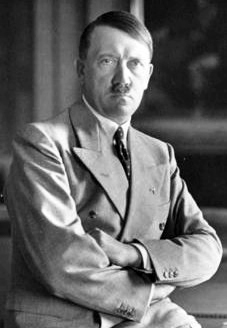
The Fuhrer
Hitler, as everyone knows, is the infamous dictator who, during World War II, waged war on several countries, who sought to ensure communist governments throughout the world, and who was responsible for the inhumane deaths of six million Jews. Whether or not Hitler was a moral man is never in question by those who seek peace, but those who examine his life will come to see that he was indeed a successful leader.

Hitler came from humble circumstances, and with both parents dead by the age of 19 (accompanied with his rejection to Vienna’s Academy of Fine Arts), it may have seemed as though Hitler would struggle to ever amount to anything. Nonetheless, he soon became interested in politics, served on the German side in World War I, and was later arrested after announcing in a beer hall that a national revolution was beginning. During his time in prison, he wrote Mein Kampf. This book sold modestly at first, but soon became the second best selling book of Germany (after the Bible). Hitler’s power continued to grow, and he was triumphant in launching one of the most horrific wars the world had ever seen.

Hitler didn’t begin with an army. He didn’t start with concentration camps. He began humbly, armed with only words. This is where true power lies: with dialogue and the ability to use it.

As I learned more of Hitler in middle school and onward, I couldn’t help but wonder at the damage he was able to due with words. Then, it made me think about what might happen if good people could be able to use their words as effectively as he did. So much light would come into the world— and it has! Inspirational speakers give hope to those struggling with various issues. Comforting words build up those brought down by sadness, and words can be used to express love and appreciation. If all words were used for good, the world would be infinitely easier to live in.

And that’s why I study English. I want to learn to use my words as effectively as I can so that I might bring a little more peace to those around me.

Image Credit: Wikipedia's page "Adolf Hitler" image in the public domain