Showing posts with label World War II. Show all posts

Monday, November 26, 2018

To the People: On Ethos and it's place in Churchill's words

Quite Large, isn't it?
Ethos is, perhaps to some, a confusing word to use. It's counterparts in Logos and Pathos are rather simple to rationalize being the appeals to logic and emotion specifically. Ethos, however, when translated from the original Greek means "Character" or "Community", it can be interpreted as either an appeal to ethics or an appeal to the spirit of the group, the "guidelines" that it follows. When Winston Churchill, then, gave his "Sinews of Peace" speech at Westminster college, the language he used for the talk was of a rather inclusive bent. Rather than simply appealing to people's emotions or even their sense of reason, he instead tries to form a connection between the people of Britain with the people of United States. Where other politicians might have emphasized "the British Spirit" or "the hardiness of Britain's people", Churchill insists on combining together the disparate people of Britain and the United States (along with Canada, who most have forgotten participated in the war) as a collective united by the hardships endured within the war as well as brothers in arms, armaments and armed nuclear devices. He does his best to create an out-group in the Communist party by pointing out how good and moral it is that only they, the current collective, possess the technology required to make atomic bombs, while also pointing a finger at how "dreaded" and "totalitarian" a reverse situation might have been. By appealing to the audience's sense of morality, he is establishing yet another enemy that they must work together to defeat.

While I will certainly agree that the speech was executed powerfully, one need only listen to Churchill's voice to agree with that notion, I am quite uneasy at some of the language he uses. By setting up the USSR as the next enemy to be defeated right after the Nazis, Italians and Japanese, he is creating perhaps not a legal precendent but rather a ethical one that the Nation of Britain, as well as the United States, must step in whatever affairs they deem necessary. It reminds me of the poem "First they came..." by Martin Niemoller with how he leads the people from one enemy to the next, and having seen the effects of such a lure in today's modern politics, I can't help but feel that it may have begun a dangerous trend.

Image Credit: "United Nations Plaza" obtained via Wikimedia Commons

Churchill: Shooing Away Doubts


I have never listened or read the “Sinews of Peace” speech from Winston Churchill and I was rather ignorant about the origins of the “Iron Curtain” metaphor. I love listening to audio tracks from before the boom of technology. 

The Importance of Taped Media

I work in broadcasting and over this past summer, I worked on a special project where I converted old tapes (legit film reels and such) into digital media. It was crazy hard and I was terrified I was going to destroy the sensitive material. But I gained a perspective on how broadcasting and media worked before the digital age where most systems are now automated. I have a greater appreciation for historical media such as the Churchill.


Painting of Winston Churchill via Wikimedia Commons

Rhetoric of Peace

As far as rhetoric for the speech, I want to lead this analysis with an important part of the audio that is not written. From what I assume are journalists or radio commenters documenting the event, saying things along the lines of “Churchill is wearing a red robe to signify academia, etc., etc.,” one of the most interesting comments occurred while the speakers transitioned, and it was noted that Churchill “shooed” away photographers. This comment encapsulates the importance of the “Sinews of Peace” speech as well as the tone that Churchill wanted to leave with the audience members. Simplistically, Churchill intended with the contents of his speech as well as this action that this was not about him or his role in public media but about the changes that the Allies can create together.


During the written components of the speech, whenever Churchill refers to himself this concept of focusing on others is still apparent, because Churchill literally says it himself: “There is nothing here but what you see,” and “This is no time for generality and I will venture to be precise.” By clarifying that there is no “fluff” in this talk, Churchill attempts to appeal to ethos by establishing authority that is simple and difficult for the audience to misunderstand.

Selflessness over Selfishness  

This was effective for the audience because it did draw attention to the overarching topic that Churchill called “the unestimated sum of human pain” in a “sad and breathless moment.”  Considering that this speech was delivered during the tail-end of war started for what could be argued as selfish reasons, the tone of the speech derailed that selfishness and united those who may be weary of world leaders or doubting the future unity and effectiveness of the Allies.

Saturday, November 3, 2018

I Do It Because of Hitler


People often ask me why I decided to become an English major, and they are usually shocked by the answer. I tell them I decided to study English because of Adolf Hitler. 
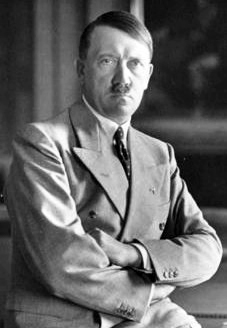
The Fuhrer
Hitler, as everyone knows, is the infamous dictator who, during World War II, waged war on several countries, who sought to ensure communist governments throughout the world, and who was responsible for the inhumane deaths of six million Jews. Whether or not Hitler was a moral man is never in question by those who seek peace, but those who examine his life will come to see that he was indeed a successful leader.

Hitler came from humble circumstances, and with both parents dead by the age of 19 (accompanied with his rejection to Vienna’s Academy of Fine Arts), it may have seemed as though Hitler would struggle to ever amount to anything. Nonetheless, he soon became interested in politics, served on the German side in World War I, and was later arrested after announcing in a beer hall that a national revolution was beginning. During his time in prison, he wrote Mein Kampf. This book sold modestly at first, but soon became the second best selling book of Germany (after the Bible). Hitler’s power continued to grow, and he was triumphant in launching one of the most horrific wars the world had ever seen.

Hitler didn’t begin with an army. He didn’t start with concentration camps. He began humbly, armed with only words. This is where true power lies: with dialogue and the ability to use it.

As I learned more of Hitler in middle school and onward, I couldn’t help but wonder at the damage he was able to due with words. Then, it made me think about what might happen if good people could be able to use their words as effectively as he did. So much light would come into the world— and it has! Inspirational speakers give hope to those struggling with various issues. Comforting words build up those brought down by sadness, and words can be used to express love and appreciation. If all words were used for good, the world would be infinitely easier to live in.

And that’s why I study English. I want to learn to use my words as effectively as I can so that I might bring a little more peace to those around me.

Image Credit: Wikipedia's page "Adolf Hitler" image in the public domain